
用于分析缺血性卒中合并胃肠道出血患者抗血小板药物使用策略的机器学习方法。
The machine learning methods to analyze the using strategy of antiplatelet drugs in ischaemic stroke patients with gastrointestinal haemorrhage.
作者信息
Cui Chaohua, Li Changhong, Hou Min, Wang Ping, Huang Zhonghua
机构信息
Department of Rehabilitation, Affiliated Hospital of Youjiang Medical University for Nationalities, zhongshaner road, youjiang District, Baise City, Guangxi Province, China.
Affiliated Liutie Central Hospital of Guangxi Medical University, Liunan Distract, Liuzhou, Guangxi, China.
出版信息
BMC Neurol. 2023 Oct 13;23(1):369. doi: 10.1186/s12883-023-03422-0.
BACKGROUND
For ischaemic stroke patients with gastrointestinal haemorrhage, stopping antiplatelet drugs or reducing the dose of antiplatelet drugs was a conventional clinical therapy method. But not a study to prove which way was better. And the machinery learning methods could help to obtain which way more suit for some patients.
METHODS
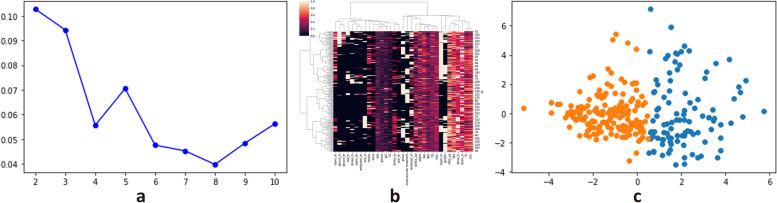
Data from consecutive ischaemic stroke patients with gastrointestinal haemorrhage were prospectively collected. The outcome was a recurrent stroke rate, haemorrhage events, mortality and favourable functional outcome (FFO). We analysed the data using conventional logistic regression methods and a supervised machine learning model. We used unsupervised machine learning to group and analyse data characters.
RESULTS
The patients of stopping antiplatelet drugs had a lower rate of bleeding events (p = 0.125), mortality (p = 0.008), rate of recurrence of stroke (p = 0.161) and distribution of severe patients (mRS 3-6) (p = 0.056). For Logistic regression, stopping antiplatelet drugs (OR = 2.826, p = 0.030) was related to lower mortality. The stopping antiplatelet drugs in the supervised machine learning model related to mortality (AUC = 0.95) and FFO (AUC = 0.82). For group by unsupervised machine learning, the patients of better prognosis had more male (p < 0.001), younger (p < 0.001), had lower NIHSS score (p < 0.001); and had a higher value of serum lipid level (p < 0.001).
CONCLUSIONS
For ischemic stroke patients with gastrointestinal haemorrhage, stopping antiplatelet drugs had a better prognosis. Patients who were younger, male, with lesser NIHSS scores at admission, with the fewest history of a medical, higher value of diastolic blood pressure, platelet, blood lipid and lower INR could have a better prognosis.
背景
对于患有胃肠道出血的缺血性中风患者,停用抗血小板药物或降低抗血小板药物剂量是一种传统的临床治疗方法。但尚无研究证明哪种方法更好。而机器学习方法有助于确定哪种方法更适合某些患者。
方法
前瞻性收集连续的患有胃肠道出血的缺血性中风患者的数据。结局指标为中风复发率、出血事件、死亡率和良好功能结局(FFO)。我们使用传统逻辑回归方法和监督机器学习模型分析数据。我们使用无监督机器学习对数据特征进行分组和分析。
结果
停用抗血小板药物的患者出血事件发生率较低(p = 0.125)、死亡率较低(p = 0.008)、中风复发率较低(p = 0.161)以及重症患者(改良Rankin量表3 - 6分)分布较少(p = 0.056)。对于逻辑回归,停用抗血小板药物(OR = 2.826,p = 0.030)与较低的死亡率相关。在监督机器学习模型中,停用抗血小板药物与死亡率(AUC = 0.95)和FFO(AUC = 0.82)相关。对于无监督机器学习分组,预后较好的患者男性更多(p < 0.001)、年龄更小(p < 0.001)、美国国立卫生研究院卒中量表(NIHSS)评分更低(p < 0.001);并且血清脂质水平值更高(p < 0.001)。
结论
对于患有胃肠道出血的缺血性中风患者,停用抗血小板药物预后更好。年龄更小、男性、入院时NIHSS评分更低、病史最少、舒张压、血小板、血脂值更高且国际标准化比值(INR)更低的患者预后可能更好。


 Zotero 插件