Department of Social and Population Health, Yirgalem Hospital Medical College, Yirgalem, Ethiopia.
Ethiopian Health Education and Promotion Professionals Association (EHEPA), Addis Ababa, Ethiopia.
BMC Public Health. 2023 Oct 13;23(1):1998. doi: 10.1186/s12889-023-16887-y.
Water, sanitation, and hygiene (WASH) interventions, which are specifically targeted towards young children-known as "BabyWASH"-reduce exposure to environmental contamination and prevent microbial burden in their play and feeding environments. The purpose of this endline study was to evaluate the effectiveness and potential sustainability of a multimedia educational intervention in influencing key BabyWASH and diarrhea prevention practices in four hard-to-reach woredas (i.e. administrative districts) of the Afar and Somali regions of Ethiopia.
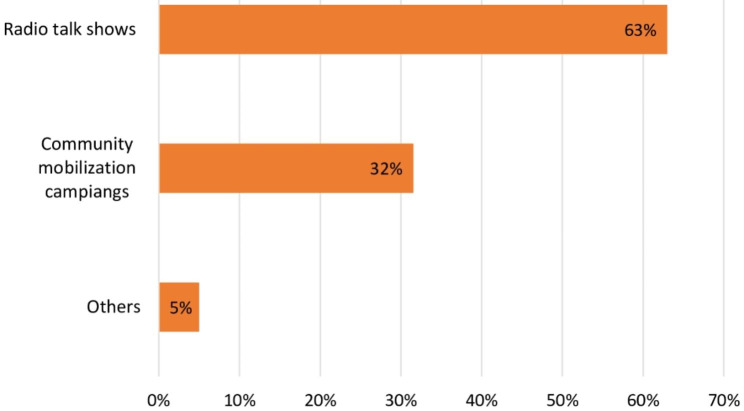
A mixed-method, comparative cross-sectional study was conducted, which included 457 household surveys, 16 key informant interviews, and 8 focus group discussions. The multimedia educational intervention comprised: broadcasting radio talk shows and radio spot messages, capacity-building training for community health workers and community leaders, community mobilization campaigns, and the distribution of promotional print media materials. Propensity score matching analysis was used to estimate the effect of the multimedia educational intervention on key BabyWASH and diarrhea prevention attitudes and practices, which was then triangulated with qualitative findings.
The multimedia intervention had a significant positive impact on good BabyWASH and diarrhea prevention practices, including appropriate practices of child feces disposal (t-test = 5.17; p < 0.001), handwashing with soap or ash (t-test = 8.85; p < 0.001), maintaining separate playgrounds for young children (t-test = 2.83; p < 0.001), washing of child's body, hands, and faces (t-test = 15.78; p < 0.001), and food hygiene practices (t-test = 2.74; p < 0.05). The findings of the qualitative assessment also revealed that the multimedia intervention packages and the approaches used were successful in influencing key BabyWASH and diarrhea prevention behaviors in the intervention implementation woredas. In addition, providing capacity building training to local actors and community leaders and recording radio talk shows and sharing them with community members were recognized as effective intervention implementation strategies.
The endline evaluation found that the multimedia educational intervention improved awareness, perception, and practice of BabyWASH and diarrhea prevention behaviors in intervention woredas compared to control woredas. Sanitation and hygiene promotion interventions in pastoralist settings can be effective when using locally and contextually appropriate intervention strategies. However, considerations for integrating both behavioral and structural components in WASH interventions is essential.
针对幼儿的水、环境卫生和个人卫生(WASH)干预措施,即所谓的“BabyWASH”,可减少幼儿在玩耍和进食环境中接触环境污染物和微生物的风险。本终线研究旨在评估多媒体教育干预在影响埃塞俄比亚阿法尔和索马里地区四个偏远地区(行政区)的关键 BabyWASH 和腹泻预防行为方面的有效性和潜在可持续性。
本研究采用混合方法、比较性横断面研究设计,包括 457 户家庭调查、16 次关键知情人访谈和 8 次焦点小组讨论。多媒体教育干预包括:播放广播脱口秀和广播插播消息、对社区卫生工作者和社区领导进行能力建设培训、社区动员运动以及分发宣传印刷媒体材料。倾向评分匹配分析用于估计多媒体教育干预对关键 BabyWASH 和腹泻预防态度和行为的影响,然后与定性研究结果进行三角验证。
多媒体干预对良好的 BabyWASH 和腹泻预防行为有显著的积极影响,包括适当处理儿童粪便(t 检验=5.17;p<0.001)、用肥皂或灰烬洗手(t 检验=8.85;p<0.001)、为幼儿设置单独的游乐区(t 检验=2.83;p<0.001)、为儿童洗澡、洗手和洗脸(t 检验=15.78;p<0.001)和食物卫生实践(t 检验=2.74;p<0.05)。定性评估结果还表明,多媒体干预包和使用的方法成功地影响了干预实施地区的关键 BabyWASH 和腹泻预防行为。此外,为当地行为者和社区领导提供能力建设培训以及录制广播脱口秀并与社区成员分享被认为是有效的干预实施策略。
终线评估发现,与对照地区相比,多媒体教育干预提高了干预地区对 BabyWASH 和腹泻预防行为的认识、看法和实践。在牧民地区开展的卫生和个人卫生促进干预措施,如果使用当地和背景适当的干预策略,可以取得成效。然而,在 WASH 干预措施中整合行为和结构组成部分是必要的。