Department of Clinical Nutrition, School of Nutrition and Food Science, Isfahan University of Medical Sciences, Isfahan, Iran.
Nutrition and Metabolic Diseases Research Center, Ahvaz Jundishapur University of Medical Sciences, Ahvaz, Iran.
Nutr J. 2023 Oct 13;22(1):51. doi: 10.1186/s12937-023-00879-0.
Pervious epidemiologic evidence indicates that soluble fiber is protective against hypertention: however, randomized controlled trials (RCTs) have presented varying results. In the present study, we aimed to conduct a systematic review and dose-response meta-analysis to summarize published RCTs which assess the effect of soluble fiber supplementation on systolic blood pressure (SBP) and diastolic blood pressure (DBP).
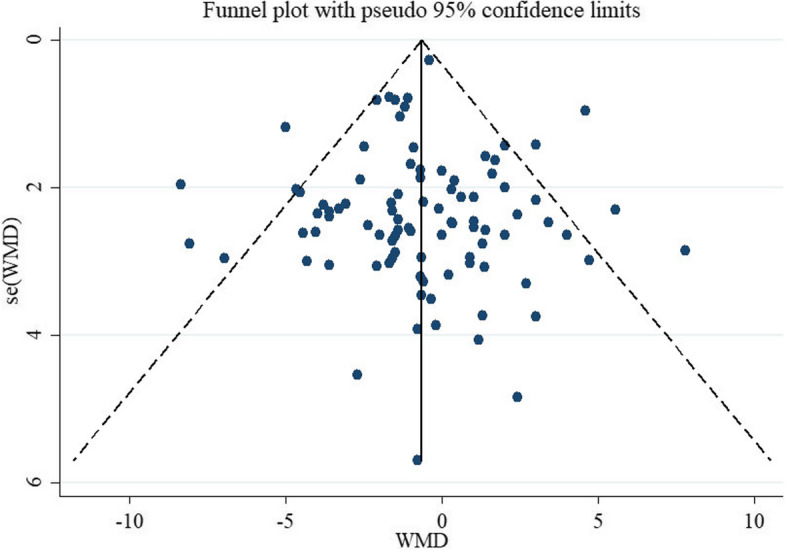
Scopus, PubMed, and ISI Web of Sciences were searched to identify relevant studies up to Aug 2022. We estimated the change in blood pressure for each 5 g/d increment in soluble fiber supplementation in each trial and then calculated the weighted mean difference (WMD) and 95%CI using a random-effects model. We estimated dose-dependent effects using a dose-response meta-analysis of differences in means. The risk of bias for study was assessed using the Cochrane tool. Publication bias was evaluated via funnel plot and Begg's test and Egger's test.
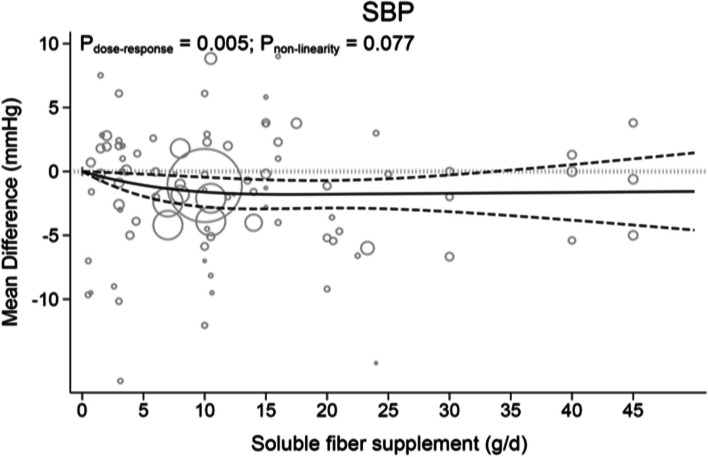
Eighty-three eligible studies with total sample size of 5,985 participants were included in the meta-analysis. Soluble fiber supplementation significantly decreased SBP (WMD: -1.36 mmHg, 95% CI: -2.13 to -0.60, P < 0.001; I = 47.1%, P < 0.001) and DBP (WMD: -0.72 mmHg, 95% CI: -1.26 to -0.18, P = 0.009; I = 45.4%, P < 0.001). Each 5 g/d increment in soluble fiber supplementation had a significant reduction in SBP (WMD: -0.54 mmHg; 95%CI: -0.86, -0.22, P = 0.001; I = 52.2, P < 0.001) and DBP (WMD: -0.28 mmHg; 95%CI: -0.49, -0.80, P = 0.007; I = 43.1%, P < 0.001). The levels of SBP decreased proportionally with the increase in soluble fiber supplementation up to 20 g/d (MD: -1.79 mmHg, 95%CI: -2.86, -0.71).
Current evidence indicated the beneficial effect of soluble fiber supplementation on blood pressure. Our findings suggest that soluble fiber supplementation could contribute to the management of hypertension and the reduction of cardiovascular disease risk.
先前的流行病学证据表明,可溶性纤维可预防高血压:然而,随机对照试验(RCT)的结果却各不相同。本研究旨在进行系统评价和剂量-反应荟萃分析,以总结评估可溶性纤维补充剂对收缩压(SBP)和舒张压(DBP)影响的已发表 RCT。
检索 Scopus、PubMed 和 ISI Web of Sciences 以确定截至 2022 年 8 月的相关研究。我们估计了每个试验中可溶性纤维补充剂每增加 5 g/d 时血压的变化,然后使用随机效应模型计算了加权均数差(WMD)和 95%置信区间。我们使用均值差异的剂量-反应荟萃分析来估计剂量依赖性效应。使用 Cochrane 工具评估研究的偏倚风险。通过漏斗图和 Begg 检验和 Egger 检验评估发表偏倚。
纳入了 83 项具有 5985 名参与者的总样本量的合格研究进行荟萃分析。可溶性纤维补充剂可显著降低 SBP(WMD:-1.36mmHg,95%CI:-2.13 至-0.60,P<0.001;I=47.1%,P<0.001)和 DBP(WMD:-0.72mmHg,95%CI:-1.26 至-0.18,P=0.009;I=45.4%,P<0.001)。可溶性纤维补充剂每增加 5 g/d,SBP(WMD:-0.54mmHg;95%CI:-0.86,-0.22,P=0.001;I=52.2,P<0.001)和 DBP(WMD:-0.28mmHg;95%CI:-0.49,-0.80,P=0.007;I=43.1%,P<0.001)均有显著降低。SBP 水平与可溶性纤维补充量呈比例下降,最高可达 20 g/d(MD:-1.79mmHg,95%CI:-2.86,-0.71)。
目前的证据表明可溶性纤维补充剂对血压有益。我们的研究结果表明,可溶性纤维补充剂可能有助于高血压的管理和降低心血管疾病的风险。