Juengel Eva, Rutz Jochen, Meiborg Moritz, Markowitsch Sascha D, Maxeiner Sebastian, Grein Timothy, Thomas Anita, Chun Felix K-H, Haferkamp Axel, Tsaur Igor, Vakhrusheva Olesya, Blaheta Roman A
Department of Urology and Pediatric Urology, University Medical Center Mainz, 55131 Mainz, Germany.
Department of Urology, Goethe-University, 60590 Frankfurt am Main, Germany.
Cancers (Basel). 2023 Oct 4;15(19):4849. doi: 10.3390/cancers15194849.
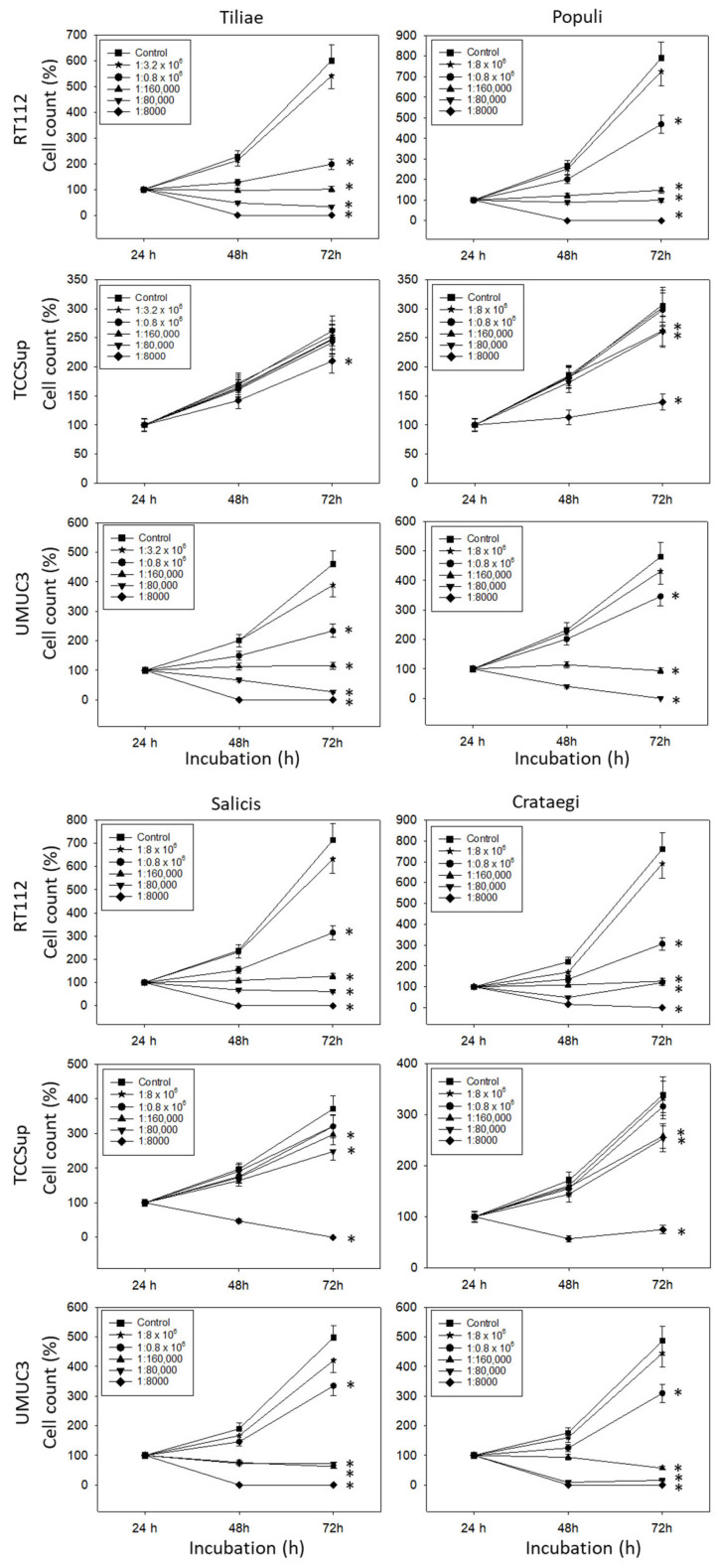
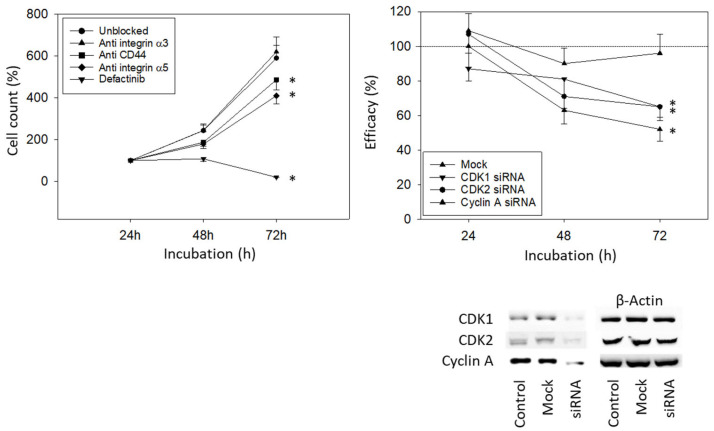
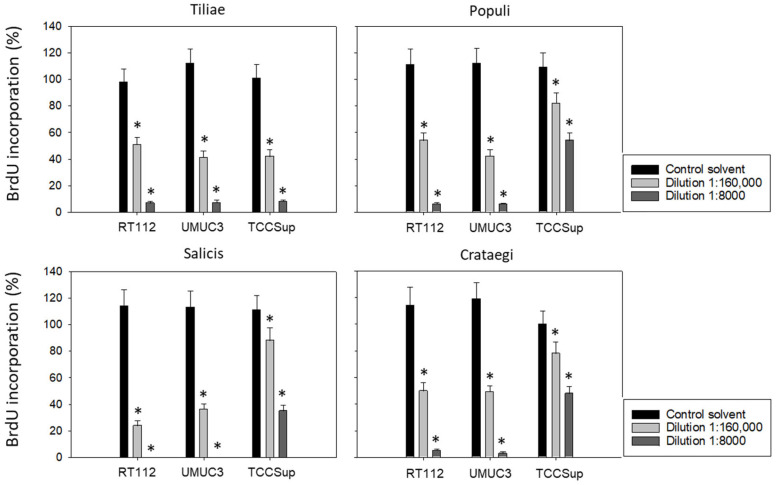
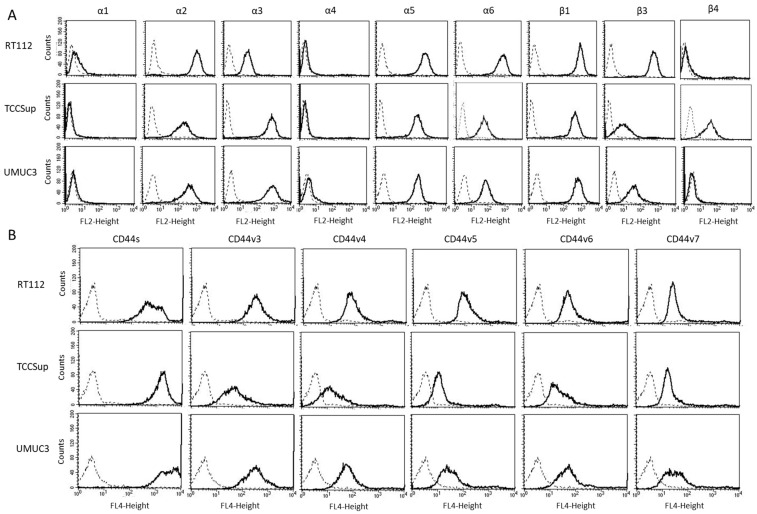
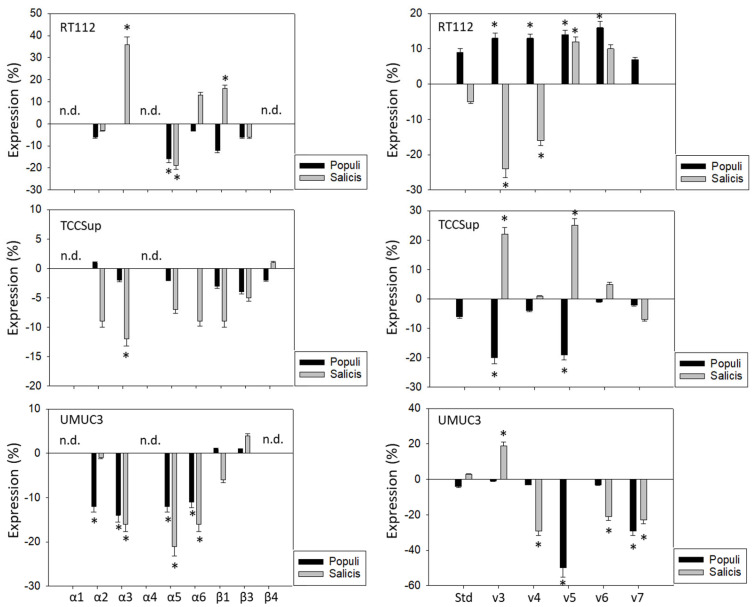
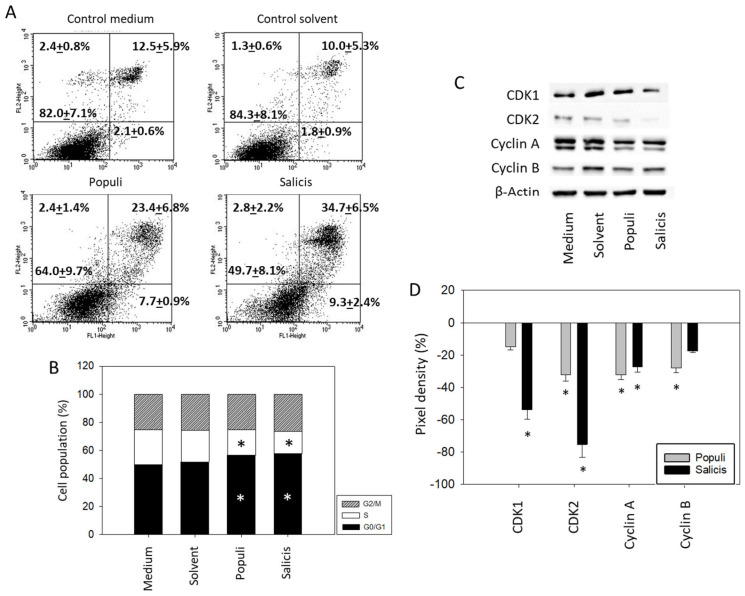
Extracts of European mistletoe () are popular as a complementary treatment for patients with many different cancer types. However, whether these extracts actually block bladder cancer progression remains unknown. The influence of different mistletoe extracts on bladder cancer cell growth and proliferation was investigated by exposing RT112, UMUC3, and TCCSup cells to mistletoe from hawthorn (), lime trees (), willow trees (), or poplar trees (). The tumor cell growth and proliferation, apoptosis induction, and cell cycle progression were then evaluated. Alterations in integrin α and β subtype expression as well as CD44 standard (CD44s) and CD44 variant (CD44v) expressions were evaluated. Cell cycle-regulating proteins (CDK1 and 2, Cyclin A and B) were also investigated. Blocking and knock-down studies served to correlate protein alterations with cell growth. All extracts significantly down-regulated the growth and proliferation of all bladder cancer cell lines, most strongly in RT112 and UMUC3 cells. Alterations in CD44 expression were not homogeneous but rather depended on the extract and the cell line. Integrin α3 was, likewise, differently modified. Integrin α5 was diminished in RT112 and UMUC3 cells (significantly) and TCCSup (trend) by and . and arrested UMUC3 in G0/G1 to a similar extent, whereas apoptosis was induced most efficiently by . Examination of cell cycle-regulating proteins revealed down-regulation of CDK1 and 2 and Cyclin A by but down-regulation of CDK2 and Cyclin A by . Blocking and knock-down studies pointed to the influence of integrin α5, CD44, and the Cyclin-CDK axis in regulating bladder cancer growth. Mistletoe extracts do block bladder cancer growth in vitro, with the molecular action differing according to the cell line and the host tree of the mistletoe. Integrating mistletoe into a guideline-based treatment regimen might optimize bladder cancer therapy.
欧洲槲寄生提取物作为多种不同癌症类型患者的辅助治疗方法广受欢迎。然而,这些提取物是否真的能阻止膀胱癌进展尚不清楚。通过将RT112、UMUC3和TCCSup细胞暴露于山楂、菩提树、柳树或杨树的槲寄生中,研究了不同槲寄生提取物对膀胱癌细胞生长和增殖的影响。然后评估肿瘤细胞的生长和增殖、凋亡诱导以及细胞周期进程。评估整合素α和β亚型表达以及CD44标准型(CD44s)和CD44变异型(CD44v)表达的变化。还研究了细胞周期调节蛋白(CDK1和2、细胞周期蛋白A和B)。阻断和敲低研究用于将蛋白质变化与细胞生长相关联。所有提取物均显著下调了所有膀胱癌细胞系的生长和增殖,在RT112和UMUC3细胞中作用最强。CD44表达的变化并不一致,而是取决于提取物和细胞系。同样,整合素α3也有不同的修饰。整合素α5在RT112和UMUC3细胞中(显著)以及TCCSup细胞中(呈趋势性)分别减少了[具体数值]和[具体数值]。[提取物名称1]和[提取物名称2]在相似程度上将UMUC3细胞阻滞在G0/G1期,而[提取物名称3]诱导凋亡的效率最高。对细胞周期调节蛋白的检测显示,[提取物名称4]使CDK1和2以及细胞周期蛋白A下调,但[提取物名称5]使CDK2和细胞周期蛋白A下调。阻断和敲低研究表明整合素α5、CD44以及细胞周期蛋白 - CDK轴在调节膀胱癌生长中的作用。槲寄生提取物在体外确实能阻止膀胱癌生长,其分子作用因细胞系和槲寄生的宿主树而异。将槲寄生纳入基于指南的治疗方案可能会优化膀胱癌治疗。