Rizzi Chiara
Department of Agronomy, Food, Natural resources, Animals and Environment (DAFNAE), University of Padova, Viale dell'Università, 16, 35020 Legnaro, Italy.
Animals (Basel). 2023 Sep 29;13(19):3064. doi: 10.3390/ani13193064.
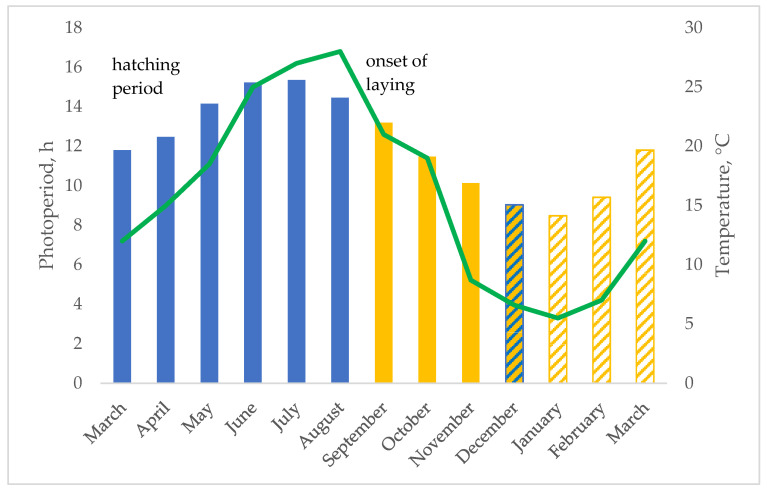
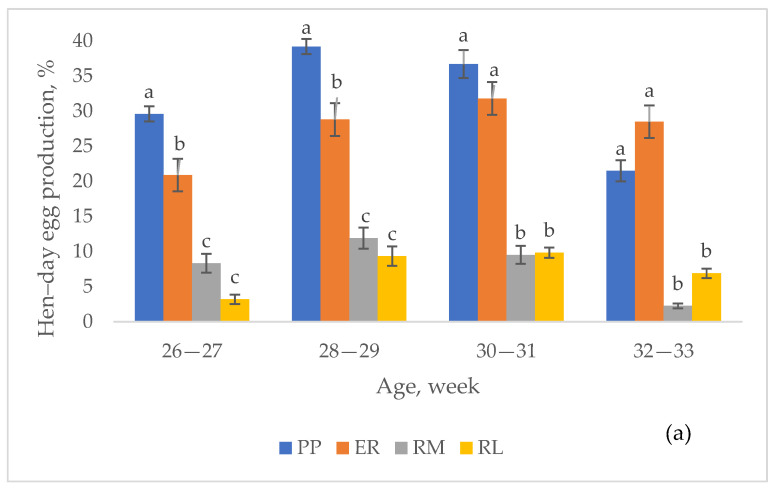
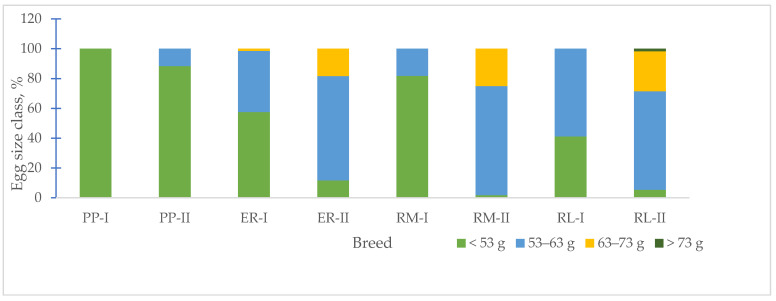
The month of hatching and the rearing management, especially temperature and photoperiod, are important factors for pullets and hens reared outdoors. The yield performance and egg quality of dual-purpose chicken breeds from the Veneto region (Italy), Pepoi (PP), Ermellinata di Rovigo (ER), Robusta Maculata (RM) and Robusta Lionata (RL), with different adult body weights (ABW, kg, PP = 1.3; ER = 2.3, RM and RL = 3.1), were studied, using a factorial model (4 × 2), considering breed and age (26-33 weeks, first age, summer-autumn, under decreasing natural photoperiod-on average, 12L:12D, and 42-53 weeks, second age, winter, under implemented photoperiod-14L:10D) as the main effects and interaction. The chicks hatched in spring, and they started laying at the end of summer/beginning of autumn. Significant ( < 0.05) results were shown for many traits. ER showed higher hen-day egg production than that of PP, and RM and RL were the lowest; ER, RM and RL showed medium-size eggs and PP showed small-size eggs. RM produced the most spherical eggs and ER the most ovoid, and they showed the highest and the lowest eggshell thickness, respectively. RM showed the highest yolk to albumen ratio, and RL showed the lowest. The age increased the laying rate and the egg weight in all the groups. At 26-33 weeks, ER and PP showed higher hen-day egg production (on average 24%) than RM and RL (on average, less than 10%). The onset of laying (at least 10% laying rate) was shown, at different ages, according to the % ABW the breeds had reached: PP was the first, followed by ER, then RM, and RL was the last. At 42-53 weeks, the hen-day egg production ranged, on average, from 38 to 52%, according to the breeds; orthogonal contrasts on two-weekly data showed, at first age, increasing linear (ER) and quadratic (other groups) trends, and at second age, positive linear (ER, RM) and cubic (PP, RL) trends. Age (32 vs. 53 weeks) affected almost all the eggshell traits in PP and ER, whereas in RL, and especially RM, fewer traits changed. The age increased the yolk to albumen ratio (unchanged in PP). These results may be useful for the effective management of local purebred chickens, with the purpose to ensure the wellbeing of the hens and for supplying eggs of different quality throughout the year.
孵化月份及饲养管理,尤其是温度和光照周期,是户外饲养的小母鸡和母鸡的重要影响因素。对意大利威尼托地区不同成年体重(ABW,千克,佩波伊(PP)=1.3;埃梅利纳塔迪罗维戈(ER)=2.3,罗布斯塔马库拉塔(RM)和罗布斯塔利奥纳塔(RL)=3.1)的两用鸡品种佩波伊(PP)、埃梅利纳塔迪罗维戈(ER)、罗布斯塔马库拉塔(RM)和罗布斯塔利奥纳塔(RL)的产蛋性能和蛋品质进行了研究,采用析因模型(4×2),将品种和年龄(26 - 33周,第一阶段,夏秋季节,自然光照递减——平均12L:12D,以及42 - 53周,第二阶段,冬季,人工光照——14L:10D)作为主要效应和交互作用因素。雏鸡于春季孵化,夏末/秋初开始产蛋。许多性状显示出显著(<0.05)差异。ER的母鸡日产蛋量高于PP,RM和RL最低;ER、RM和RL产中等大小的蛋,PP产小蛋。RM产出的蛋最接近球形,ER产出的蛋最接近椭圆形,且它们的蛋壳厚度分别为最高和最低。RM的蛋黄蛋白比最高,RL最低。所有组中,年龄增长均提高了产蛋率和蛋重。在26 - 33周时,ER和PP的母鸡日产蛋量(平均24%)高于RM和RL(平均低于10%)。根据各品种达到的成年体重百分比,不同年龄时显示出不同的开产情况(产蛋率至少达到10%):PP最先开产,其次是ER,然后是RM,RL最后开产。在42 - 53周时,根据品种不同,母鸡日产蛋量平均在38%至52%之间;对两周数据的正交对比显示,在第一阶段,ER呈线性增加趋势,其他组呈二次趋势,在第二阶段,ER和RM呈正线性趋势,PP和RL呈三次趋势。年龄(32周与53周)对PP和ER的几乎所有蛋壳性状都有影响,而在RL尤其是RM中,变化的性状较少。年龄增加了蛋黄蛋白比(PP中无变化)。这些结果可能有助于对当地纯种鸡进行有效管理,以确保母鸡健康,并全年供应不同品质的鸡蛋。