Animal Breeding and Genetics Group, Department of Animal Sciences, University of Goettingen, 37075, Goettingen, Germany.
Center for Integrated Breeding Research, Department of Animal Sciences, University of Goettingen, 37075, Goettingen, Germany.
BMC Genomics. 2019 May 7;20(1):345. doi: 10.1186/s12864-019-5727-9.
Since domestication, chickens did not only disperse into the different parts of the world but they have also undergone significant genomic changes in this process. Many breeds, strains or lines have been formed and those represent the diversity of the species. However, other than the natural evolutionary forces, management practices (including those that threaten the persistence of genetic diversity) following domestication have shaped the genetic make-up of and diversity between today's chicken breeds. As part of the SYNBREED project, samples from a wide variety of chicken populations have been collected across the globe and were genotyped with a high density SNP array. The panel consists of the wild type, commercial layers and broilers, indigenous village/local type and fancy chicken breeds. The SYNBREED chicken diversity panel (SCDP) is made available to serve as a public basis to study the genetic structure of chicken diversity. In the current study we analyzed the genetic diversity between and within the populations in the SCDP, which is important for making informed decisions for effective management of farm animal genetic resources.
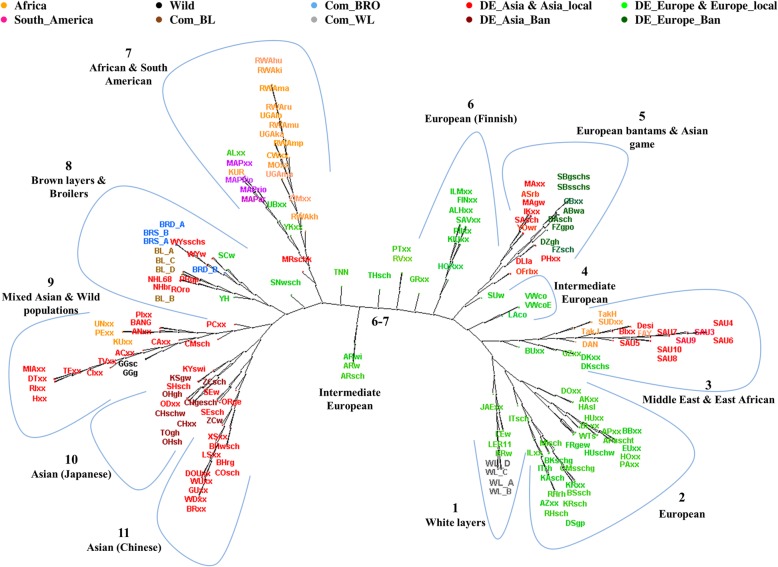
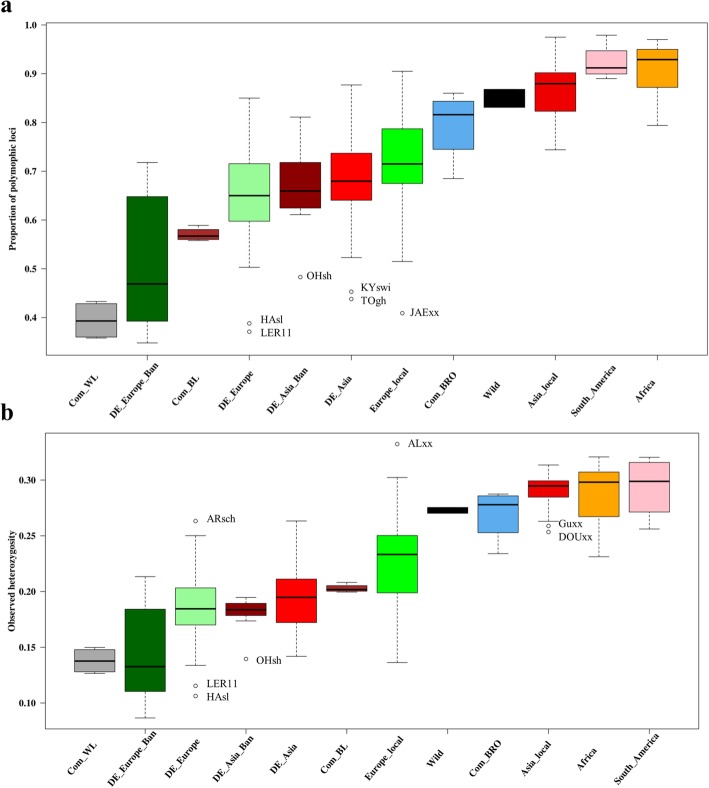
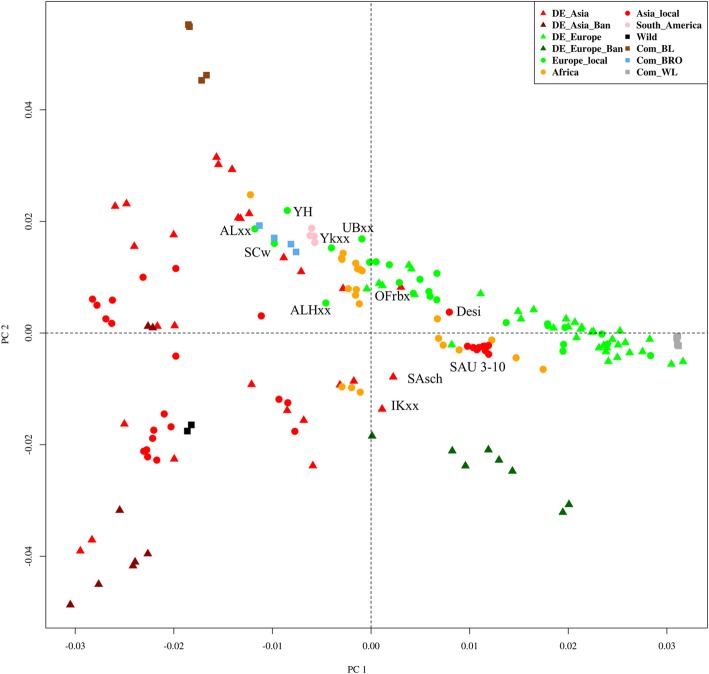
Many of the fancy breeds cover a wide spectrum and clustered with other breeds of similar supposed origin as shown by the phylogenetic tree and principal component analysis. However, the fancy breeds as well as the highly selected commercial layer lines have reduced genetic diversity within the population, with the average observed heterozygosity estimates lower than 0.205 across their breeds' categories and the average proportion of polymorphic loci lower than 0.680. We show that there is still a lot of genetic diversity preserved within the wild and less selected African, South American and some local Asian and European breeds with the average observed heterozygosity greater than 0.225 and the average proportion of polymorphic loci larger than 0.720 within their breeds' categories.
It is important that such highly diverse breeds are maintained for the sustainability and flexibility of future chicken breeding. This diversity panel provides opportunities for exploitation for further chicken molecular genetic studies. With the possibility to further expand, it constitutes a very useful community resource for chicken genetic diversity research.
自从驯化以来,鸡不仅分散到世界的不同地区,而且在这个过程中也经历了显著的基因组变化。许多品种、品系或系已经形成,代表了物种的多样性。然而,除了自然进化力量之外,驯化后管理实践(包括那些威胁遗传多样性持续存在的实践)也塑造了今天鸡品种之间的遗传结构和多样性。作为 SYNBREED 项目的一部分,已经从全球各地收集了各种鸡群的样本,并使用高密度 SNP 阵列对其进行了基因分型。该面板包括野生型、商业蛋鸡和肉鸡、本土乡村/地方品种和观赏鸡品种。SYNBREED 鸡多样性面板(SCDP)可供使用,作为研究鸡多样性遗传结构的公共基础。在当前的研究中,我们分析了 SCDP 中群体之间和群体内的遗传多样性,这对于做出明智的决策以有效管理农场动物遗传资源非常重要。
许多观赏品种涵盖了广泛的范围,并与其他具有相似起源的品种聚类,如系统发育树和主成分分析所示。然而,观赏品种以及高度选择的商业蛋鸡系内的遗传多样性减少,其品种类别的平均观测杂合度估计值低于 0.205,多态性位点的平均比例低于 0.680。我们表明,在非洲、南美洲以及一些亚洲和欧洲的本地品种中仍然保留了大量的遗传多样性,这些品种的平均观测杂合度大于 0.225,多态性位点的平均比例大于 0.720。
维持这种高度多样化的品种对于未来鸡的可持续性和灵活性非常重要。该多样性面板为进一步的鸡分子遗传研究提供了利用机会。随着进一步扩展的可能性,它构成了一个非常有用的鸡遗传多样性研究社区资源。