Cordero Paloma, Díaz-Avilés Francisca, Torres Paulina, Guzmán Miguel, Niknafs Shahram, Roura Eugeni, Guzmán-Pino Sergio A
Programa de Doctorado en Ciencias Silvoagropecuarias y Veterinarias, Campus Sur, Universidad de Chile, Santiago 8820808, Chile.
Departamento de Fomento de la Producción Animal, Facultad de Ciencias Veterinarias y Pecuarias, Universidad de Chile, Santiago 8820808, Chile.
Animals (Basel). 2023 Oct 6;13(19):3120. doi: 10.3390/ani13193120.
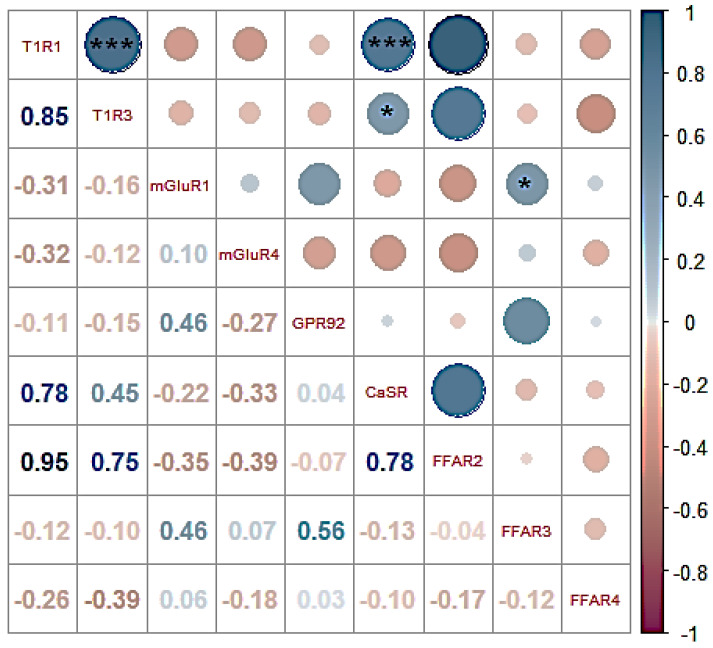
This work aimed to evaluate the gene expression of amino acids (AA) and fatty acids (FA) sensors in the gastrointestinal tract (GIT) of chickens at two different ages (7 and 26 days post-hatch). Sixteen broilers (Ross 308) were selected, and ten sections of the GIT, including upper (tongue base, upper palate, crop, proventriculus), middle (gizzard, duodenum, jejunum, ileum), and lower GIT section (cecum, colon) were collected for analysis. Relative gene expression of AA (T1R1, T1R3, mGluR1, mGluR4, CaSR, GPR139, GPRC6A, GPR92) and FA (FFAR2, FFAR3, FFAR4) sensors were assessed using qPCR. The statistical model included age, GIT section, and gene. In addition, the correlations between gene expressions were calculated. At day 7, a significantly ( = 0.004) higher expression of AA sensors in the oral cavity and FA sensors in the lower GIT section (i.e., cecum and colon) compared to the middle section was recorded. A higher expression of AA compared to FA sensors was detected at the upper GIT section in 7 ( < 0.001) and 26-day-old chickens ( = 0.026). Thus, at day 7, AA sensors were predominantly ( < 0.05) expressed in the upper GIT section (mainly oral cavity), while FA sensors were mainly expressed in the lower GIT section, at cecum (FFR2 and 4) or colon (FFAR3). These results may indicate that in early life, both ends of the GIT are fundamental for feed intake (oral cavity) and development of the microbiota (cecum and colon). In contrast, at 26 days of age, the results showed the emergence of both AA and FA sensors in the jejunum, presumably indicating the essential role of the jejunum in the digestion absorption of nutrients and the signaling to the brain (gut-brain axis) through the enteroendocrine system. Significant positive correlations were observed between T1R1 and T1R3 (r = 0.85, < 0.001), CaSR and T1R1 (r = 0.78, < 0.001), CaSR and T1R3 (r = 0.45, < 0.050), and mGluR1 and FFAR3 (r = 0.46, < 0.050). It is concluded that the gene expression is greater in the oral cavity for AA sensors and the lower gut for FA sensors. On day 26, the role of jejunum regarding nutrient sensing is highlighted.
本研究旨在评估两个不同年龄(孵化后7天和26天)的鸡胃肠道(GIT)中氨基酸(AA)和脂肪酸(FA)传感器的基因表达情况。选取了16只罗斯308肉鸡,收集了GIT的10个部位,包括上部(舌根、上颚、嗉囊、腺胃)、中部(肌胃、十二指肠、空肠、回肠)和下部GIT部位(盲肠、结肠)进行分析。使用qPCR评估AA(T1R1、T1R3、mGluR1、mGluR4、CaSR、GPR139、GPRC6A、GPR92)和FA(FFAR2、FFAR3、FFAR4)传感器的相对基因表达。统计模型包括年龄、GIT部位和基因。此外,还计算了基因表达之间的相关性。在7日龄时,与中部相比,口腔中AA传感器和下部GIT部位(即盲肠和结肠)中FA传感器的表达显著升高(P = 0.004)。在7日龄(P < 0.001)和26日龄(P = 0.026)的鸡中,上部GIT部位检测到的AA传感器表达高于FA传感器。因此,在7日龄时,AA传感器主要(P < 0.05)在上部GIT部位(主要是口腔)表达,而FA传感器主要在下部GIT部位表达,在盲肠(FFR2和4)或结肠(FFAR3)。这些结果可能表明,在生命早期,GIT的两端对于采食量(口腔)和微生物群的发育(盲肠和结肠)至关重要。相比之下,在26日龄时,结果显示空肠中出现了AA和FA传感器,这可能表明空肠在营养物质消化吸收以及通过肠内分泌系统向大脑(肠-脑轴)发出信号方面起着重要作用。在T1R1和T1R3之间观察到显著的正相关(r = 0.85,P < 0.001),CaSR和T1R1之间(r = 0.78,P < 0.001),CaSR和T1R3之间(r = 0.45,P < 0.050),以及mGluR1和FFAR3之间(r = 0.46,P < 0.050)。研究得出结论,AA传感器在口腔中的基因表达更高,FA传感器在肠道下部的基因表达更高。在26日龄时,空肠在营养感知方面的作用得到凸显。