Huang Sheng, Gao Shasha, Zhang Hui, Bian Ce, Zhao Yulong, Gu Xiuquan, Xu Wenjie
School of Materials Science and Physics, China University of Mining and Technology, Xuzhou 221116, China.
Polymers (Basel). 2023 Oct 4;15(19):3986. doi: 10.3390/polym15193986.
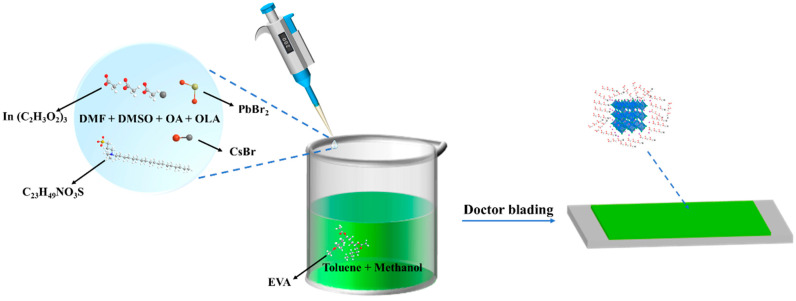
In recent years, all-inorganic cesium lead halide perovskite quantum dots have emerged as promising candidates for various optoelectronic applications, including sensors, light-emitting diodes, and solar cells, owing to their exceptional photoelectric properties. However, their commercial utilization has been limited by stability issues. In this study, we addressed this challenge by passivating the surface defects of CsPbBr quantum dots using indium acetate, a metal-organic compound. The resulting CsPbBr quantum dots exhibited not only high photoluminescence intensity, but also a remarkably narrow half-peak width of 19 nm. Furthermore, by embedding the CsPbBr quantum dots in ethylene-vinyl acetate, we achieved stretchability and significantly enhanced stability while preserving the original luminous intensity. The resulting composite film demonstrated the potential to improve the power conversion efficiency of crystalline silicon solar cells and enabled the creation of excellent white light-emitting diodes with coordinates of (0.33, 0.31). This co-passivation strategy, involving surface passivation and polymer packaging, provides a new idea for the practical application of CsPbBr quantum dots.
近年来,全无机铯铅卤化物钙钛矿量子点因其优异的光电性能,成为传感器、发光二极管和太阳能电池等各种光电器件应用的有力候选材料。然而,其稳定性问题限制了它们的商业应用。在本研究中,我们通过使用金属有机化合物醋酸铟钝化CsPbBr量子点的表面缺陷来应对这一挑战。所得的CsPbBr量子点不仅具有高光致发光强度,而且半峰宽显著窄至19nm。此外,通过将CsPbBr量子点嵌入乙烯-醋酸乙烯酯中,我们在保持原始发光强度的同时实现了可拉伸性并显著提高了稳定性。所得复合膜显示出提高晶体硅太阳能电池功率转换效率的潜力,并能够制造出色坐标为(0.33, 0.31)的白光发光二极管。这种涉及表面钝化和聚合物封装的共钝化策略为CsPbBr量子点的实际应用提供了新思路。