Suwanpitak Kittipat, Sriamornsak Pornsak, Singh Inderbir, Sangnim Tanikan, Huanbutta Kampanart
Faculty of Pharmaceutical Sciences, Burapha University, Chonburi 20131, Thailand.
Department of Industrial Pharmacy, Faculty of Pharmacy, Silpakorn University, Nakhon Pathom 73000, Thailand.
Nanomaterials (Basel). 2023 Sep 29;13(19):2679. doi: 10.3390/nano13192679.
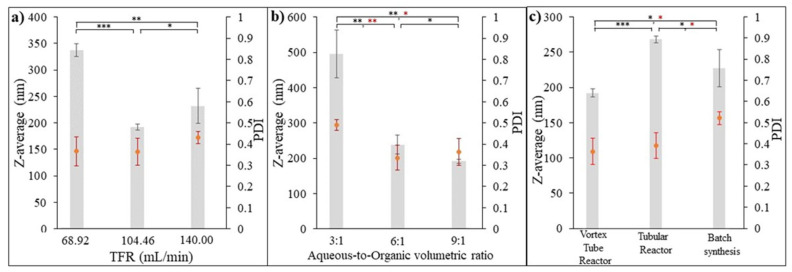
Polyglycolic acid (PGA) nanoparticles show promise in biomedical applications due to their exceptional biocompatibility and biodegradability. These nanoparticles can be readily modified, facilitating targeted drug delivery and promoting specific interactions with diseased tissues or cells, including imaging agents and theranostic approaches. Their potential to advance precision medicine and personalized treatments is evident. However, conventional methods such as emulsification solvent evaporation via batch synthesis or tubular reactors via flow chemistry have limitations in terms of nanoparticle properties, productivity, and scalability. To overcome these limitations, this study focuses on the design and development of a 3D-printed vortex tube reactor for the continuous synthesis of PGA nanoparticles using flow chemistry. Computer-aided design (CAD) and the design of experiments (DoE) optimize the reactor design, and computational fluid dynamics simulations (CFD) evaluate the mixing index (MI) and Reynolds (Re) expression. The optimized reactor design was fabricated using fused deposition modeling (FDM) with polypropylene (PP) as the polymer. Dispersion experiments validate the optimization process and investigate the impact of input flow parameters. PGA nanoparticles were synthesized and characterized for size and polydispersity index (PDI). The results demonstrate the feasibility of using a 3D-printed vortex tube reactor for the continuous synthesis of PGA nanoparticles through flow chemistry and highlight the importance of reactor design in nanoparticle production. The CFD results of the optimized reactor design showed homogeneous mixing across a wide range of flow rates with increasing Reynolds expression. The residence time distribution (RTD) results confirmed that increasing the flow rate in the 3D-printed vortex tube reactor system reduced the dispersion variance in the tracer. Both experiments demonstrated improved mixing efficiency and productivity compared to traditional tubular reactors. The study also revealed that the total flow rate had a significant impact on the size and polydispersity index of the formulated PGA nanoparticle, with the optimal total flow rate at 104.46 mL/min, leading to smaller nanoparticles and a lower polydispersity index. Additionally, increasing the aqueous-to-organic volumetric ratio had a significant effect on the reduced particle size of the PGA nanoparticles. Overall, this study provides insights into the use of 3D-printed vortex tube reactors for the continuous synthesis of PGA nanoparticles and underscores the importance of reactor design and flow parameters in PGA nanoparticle formulation.
聚乙醇酸(PGA)纳米颗粒因其卓越的生物相容性和生物降解性在生物医学应用中展现出前景。这些纳米颗粒易于修饰,有助于靶向给药,并促进与患病组织或细胞的特定相互作用,包括成像剂和诊疗方法。它们在推进精准医学和个性化治疗方面的潜力显而易见。然而,诸如通过间歇合成的乳化溶剂蒸发或通过流动化学的管式反应器等传统方法在纳米颗粒性质、生产率和可扩展性方面存在局限性。为克服这些局限性,本研究聚焦于设计和开发一种用于通过流动化学连续合成PGA纳米颗粒的3D打印涡旋管反应器。计算机辅助设计(CAD)和实验设计(DoE)对反应器设计进行了优化,计算流体动力学模拟(CFD)评估了混合指数(MI)和雷诺数(Re)表达式。使用以聚丙烯(PP)为聚合物的熔融沉积建模(FDM)制造了优化后的反应器设计。分散实验验证了优化过程,并研究了输入流量参数的影响。合成了PGA纳米颗粒,并对其尺寸和多分散指数(PDI)进行了表征。结果证明了使用3D打印涡旋管反应器通过流动化学连续合成PGA纳米颗粒的可行性,并突出了反应器设计在纳米颗粒生产中的重要性。优化后的反应器设计的CFD结果表明,随着雷诺数表达式的增加,在很宽的流速范围内混合均匀。停留时间分布(RTD)结果证实,在3D打印涡旋管反应器系统中增加流速可降低示踪剂中的分散方差。与传统管式反应器相比,这两个实验均显示出混合效率和生产率的提高。该研究还表明,总流速对配制的PGA纳米颗粒的尺寸和多分散指数有显著影响,最佳总流速为104.46 mL/min,可得到更小的纳米颗粒和更低的多分散指数。此外,增加水相与有机相的体积比对PGA纳米颗粒粒径的减小有显著影响。总体而言,本研究为使用3D打印涡旋管反应器连续合成PGA纳米颗粒提供了见解,并强调了反应器设计和流动参数在PGA纳米颗粒制剂中的重要性。