• 文献检索
  • 文档翻译
  • 深度研究
  • 学术资讯
  • Suppr Zotero 插件Zotero 插件
  • 邀请有礼
  • 套餐&价格
  • 历史记录
应用&插件
Suppr Zotero 插件Zotero 插件浏览器插件Mac 客户端Windows 客户端微信小程序
定价
高级版会员购买积分包购买API积分包
服务
文献检索文档翻译深度研究API 文档MCP 服务
关于我们
关于 Suppr公司介绍联系我们用户协议隐私条款
关注我们

Suppr 超能文献

核心技术专利:CN118964589B侵权必究
粤ICP备2023148730 号-1Suppr @ 2026

文献检索

告别复杂PubMed语法,用中文像聊天一样搜索,搜遍4000万医学文献。AI智能推荐,让科研检索更轻松。

立即免费搜索

文件翻译

保留排版,准确专业,支持PDF/Word/PPT等文件格式,支持 12+语言互译。

免费翻译文档

深度研究

AI帮你快速写综述,25分钟生成高质量综述,智能提取关键信息,辅助科研写作。

立即免费体验

用于酶固定化的3D打印陶瓷作为固体载体:一种用于连续流应用的自动化实验设计方法。

3D printed ceramics as solid supports for enzyme immobilization: an automated DoE approach for applications in continuous flow.

作者信息

Valotta Alessia, Maier Manuel C, Soritz Sebastian, Pauritsch Magdalena, Koenig Michael, Brouczek Dominik, Schwentenwein Martin, Gruber-Woelfler Heidrun

机构信息

Institute of Process and Particle Engineering, Graz University of Technology, Graz, Austria.

CATalytic mechanisms and AppLications of OXidoreductases (CATALOX), Graz, Austria.

出版信息

J Flow Chem. 2021;11(3):675-689. doi: 10.1007/s41981-021-00163-4. Epub 2021 Apr 29.

DOI:10.1007/s41981-021-00163-4
PMID:34745652
原文链接:https://pmc.ncbi.nlm.nih.gov/articles/PMC8563604/
Abstract

UNLABELLED

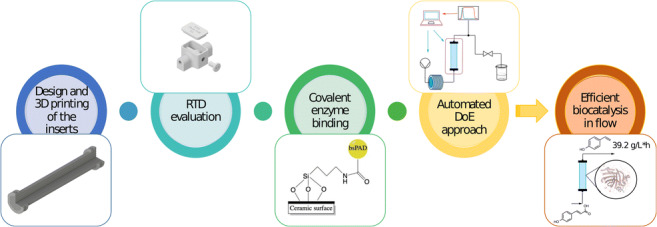
In recent years, 3D printing has emerged in the field of chemical engineering as a powerful manufacturing technique to rapidly design and produce tailor-made reaction equipment. In fact, reactors with complex internal geometries can be easily fabricated, optimized and interchanged in order to respond to precise process needs, such as improved mixing and increased surface area. These advantages make them interesting especially for catalytic applications, since customized structured bed reactors can be easily produced. 3D printing applications are not limited to reactor design, it is also possible to realize functional low cost alternatives to analytical equipment that can be used to increase the level of process understanding while keeping the investment costs low. In this work, in-house designed ceramic structured inserts printed via vat photopolymerization (VPP) are presented and characterized. The flow behavior inside these inserts was determined with residence time distribution (RTD) experiments enabled by in-house designed and 3D printed inline photometric flow cells. As a proof of concept, these structured inserts were fitted in an HPLC column to serve as solid inorganic supports for the immobilization of the enzyme Phenolic acid Decarboxylase (PAD), which catalyzes the decarboxylation of cinnamic acids. The conversion of coumaric acid to vinylphenol was chosen as a model system to prove the implementation of these engineered inserts in a continuous biocatalytic application with high product yield and process stability. The setup was further automated in order to quickly identify the optimum operating conditions via a Design of Experiments (DoE) approach. The use of a systematic optimization, together with the adaptability of 3D printed equipment to the process requirements, render the presented approach highly promising for a more feasible implementation of biocatalysts in continuous industrial processes. Graphical abstract.

SUPPLEMENTARY INFORMATION

The online version contains supplementary material available at 10.1007/s41981-021-00163-4.

摘要

未标注

近年来,3D打印作为一种强大的制造技术出现在化学工程领域,用于快速设计和生产定制的反应设备。事实上,具有复杂内部几何形状的反应器可以很容易地制造、优化和互换,以满足精确的工艺需求,如改善混合和增加表面积。这些优点使它们在催化应用中特别有吸引力,因为可以很容易地生产定制的结构化床反应器。3D打印应用不仅限于反应器设计,还可以实现功能低成本的分析设备替代品,可用于提高工艺理解水平,同时保持投资成本较低。在这项工作中,展示并表征了通过立体光刻聚合(VPP)打印的内部设计的陶瓷结构化插件。这些插件内部的流动行为通过内部设计和3D打印的在线光度流动池进行的停留时间分布(RTD)实验来确定。作为概念验证,这些结构化插件被安装在HPLC柱中,用作固定化酶酚酸脱羧酶(PAD)的固体无机载体,该酶催化肉桂酸的脱羧反应。选择香豆酸向乙烯基苯酚的转化作为模型系统,以证明这些工程插件在具有高产品收率和工艺稳定性的连续生物催化应用中的实施。该装置进一步自动化,以便通过实验设计(DoE)方法快速确定最佳操作条件。系统优化的使用,以及3D打印设备对工艺要求的适应性,使得所提出的方法在连续工业过程中更可行地实施生物催化剂方面极具前景。图形摘要。

补充信息

在线版本包含可在10.1007/s41981-021-00163-4获取的补充材料。
https://cdn.ncbi.nlm.nih.gov/pmc/blobs/c2df/8563604/b28fd5004131/41981_2021_163_Fig4_HTML.jpg
https://cdn.ncbi.nlm.nih.gov/pmc/blobs/c2df/8563604/6d17d7a96adf/41981_2021_163_Figa_HTML.jpg
https://cdn.ncbi.nlm.nih.gov/pmc/blobs/c2df/8563604/1f7cce236186/41981_2021_163_Sch1_HTML.jpg
https://cdn.ncbi.nlm.nih.gov/pmc/blobs/c2df/8563604/ba15176a6e4b/41981_2021_163_Fig1_HTML.jpg
https://cdn.ncbi.nlm.nih.gov/pmc/blobs/c2df/8563604/fae6b9851d0d/41981_2021_163_Sch2_HTML.jpg
https://cdn.ncbi.nlm.nih.gov/pmc/blobs/c2df/8563604/e7d108d3f6ef/41981_2021_163_Fig2_HTML.jpg
https://cdn.ncbi.nlm.nih.gov/pmc/blobs/c2df/8563604/e316aca4442c/41981_2021_163_Sch3_HTML.jpg
https://cdn.ncbi.nlm.nih.gov/pmc/blobs/c2df/8563604/c7577710be26/41981_2021_163_Fig3_HTML.jpg
https://cdn.ncbi.nlm.nih.gov/pmc/blobs/c2df/8563604/b28fd5004131/41981_2021_163_Fig4_HTML.jpg
https://cdn.ncbi.nlm.nih.gov/pmc/blobs/c2df/8563604/6d17d7a96adf/41981_2021_163_Figa_HTML.jpg
https://cdn.ncbi.nlm.nih.gov/pmc/blobs/c2df/8563604/1f7cce236186/41981_2021_163_Sch1_HTML.jpg
https://cdn.ncbi.nlm.nih.gov/pmc/blobs/c2df/8563604/ba15176a6e4b/41981_2021_163_Fig1_HTML.jpg
https://cdn.ncbi.nlm.nih.gov/pmc/blobs/c2df/8563604/fae6b9851d0d/41981_2021_163_Sch2_HTML.jpg
https://cdn.ncbi.nlm.nih.gov/pmc/blobs/c2df/8563604/e7d108d3f6ef/41981_2021_163_Fig2_HTML.jpg
https://cdn.ncbi.nlm.nih.gov/pmc/blobs/c2df/8563604/e316aca4442c/41981_2021_163_Sch3_HTML.jpg
https://cdn.ncbi.nlm.nih.gov/pmc/blobs/c2df/8563604/c7577710be26/41981_2021_163_Fig3_HTML.jpg
https://cdn.ncbi.nlm.nih.gov/pmc/blobs/c2df/8563604/b28fd5004131/41981_2021_163_Fig4_HTML.jpg

相似文献

1
3D printed ceramics as solid supports for enzyme immobilization: an automated DoE approach for applications in continuous flow.用于酶固定化的3D打印陶瓷作为固体载体:一种用于连续流应用的自动化实验设计方法。
J Flow Chem. 2021;11(3):675-689. doi: 10.1007/s41981-021-00163-4. Epub 2021 Apr 29.
2
Advantages of Hydrogel-Based 3D-Printed Enzyme Reactors and Their Limitations for Biocatalysis.基于水凝胶的3D打印酶反应器的优势及其在生物催化中的局限性
Front Bioeng Biotechnol. 2019 Jan 14;6:211. doi: 10.3389/fbioe.2018.00211. eCollection 2018.
3
Three-Dimensional-Printed Vortex Tube Reactor for Continuous Flow Synthesis of Polyglycolic Acid Nanoparticles with High Productivity.用于连续流动合成高生产率聚乙醇酸纳米颗粒的三维打印涡管反应器
Nanomaterials (Basel). 2023 Sep 29;13(19):2679. doi: 10.3390/nano13192679.
4
3D-Printed Phenacrylate Decarboxylase Flow Reactors for the Chemoenzymatic Synthesis of 4-Hydroxystilbene.用于4-羟基二苯乙烯化学酶合成的3D打印苯丙烯酸酯脱羧酶流动反应器
Chemistry. 2019 Dec 13;25(70):15998-16001. doi: 10.1002/chem.201904206. Epub 2019 Nov 19.
5
Biomaterials Adapted to Vat Photopolymerization in 3D Printing: Characteristics and Medical Applications.适用于3D打印中光固化成型的生物材料:特性与医学应用
J Funct Biomater. 2023 Dec 22;15(1):7. doi: 10.3390/jfb15010007.
6
Self-Sufficient and Autosensing Biocatalytic Inks for 3D-Printed Monolithic Bioreactors.用于3D打印整体式生物反应器的自给自感生物催化墨水。
ACS Appl Mater Interfaces. 2025 Jun 4;17(22):32350-32361. doi: 10.1021/acsami.5c03485. Epub 2025 May 25.
7
3D Printing: An Emerging Technology for Biocatalyst Immobilization.3D 打印:一种新兴的生物催化剂固定化技术。
Macromol Biosci. 2022 Sep;22(9):e2200110. doi: 10.1002/mabi.202200110. Epub 2022 May 26.
8
Simulative Minimization of Mass Transfer Limitations Within Hydrogel-Based 3D-Printed Enzyme Carriers.基于水凝胶的3D打印酶载体传质限制的模拟最小化
Front Bioeng Biotechnol. 2020 Apr 28;8:365. doi: 10.3389/fbioe.2020.00365. eCollection 2020.
9
A Review of Multi-Material 3D Printing of Functional Materials via Vat Photopolymerization.基于光固化的功能材料多材料3D打印综述
Polymers (Basel). 2022 Jun 16;14(12):2449. doi: 10.3390/polym14122449.
10
Continuous Flow Biocatalytic Reductive Amination by Co-Entrapping Dehydrogenases with Agarose Gel in a 3D-Printed Mould Reactor.琼脂糖凝胶共包埋脱氢酶在 3D 打印模具式反应器中连续流生物催化还原胺化。
Chembiochem. 2022 Nov 18;23(22):e202200549. doi: 10.1002/cbic.202200549. Epub 2022 Oct 26.

引用本文的文献

1
3D Printing in Biocatalysis and Biosensing: From General Concepts to Practical Applications.生物催化与生物传感中的3D打印:从一般概念到实际应用
Chem Asian J. 2024 Dec 16;19(24):e202400717. doi: 10.1002/asia.202400717. Epub 2024 Nov 7.
2
Stability Increase of Phenolic Acid Decarboxylase by a Combination of Protein and Solvent Engineering Unlocks Applications at Elevated Temperatures.通过蛋白质工程和溶剂工程相结合提高酚酸脱羧酶的稳定性,从而开启其在高温下的应用。
ACS Sustain Chem Eng. 2024 Feb 21;12(9):3575-3584. doi: 10.1021/acssuschemeng.3c06513. eCollection 2024 Mar 4.
3
Pros and Cons in Various Immobilization Techniques and Carriers for Enzymes.

本文引用的文献

1
Elevating Chemistry Research with a Modern Electronics Toolkit.用现代电子工具包提升化学研究。
Chem Rev. 2020 Sep 9;120(17):9482-9553. doi: 10.1021/acs.chemrev.0c00206. Epub 2020 Jul 27.
2
Correction to: Immobilization of Enzymes and Cells.《酶与细胞的固定化》勘误
Methods Mol Biol. 2020;2100:C1. doi: 10.1007/978-1-0716-0215-7_33.
3
Accelerating the implementation of biocatalysis in industry.加速生物催化在工业中的应用。
各种酶固定化技术和载体的优缺点。
Appl Biochem Biotechnol. 2024 Sep;196(9):5633-5655. doi: 10.1007/s12010-023-04838-7. Epub 2024 Jan 4.
4
Advances in 3D Gel Printing for Enzyme Immobilization.用于酶固定化的3D凝胶打印技术进展
Gels. 2022 Jul 22;8(8):460. doi: 10.3390/gels8080460.
Appl Microbiol Biotechnol. 2019 Jun;103(12):4733-4739. doi: 10.1007/s00253-019-09796-x. Epub 2019 May 2.
4
From Lab on a Chip to Point of Care Devices: The Role of Open Source Microcontrollers.从芯片实验室到即时检测设备:开源微控制器的作用。
Micromachines (Basel). 2018 Aug 14;9(8):403. doi: 10.3390/mi9080403.
5
3D printing in chemical engineering and catalytic technology: structured catalysts, mixers and reactors.3D 打印在化学工程和催化技术中的应用:结构化催化剂、混合器和反应器。
Chem Soc Rev. 2018 Jan 2;47(1):209-230. doi: 10.1039/c7cs00631d.
6
Glutaraldehyde inactivation of enveloped DNA viruses in the preparation of haemoglobin-based oxygen carriers.戊二醛对用于制备血红蛋白类氧载体的包膜 DNA 病毒的灭活作用。
Artif Cells Nanomed Biotechnol. 2018 Feb;46(1):33-38. doi: 10.1080/21691401.2017.1394875. Epub 2017 Oct 28.
7
Enzyme immobilization: an overview on techniques and support materials.酶固定化:技术与载体材料综述
3 Biotech. 2013 Feb;3(1):1-9. doi: 10.1007/s13205-012-0071-7. Epub 2012 Jun 6.
8
The upcoming 3D-printing revolution in microfluidics.微流控领域即将到来的 3D 打印革命。
Lab Chip. 2016 May 21;16(10):1720-42. doi: 10.1039/c6lc00163g. Epub 2016 Apr 21.
9
3D-printing technologies for electrochemical applications.电化学应用的 3D 打印技术。
Chem Soc Rev. 2016 May 21;45(10):2740-55. doi: 10.1039/c5cs00714c. Epub 2016 Apr 6.
10
3D-Printed Microfluidics.3D打印微流体技术
Angew Chem Int Ed Engl. 2016 Mar 14;55(12):3862-81. doi: 10.1002/anie.201504382. Epub 2016 Feb 8.