Nutrition Institute, Koprska Ulica 98, SI-1000 Ljubljana, Slovenia.
VIST-Faculty of Applied Sciences, Gerbičeva Cesta 51A, SI-1000 Ljubljana, Slovenia.
Nutrients. 2023 Oct 9;15(19):4304. doi: 10.3390/nu15194304.
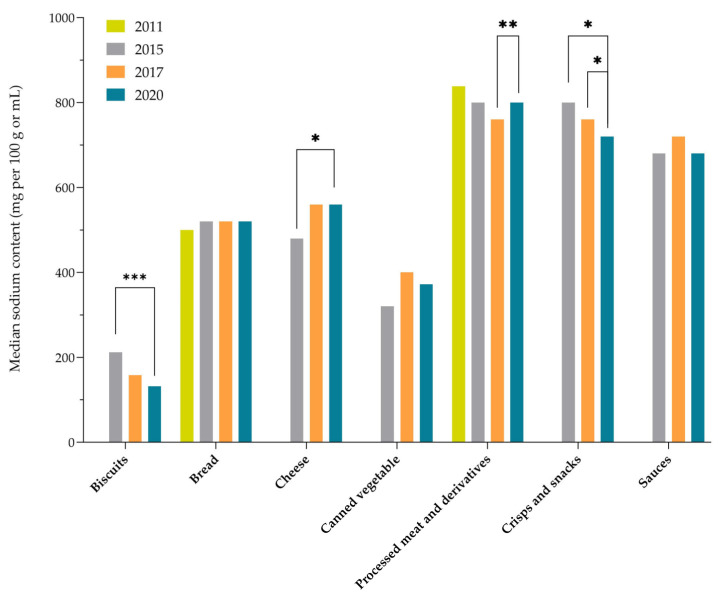
High sodium intake is the leading diet-related risk factor for mortality globally. Many countries have introduced policies to support the reformulation of foods and to reduce sodium intake, mainly on a voluntary basis, but there are limited data available about the long-term efficiency of such measures. Slovenia implemented salt reduction policies for the period of 2010-2020; these policies also included the voluntary reformulation of foods with the lowering of sodium content. This study's aim was to explore the nationally representative branded food datasets collected in the years 2011, 2015, 2017, and 2020 to investigate the changes in the sodium content in prepacked branded foods. The study was conducted with datasets collected from food labels using standard food monitoring studies and included all the major retailers. Differences in market shares were adjusted by sales weighting, which was conducted using the yearly sales data provided by the major retailers. The food categories with a major contribution to the overall sales of sodium in prepacked branded foods were processed meat and derivatives (19.0%), canned vegetables (7.1%), water (6.7%), bread (7.2%), and cheese (6.3%). Considering the available food products, a notable decreasing sodium content trend was observed in biscuits, breakfast cereals, pizza, and spreads. Year-to-year differences were much less expressed after the correction for market share differences, and neutral trends were most frequently highlighted. This indicates that sodium was less frequently reduced in market-leading products. The study results revealed that very limited progress in sodium food reformulation was achieved in the 10-year period, indicating the need for more efficient policy approaches. The study demonstrated the importance of the systematic monitoring of the food supply for the evaluation of food policies.
高钠摄入量是全球与饮食相关的主要死亡风险因素。许多国家已经出台政策,支持食品配方改革,以减少钠的摄入量,主要是基于自愿原则,但关于此类措施的长期效果的数据有限。斯洛文尼亚在 2010-2020 年期间实施了减盐政策;这些政策还包括自愿调整食品配方,降低钠含量。本研究旨在探索 2011 年、2015 年、2017 年和 2020 年收集的具有代表性的全国品牌食品数据集,以调查预包装品牌食品中钠含量的变化。该研究使用标准食品监测研究从食品标签中收集数据集,包括所有主要零售商。通过使用主要零售商提供的年度销售数据进行销售加权调整,对市场份额差异进行了调整。对预包装品牌食品整体销售中钠含量贡献最大的食品类别是加工肉类及其衍生品(19.0%)、罐装蔬菜(7.1%)、水(6.7%)、面包(7.2%)和奶酪(6.3%)。考虑到现有的食品产品,饼干、早餐麦片、比萨和涂抹酱的钠含量明显呈下降趋势。在对市场份额差异进行校正后,年际差异的表达要小得多,并且经常强调中性趋势。这表明在市场领先产品中,钠的含量减少得较少。研究结果表明,在 10 年期间,在食品配方的减钠方面取得的进展非常有限,这表明需要更有效的政策方法。该研究表明了系统监测食品供应对评估食品政策的重要性。