Department of Laboratory Medicine, Kenyatta National Hospital, 20723-00202, Nairobi, Kenya.
Department of Medical Laboratory Sciences, Kenyatta University, 43844-00100, Nairobi, Kenya.
Ann Clin Microbiol Antimicrob. 2023 Oct 14;22(1):91. doi: 10.1186/s12941-023-00641-8.
Bacterial infections in COVID-19 patients, especially those caused by multidrug-resistant gram-negative strains, are associated with increased morbidity, hospital stay and mortality. However, there is limited data on the epidemiology of extended-spectrum β-lactamase (ESBL)-producing bacteria in COVID-19 patients. Here, we assessed the prevalence and the factors associated with ESBL-producing gram-negative bacterial (GNB) infections among severely ill COVID-19 patients admitted in Kenyatta National Hospital (KNH), Kenya.
We adopted a descriptive cross-sectional study design for patients admitted between October 2021 and February 2022, purposively recruiting 120 SARS-CoV- 2 infected participants based on clinical presentation. Demographics and clinical characteristics data were collected using structured questionnaires and case report forms. Clinical samples were collected and analyzed by standard microbiological methods in the KNH Microbiology laboratory and the Centre for Microbiology Research, Kenya Medical Research Institute.
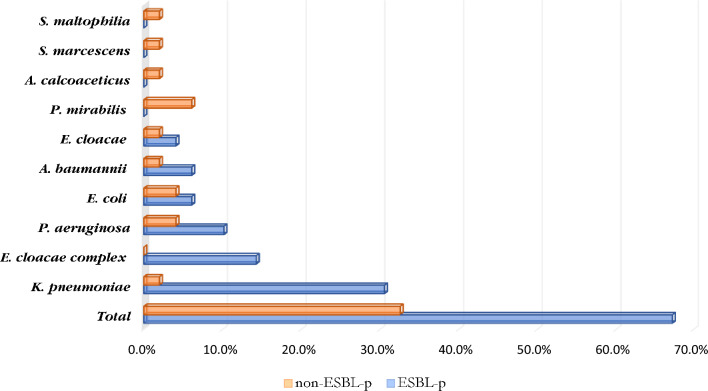
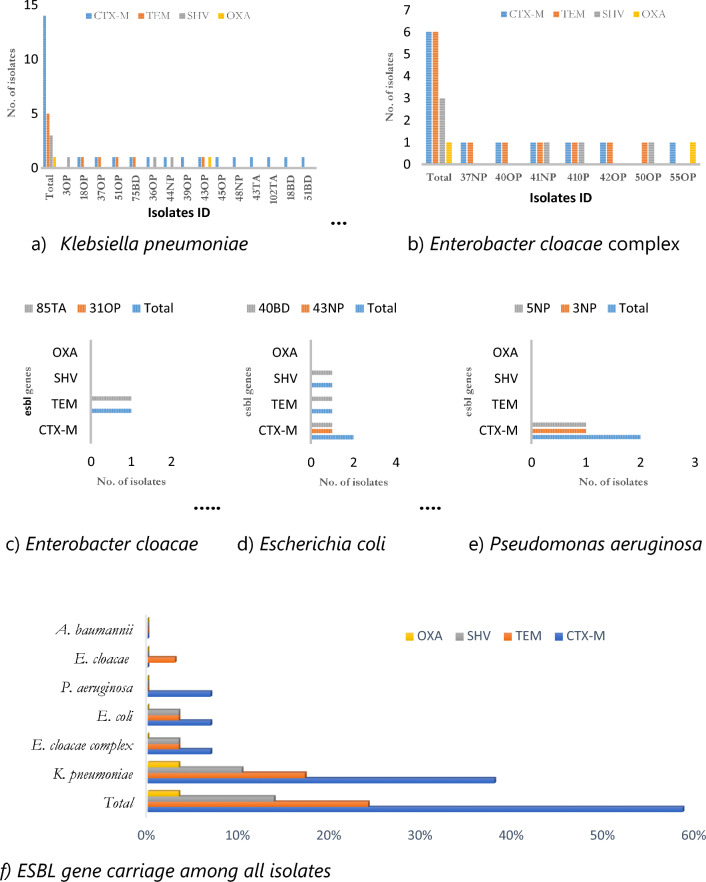
GNB infections prevalence was 40.8%, majorly caused by ESBL-producers (67.3%) predominated by Klebsiella pneumoniae (45.5%). Generally, 73% of the ESBL producers harboured our target ESBL genes, mainly CTX-M-type (59%, 17/29) in K. pneumoniae (76.9%, 20/26). GNB harbouring TEM-type (83%, 10/12) and SHV-type (100%, 7/7) genes showed ESBLs phenotypes and inhibitor resistance, mainly involving clavulanate, but most of them remained susceptible to tazobactam (60%, 6/10). SHV-type genes carrying ESBL producers showed resistance to both cefotaxime (CTX) and ceftazidime (CAZ) (K. pneumoniae), CAZ (E. coli) or CTX (E. cloacae complex and K. pneumoniae). About 87% (20/23) of isolates encoding CTX-M-type β-lactamases displayed CTX/ceftriaxone (CRO) resistance phenotype. About 42% of isolates with CTX-M-type β-lactamases only hydrolyzed ceftazidime (CAZ). Isolates with OXA-type β-lactamases were resistant to CTX, CAZ, CRO, cefepime and aztreonam. Patients with comorbidities were 10 times more likely to have an ESBL-producing GNB infection (aOR = 9.86, 95%CI 1.30 - 74.63, p = 0.003).
We report a high prevalence of ESBL-GNB infections in severely ill COVID-19 patients, predominantly due to Klebsiella pneumoniae harbouring CTX-M type ESBL genes. The patient's underlying comorbidities increased the risk of ESBL-producing GNB infection. In COVID-19 pandemic, enhanced systematic and continuous surveillance of ESBL-producing GNB, strict adherence to infection control measures and antimicrobial stewardship policies are warranted in the current study setting.
COVID-19 患者的细菌感染,尤其是由多药耐药革兰氏阴性菌株引起的感染,与发病率、住院时间和死亡率的增加有关。然而,关于 COVID-19 患者中产Extended-spectrum β-lactamase (ESBL)的细菌(GNB)感染的流行病学数据有限。在这里,我们评估了在肯尼亚肯雅塔国家医院(KNH)住院的重症 COVID-19 患者中产 ESBL 的革兰氏阴性细菌(GNB)感染的患病率和相关因素。
我们采用描述性的横断面研究设计,对 2021 年 10 月至 2022 年 2 月期间入院的患者进行研究,根据临床表现有目的地招募了 120 名 SARS-CoV-2 感染的参与者。使用结构化问卷和病例报告表收集人口统计学和临床特征数据。临床样本由 KNH 微生物实验室和肯尼亚医学研究所的微生物研究中心按照标准微生物学方法进行收集和分析。
GNB 感染的患病率为 40.8%,主要由产 ESBL 菌(67.3%)引起,以肺炎克雷伯菌(45.5%)为主。总的来说,73%的 ESBL 产生菌携带我们的目标 ESBL 基因,主要是 CTX-M 型(59%,17/29)在肺炎克雷伯菌(76.9%,20/26)中。携带 TEM 型(83%,10/12)和 SHV 型(100%,7/7)基因的 GNB 表现出 ESBL 表型和抑制剂耐药性,主要涉及克拉维酸,但大多数对他唑巴坦仍敏感(60%,6/10)。携带 SHV 型基因的产 ESBL 菌对头孢噻肟(CTX)和头孢他啶(CAZ)(肺炎克雷伯菌)、CAZ(大肠杆菌)或 CTX(阴沟肠杆菌复合物和肺炎克雷伯菌)均有耐药性。约 87%(20/23)携带 CTX-M 型β-内酰胺酶的分离株显示出对 CTX/头孢曲松(CRO)的耐药表型。约 42%的携带 CTX-M 型β-内酰胺酶的分离株仅水解头孢他啶(CAZ)。携带 OXA 型β-内酰胺酶的分离株对 CTX、CAZ、CRO、头孢吡肟和氨曲南耐药。合并症患者发生产 ESBL 的 GNB 感染的可能性是无合并症患者的 10 倍(优势比=9.86,95%置信区间 1.30-74.63,p=0.003)。
我们报告了在重症 COVID-19 患者中 ESBL-GNB 感染的高患病率,主要是由携带 CTX-M 型 ESBL 基因的肺炎克雷伯菌引起的。患者的潜在合并症增加了产 ESBL 的 GNB 感染的风险。在 COVID-19 大流行期间,在当前研究环境中,需要加强对产 ESBL 的 GNB 的系统和持续监测,严格遵守感染控制措施和抗菌药物管理政策。