Department of Respiration, Children's Hospital of Soochow University, Suzhou, 215003, China.
National Center for Respiratory Medicine, The First Affiliated Hospital of Guangzhou Medical University, National Clinical Research Center for Respiratory Disease, State Key Laboratory of Respiratory Disease, Guangzhou Institute of Respiratory Health, Guangzhou, 510120, China.
Virol J. 2022 Mar 19;19(1):49. doi: 10.1186/s12985-022-01783-5.
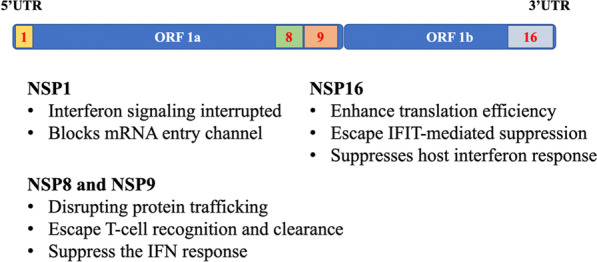
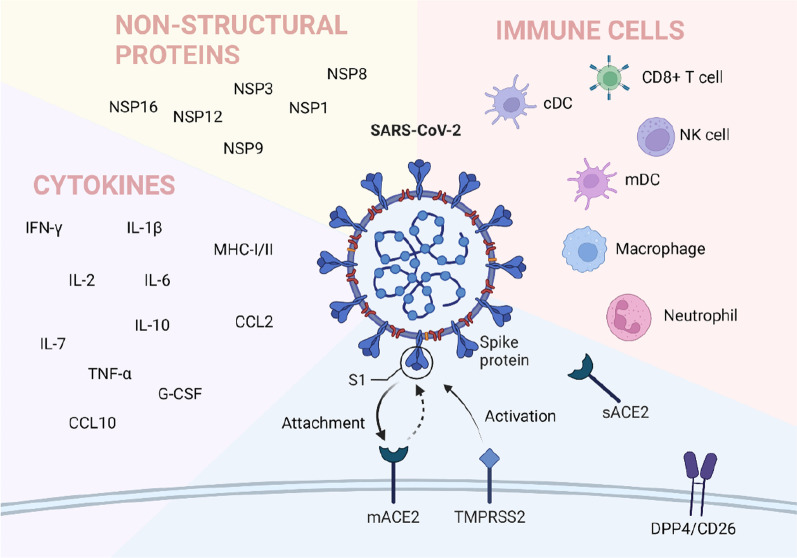
The newly identified Severe Acute Respiratory Syndrome Coronavirus 2 (SARS-CoV-2) has resulted in a global health emergency (COVID-19) because of its rapid spread and high mortality. Since the virus epidemic, many pathogenic mechanisms have been revealed, and virus-related vaccines have been successfully developed and applied in clinical practice. However, the pandemic is still developing, and new mutations are still emerging. Virus pathogenicity is closely related to the immune status of the host. As innate immunity is the body's first defense against viruses, understanding the inhibitory effect of SARS-CoV-2 on innate immunity is of great significance for determining the target of antiviral intervention. This review summarizes the molecular mechanism by which SARS-CoV-2 escapes the host immune system, including suppressing innate immune production and blocking adaptive immune priming. Here, on the one hand, we devoted ourselves to summarizing the combined action of innate immune cells, cytokines, and chemokines to fine-tune the outcome of SARS-CoV-2 infection and the related immunopathogenesis. On the other hand, we focused on the effects of the SARS-CoV-2 on innate immunity, including enhancing viral adhesion, increasing the rate of virus invasion, inhibiting the transcription and translation of immune-related mRNA, increasing cellular mRNA degradation, and inhibiting protein transmembrane transport. This review on the underlying mechanism should provide theoretical support for developing future molecular targeted drugs against SARS-CoV-2. Nevertheless, SARS-CoV-2 is a completely new virus, and people's understanding of it is in the process of rapid growth, and various new studies are also being carried out. Although we strive to make our review as inclusive as possible, there may still be incompleteness.
新鉴定的严重急性呼吸综合征冠状病毒 2(SARS-CoV-2)由于其快速传播和高死亡率,导致了全球卫生紧急情况(COVID-19)。自病毒流行以来,许多发病机制已经被揭示,并且与病毒相关的疫苗已经成功地开发并应用于临床实践。然而,大流行仍在发展,新的突变仍在出现。病毒的致病性与宿主的免疫状态密切相关。由于先天免疫是机体抵御病毒的第一道防线,因此了解 SARS-CoV-2 对先天免疫的抑制作用对于确定抗病毒干预的靶标具有重要意义。本综述总结了 SARS-CoV-2 逃避宿主免疫系统的分子机制,包括抑制先天免疫产物的产生和阻断适应性免疫的启动。在这里,一方面,我们致力于总结先天免疫细胞、细胞因子和趋化因子的联合作用,以微调 SARS-CoV-2 感染的结果和相关的免疫发病机制。另一方面,我们关注 SARS-CoV-2 对先天免疫的影响,包括增强病毒的黏附性、增加病毒入侵的速度、抑制与免疫相关的 mRNA 的转录和翻译、增加细胞 mRNA 的降解以及抑制蛋白质的跨膜转运。关于潜在机制的这篇综述应为开发针对 SARS-CoV-2 的未来分子靶向药物提供理论支持。然而,SARS-CoV-2 是一种全新的病毒,人们对它的认识正在快速发展,并且正在进行各种新的研究。尽管我们努力使我们的综述尽可能全面,但仍可能存在不完整。