Department of Rheumatology, Guanghua Hospital Affiliated to Shanghai University of Traditional Chinese Medicine, Shanghai University of Traditional Chinese Medicine, Shanghai, China.
Department of Rheumatology, Shanghai Guanghua Hospital of Integrated Traditional Chinese and Western Medicine, Shanghai, China.
Front Immunol. 2023 Sep 28;14:1189036. doi: 10.3389/fimmu.2023.1189036. eCollection 2023.
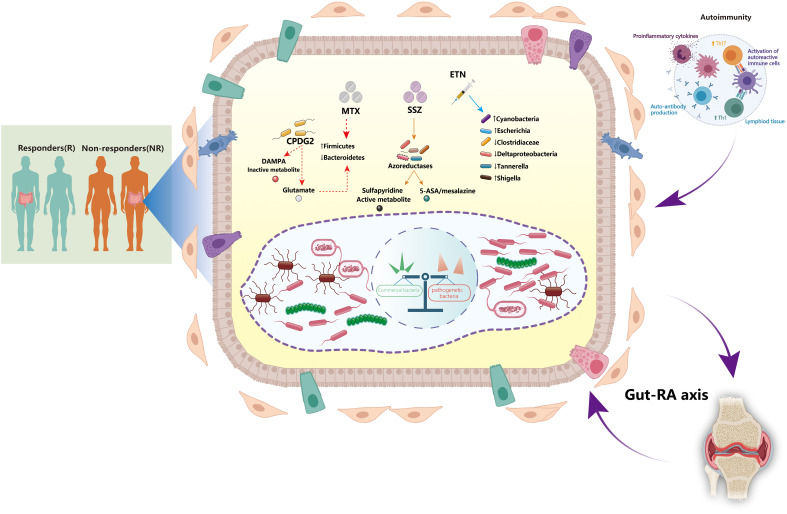
Alterations in the composition or function of the gut microbiota are associated with the etiology of human diseases. Drug-microbiota interactions can affect drug bioavailability, effectiveness, and toxicity through various routes. For instance, the direct effect of microbial enzymes on drugs can either boost or diminish their efficacy. Thus, considering its wide range of metabolic capabilities, the gut microbiota is a promising target for pharmacological modulation. Furthermore, drugs can alter the microbiota and the mechanisms by which they interact with their host. Individual variances in microbial profiles can also contribute to the different host responses to various drugs. However, the influence of interactions between the gut microbiota and drugs on treatment efficacy remains poorly elucidated. In this review, we will discuss the impact of microbiota dysbiosis in the pathogenesis of rheumatoid arthritis (RA), and we will attempt to elucidate the crosstalk between the gut microbiota and disease-modifying anti-rheumatic drugs (DMARDs), with an emphasis on how drug-microbiota interactions affect the treatment efficacy in RA. We speculate that improved knowledge of these critical interactions will facilitate the development of novel therapeutic options that use microbial markers for predicting or optimizing treatment outcomes.
肠道微生物组的组成或功能的改变与人类疾病的病因有关。药物-微生物组相互作用可以通过多种途径影响药物的生物利用度、疗效和毒性。例如,微生物酶对药物的直接作用可以增强或减弱其疗效。因此,考虑到其广泛的代谢能力,肠道微生物组是一个有前途的药理学调节靶点。此外,药物可以改变微生物组及其与宿主相互作用的机制。微生物谱的个体差异也可能导致宿主对各种药物的不同反应。然而,肠道微生物组和药物之间的相互作用对治疗效果的影响仍不清楚。在这篇综述中,我们将讨论肠道微生物组失调在类风湿关节炎(RA)发病机制中的作用,并试图阐明肠道微生物组与改善病情的抗风湿药物(DMARDs)之间的相互作用,重点讨论药物-微生物组相互作用如何影响 RA 的治疗效果。我们推测,对这些关键相互作用的深入了解将有助于开发新的治疗选择,利用微生物标志物来预测或优化治疗结果。