Beijing Key Laboratory of Research of Chinese Medicine on Prevention and Treatment for Major Diseases, Experimental Research Center, China Academy of Chinese Medical Science, Beijing 100700, China.
Institute of Clinical Medicine, China-Japan Friendship Hospital, Beijing 100029, China.
Mediators Inflamm. 2020 Sep 9;2020:1430605. doi: 10.1155/2020/1430605. eCollection 2020.
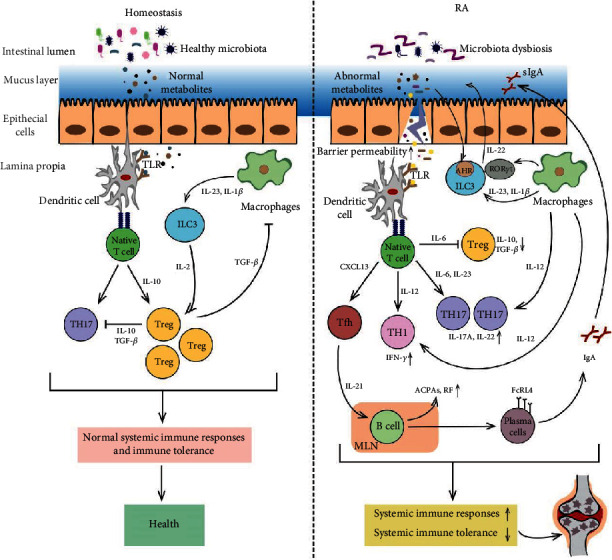
Rheumatoid arthritis (RA) is one of the most common autoimmune diseases caused by abnormal immune activation and immune tolerance. Immunomodulatory cells (ICs) play a critical role in the maintenance and homeostasis of normal immune function and in the pathogenesis of RA. The human gastrointestinal tract is inhabited by trillions of commensal microbiota on the mucosal surface that play a fundamental role in the induction, maintenance, and function of the host immune system. Gut microbiota dysbiosis can impact both the local and systemic immune systems and further contribute to various diseases, such as RA. The neighbouring intestinal ICs located in distinct intestinal mucosa may be the most likely intermediary by which the gut microbiota can affect the occurrence and development of RA. However, the reciprocal interaction between the components of the gut microbiota and their microbial metabolites with distinct ICs and how this interaction may impact the development of RA are not well studied. Therefore, a better understanding of the gut microbiota, ICs, and their interactions might improve our knowledge of the mechanisms by which the gut microbiota contribute to RA and facilitate the further development of novel therapeutic approaches. In this review, we have summarized the roles of the gut microbiota in the immunopathogenesis of RA, especially the interactions between the gut microbiota and ICs, and further discussed the strategies for treating RA by targeting/regulating the gut microbiota.
类风湿关节炎(RA)是一种最常见的自身免疫性疾病,由异常的免疫激活和免疫耐受引起。免疫调节细胞(ICs)在维持和调节正常免疫功能以及 RA 的发病机制中起着关键作用。人类胃肠道在黏膜表面栖息着数以万亿计的共生菌群,在诱导、维持和调节宿主免疫系统方面发挥着基本作用。肠道菌群失调可影响局部和全身免疫系统,并进一步导致各种疾病,如 RA。位于不同肠道黏膜中的邻近肠道 ICs 可能是肠道菌群影响 RA 发生和发展的最有可能的中介。然而,肠道菌群的组成部分及其微生物代谢产物与不同 ICs 的相互作用,以及这种相互作用如何影响 RA 的发展,尚未得到很好的研究。因此,更好地了解肠道菌群、ICs 及其相互作用可能会增进我们对肠道菌群促进 RA 发病机制的认识,并有助于进一步开发新的治疗方法。在这篇综述中,我们总结了肠道菌群在 RA 的免疫发病机制中的作用,特别是肠道菌群与 ICs 的相互作用,并进一步讨论了通过靶向/调节肠道菌群来治疗 RA 的策略。