Institute of Orthopedic Research and Biomechanics, Center for Trauma Research, Ulm University Medical Center, Helmholtzstraße 14, 89081, Ulm, Germany.
Department of Orthopedic Surgery, RKU, Ulm University Medical Center, Ulm, Germany.
Knee Surg Sports Traumatol Arthrosc. 2023 Dec;31(12):5554-5564. doi: 10.1007/s00167-023-07602-w. Epub 2023 Oct 16.
The purpose of this in vitro study was to investigate whether or not hyaluronic acid supplementation improves knee joint friction during osteoarthritis progression under gait-like loading conditions.
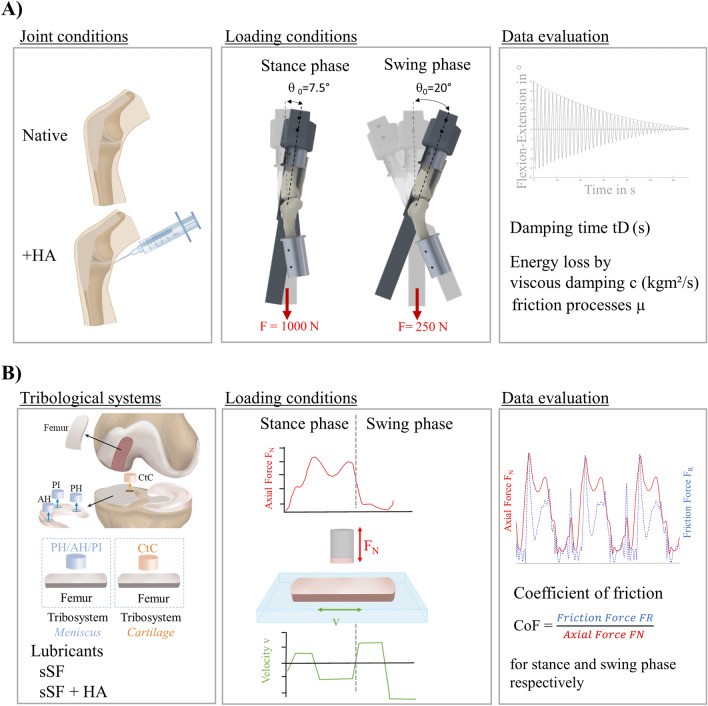
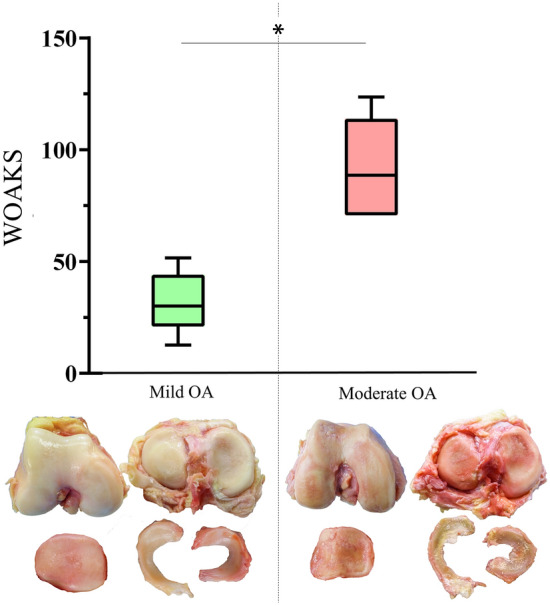
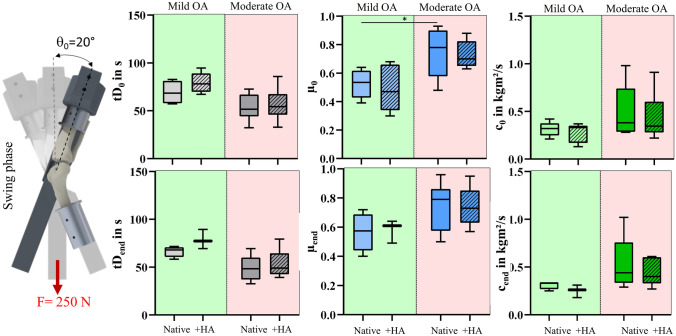
Twelve human cadaveric knee joints were equally divided into mild and moderate osteoarthritic groups. After initial conservative preparation, a passive pendulum setup was used to test the whole joints under gait-like conditions before and after hyaluronic acid supplementation. The friction-related damping properties given by the coefficient of friction µ and the damping coefficient c (in kg m/s) were calculated from the decaying flexion-extension motion of the knee. Subsequently, tibial and femoral cartilage and meniscus samples were extracted from the joints and tested in an established dynamic pin-on-plate tribometer using synthetic synovial fluid followed by synthetic synovial fluid supplemented with hyaluronic acid as lubricant. Friction was quantified by calculating the coefficient of friction.
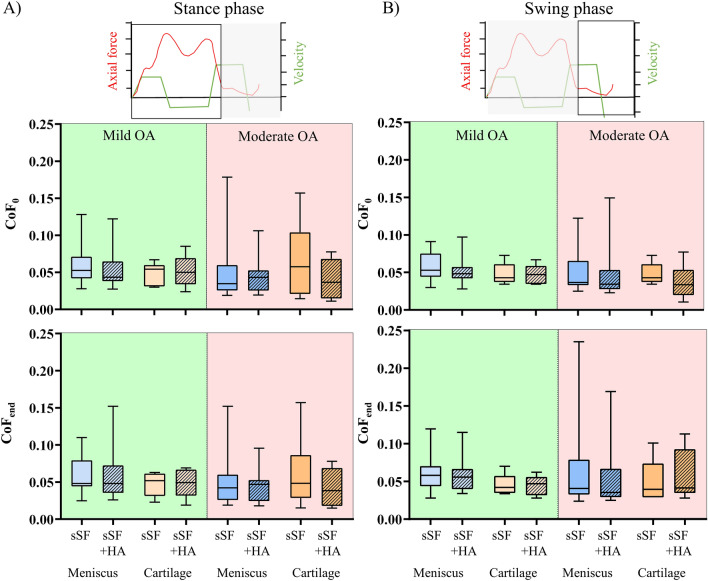
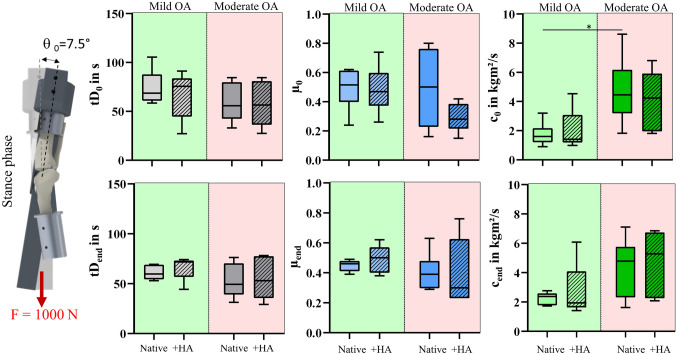
In the pendulum tests, the moderate OA group indicated significantly lower c values (p < 0.05) under stance phase conditions and significantly lower µ (p = 0.01) values under swing phase conditions. No degeneration-related statistical differences were found for µ or c. Friction was not significantly different (p > 0.05) with regard to mild and moderate osteoarthritis in the pin-on-plate tests. Additionally, hyaluronic acid did not affect friction in both, the pendulum (p > 0.05) and pin-on-plate friction tests (p > 0.05).
The results of this in vitro study suggested that the friction of cadaveric knee joint tissues does not increase with progressing degeneration. Moreover, hyaluronic acid viscosupplementation does not lead to an initial decrease in knee joint friction.
本体外研究旨在探讨透明质酸补充是否能改善步态负荷条件下骨关节炎进展过程中膝关节的摩擦。
12 个人体尸体膝关节平均分为轻度和中度骨关节炎组。经过初始的保守准备,使用被动摆锤装置在透明质酸补充前后测试全关节在步态条件下的摩擦相关阻尼特性。通过膝关节屈伸运动的衰减,计算摩擦系数µ和阻尼系数 c(kg·m/s)。随后,从关节中提取胫骨和股骨软骨和半月板样本,并在建立的动态销盘摩擦试验机中使用合成滑液进行测试,然后使用合成滑液补充透明质酸作为润滑剂。通过计算摩擦系数来量化摩擦。
在摆锤测试中,中度 OA 组在站立相条件下的 c 值显著降低(p<0.05),在摆动相条件下的 µ 值显著降低(p=0.01)。µ 或 c 没有与退变相关的统计学差异。在销盘测试中,µ 或 c 在轻度和中度骨关节炎之间没有显著差异(p>0.05)。此外,透明质酸在摆锤(p>0.05)和销盘摩擦测试(p>0.05)中均未对摩擦产生影响。
本体外研究结果表明,尸体膝关节组织的摩擦不会随着退变的进展而增加。此外,透明质酸粘弹性补充不会导致膝关节摩擦的初始降低。