BioArCh, Department of Archaeology, University of York, York YO10 5DD, United Kingdom.
Institute of History and Archaeology, Institute of Chemistry, University of Tartu, Tartu 50411, Estonia.
Proc Natl Acad Sci U S A. 2023 Oct 24;120(43):e2310138120. doi: 10.1073/pnas.2310138120. Epub 2023 Oct 16.
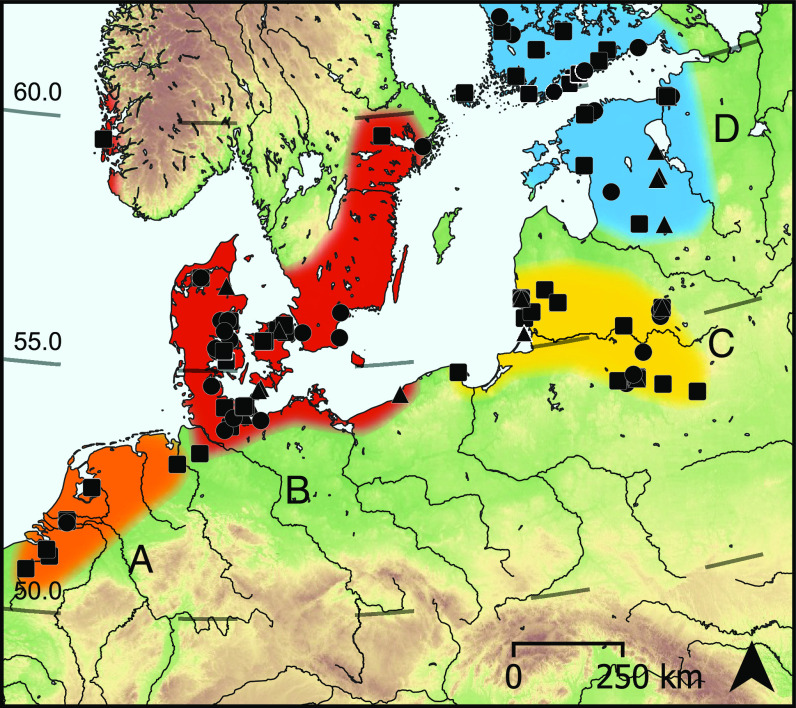
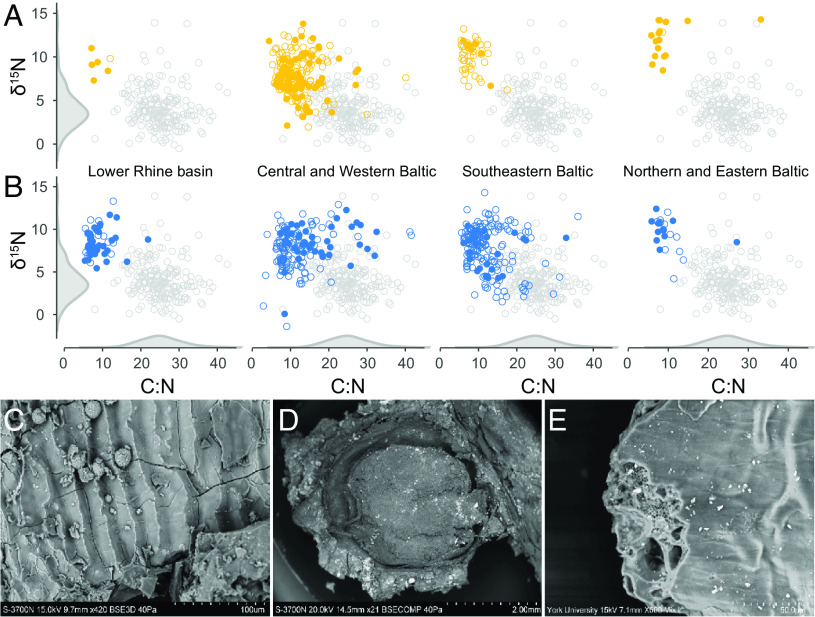
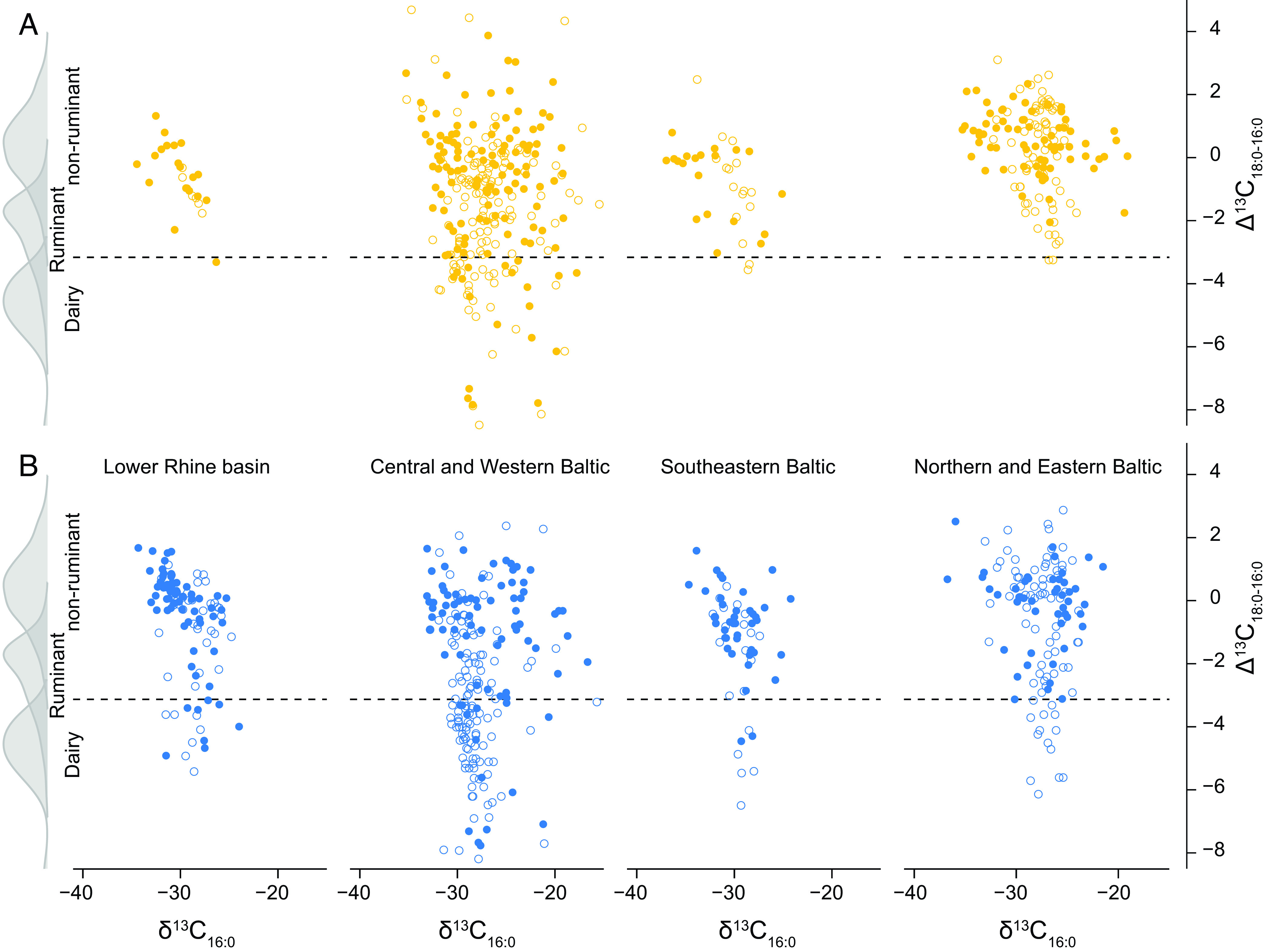
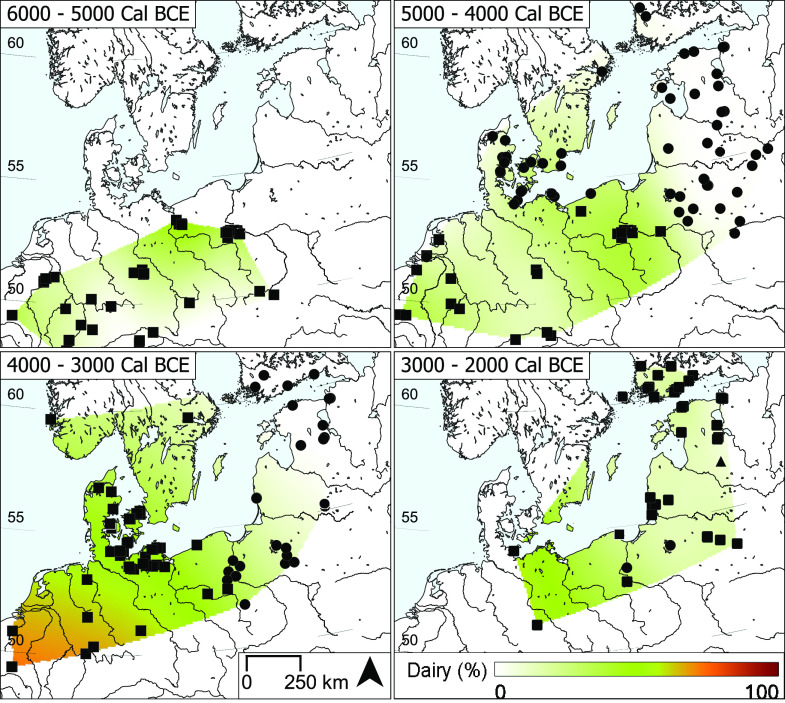
To investigate changes in culinary practices associated with the arrival of farming, we analysed the organic residues of over 1,000 pottery vessels from hunter-gatherer-fisher and early agricultural sites across Northern Europe from the Lower Rhine Basin to the Northeastern Baltic. Here, pottery was widely used by hunter-gatherer-fishers prior to the introduction of domesticated animals and plants. Overall, there was surprising continuity in the way that hunter-gatherer-fishers and farmers used pottery. Both aquatic products and wild plants remained prevalent, a pattern repeated consistently across the study area. We argue that the rapid adaptation of farming communities to exploit coastal and lagoonal resources facilitated their northerly expansion, and in some cases, hunting, gathering, and fishing became the most dominant subsistence strategy. Nevertheless, dairy products frequently appear in pottery associated with the earliest farming groups often mixed with wild plants and fish. Interestingly, we also find compelling evidence of dairy products in hunter-gatherer-fisher Ertebølle pottery, which predates the arrival of domesticated animals. We propose that Ertebølle hunter-gatherer-fishers frequently acquired dairy products through exchange with adjacent farming communities prior to the transition. The continuity observed in pottery use across the transition to farming contrasts with the analysis of human remains which shows substantial demographic change through ancient DNA and, in some cases, a reduction in marine consumption through stable isotope analysis. We postulate that farmers acquired the knowledge and skills they needed to succeed from local hunter-gatherer-fishers but without substantial admixture.
为了研究与农业出现相关的烹饪实践变化,我们分析了来自北欧从莱茵河流域到东北波罗的海的 1000 多个 hunter-gatherer-fisher 和早期农业遗址的陶器残留物。在这里,在引入驯化动植物之前,hunter-gatherer-fisher 广泛使用陶器。总体而言,hunter-gatherer-fisher 和农民使用陶器的方式惊人地保持一致。水产品和野生植物仍然很普遍,这一模式在整个研究区域内一致重复。我们认为,农业社区对利用沿海和泻湖资源的快速适应促进了他们的向北扩张,在某些情况下,狩猎、采集和捕鱼成为最主要的生计策略。然而,奶制品经常出现在与最早的农业群体相关的陶器中,通常与野生植物和鱼类混合在一起。有趣的是,我们在 hunter-gatherer-fisher 时期的 Ertebølle 陶器中也发现了奶制品的有力证据,这早于驯化动物的出现。我们提出,在过渡之前,Ertebølle 的 hunter-gatherer-fisher 可能通过与邻近的农业社区进行交换获得了奶制品。在向农业过渡过程中观察到的陶器使用连续性与人类遗骸的分析形成对比,人类遗骸的分析表明通过古代 DNA 发生了大量的人口变化,并且在某些情况下,通过稳定同位素分析减少了对海洋资源的消费。我们假设农民从当地的 hunter-gatherer-fisher 那里获得了成功所需的知识和技能,但没有大量的混合。