Center for Science, Health, and Society, Case Western Reserve University, Cleveland, Ohio, USA.
Center for Community Health Integration, Case Western Reserve University School of Medicine, Cleveland, Ohio, USA.
Fam Med Community Health. 2023 Oct;11(4). doi: 10.1136/fmch-2023-002453.
The long-term time trend and seasonality variations of first-time medically attended respiratory syncytial virus (RSV) infections among young children are unknown. We aim to examine the time trend of medically attended first-time RSV infections among young children in the USA from January 2010 through January 2023.
This is a population-based cohort study using electronic health records (EHRs). Monthly incidence rate of medically attended first-time RSV infection (cases per 10 000 000 person-days). A time-series regression model was used to model and predict time trends and seasonality.
Multicenter and nationwide TriNetX Network in the USA.
The study population comprised children aged 0-5 years who had medical visits during the period of January 2010 to January 2023.
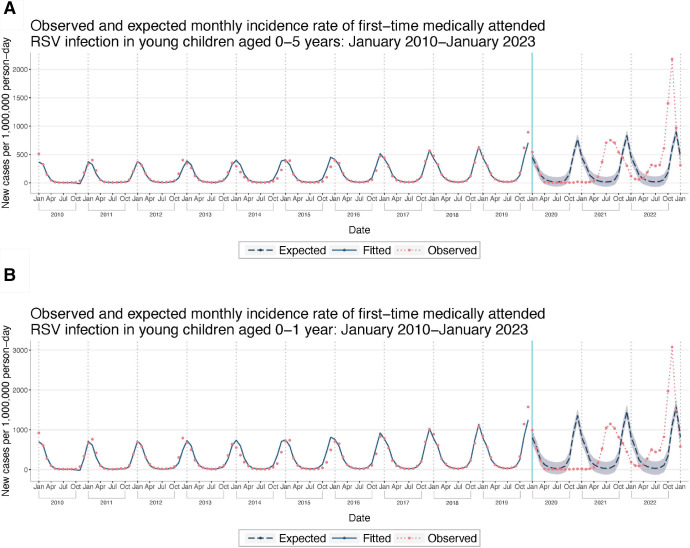
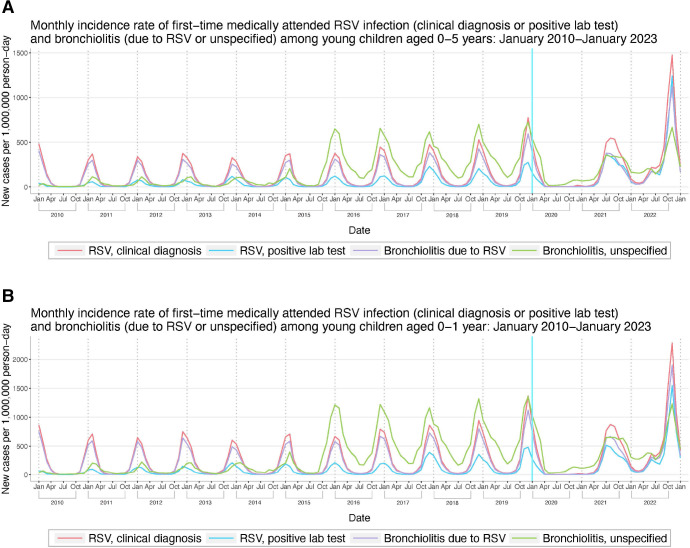
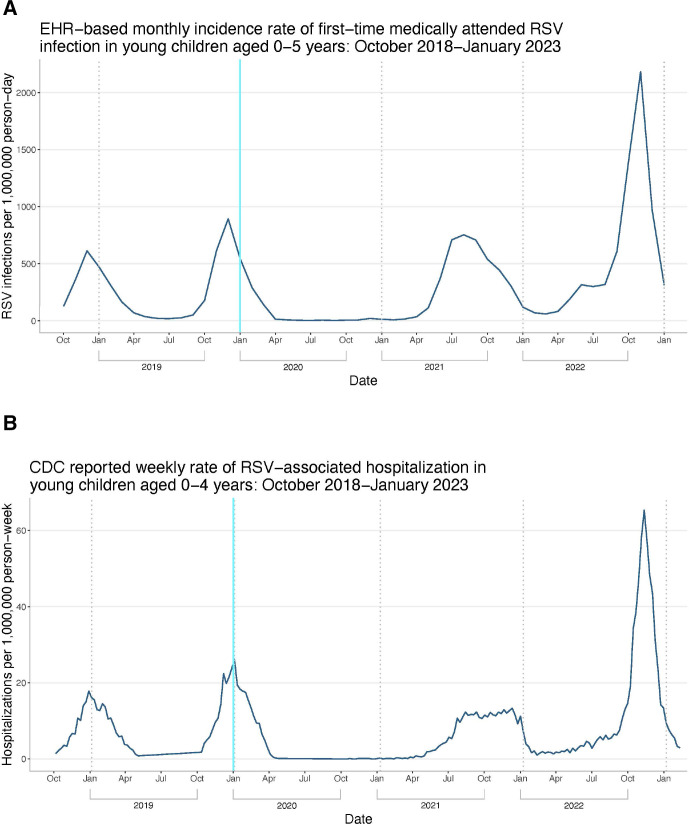
The data included 29 013 937 medical visits for children aged 05 years (46.5% girls and 53.5% boys) from January 2010 through January 2023. From 2010 through 2019, the monthly incidence rate of first-time medically attended RSV infection in children aged 05 years followed a consistent seasonal pattern. Seasonal patterns of medically attended RSV infections were significantly disrupted during the COVID-19 pandemic. In 2020, the seasonal variation disappeared with a peak incidence rate of 20 cases per 1 000 000 person-days, a decrease of 97.4% from the expected peak rate (rate ratio or RR: 0.026, 95% CI 0.017 to 0.040). In 2021, the seasonality returned but started 4 months earlier, lasted for 9 months, and peaked in August at a rate of 753 cases per 1 000 000 person-days, a decrease of 9.6% from the expected peak rate (RR: 0.90, 95% CI 0.82 to 0.99). In 2022, the seasonal pattern is similar to prepandemic years but reached a historically high rate of 2182 cases per 10 000 000 person-days in November, an increase of 143% from the expected peak rate (RR: 2.43, 95% CI 2.25 to 2.63). The time trend and seasonality of the EHR-based medically attended RSV infections are consistent with those of RSV-associated hospitalisations from the Centers for Disease Control and Prevention (CDC) survey-based surveillance system.
The findings show the disrupted seasonality during the COVID-19 pandemic and a historically high surge of paediatric RSV cases that required medical attention in 2022. Our study demonstrates the potential of EHRs as a cost-effective alternative for real-time pathogen and syndromic surveillance of unexpected disease patterns including RSV infection.
儿童首次因呼吸道合胞病毒(RSV)感染而接受医学治疗的长期时间趋势和季节性变化尚不清楚。我们旨在研究 2010 年 1 月至 2023 年 1 月期间美国 0-5 岁儿童首次因 RSV 感染而接受医学治疗的时间趋势。
这是一项基于人群的队列研究,使用电子健康记录(EHR)。每月因 RSV 感染而首次接受医学治疗的儿童发病率(每 1000 万儿童天的病例数)。使用时间序列回归模型对时间趋势和季节性进行建模和预测。
美国多中心和全国范围的 TriNetX 网络。
研究人群包括在 2010 年 1 月至 2023 年 1 月期间接受医疗就诊的 0-5 岁儿童。
该数据包括 2010 年 1 月至 2023 年 1 月期间 0-5 岁儿童的 29013937 次医疗就诊(46.5%为女孩,53.5%为男孩)。从 2010 年到 2019 年,0-5 岁儿童首次因 RSV 感染而接受医学治疗的每月发病率呈一致的季节性模式。COVID-19 大流行期间,呼吸道合胞病毒感染的季节性模式明显受到干扰。2020 年,季节性变化消失,发病率峰值为 20 例/100 万儿童天,比预期峰值下降 97.4%(率比或 RR:0.026,95%CI 0.017 至 0.040)。2021 年,季节性回归,但提前了 4 个月,持续了 9 个月,8 月发病率达到 753 例/100 万儿童天,比预期峰值下降 9.6%(RR:0.90,95%CI 0.82 至 0.99)。2022 年,季节性模式与大流行前年份相似,但 11 月发病率达到历史最高水平,为 2182 例/100 万儿童天,比预期峰值上升 143%(RR:2.43,95%CI 2.25 至 2.63)。基于 EHR 的首次因 RSV 感染而接受医学治疗的时间趋势和季节性与疾病控制和预防中心(CDC)基于调查的监测系统中与 RSV 相关的住院率的时间趋势和季节性一致。
这些发现表明,COVID-19 大流行期间季节性发生中断,以及 2022 年 RSV 病例数量创历史新高,需要医疗干预。我们的研究表明,EHR 作为实时病原体和综合征监测的一种具有成本效益的替代方法具有潜力,可用于监测包括 RSV 感染在内的意外疾病模式。