Hunan Provincial People's Hospital (The First Affiliated Hospital of Hunan Normal University), 410005, Changsha, China.
Virol J. 2024 Mar 7;21(1):62. doi: 10.1186/s12985-024-02336-8.
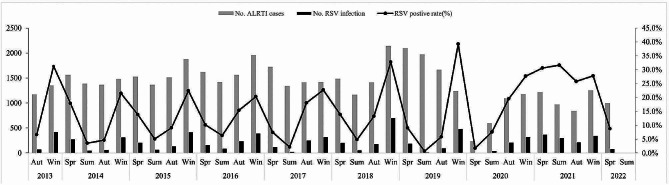
In China, respiratory syncytial virus (RSV) infections traditionally occur during the spring and winter seasons. However, a shift in the seasonal trend was noted in 2020-2022, during the coronavirus disease 2019 (COVID-19) pandemic.
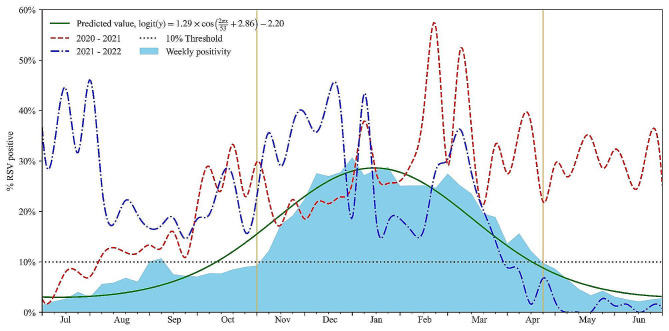
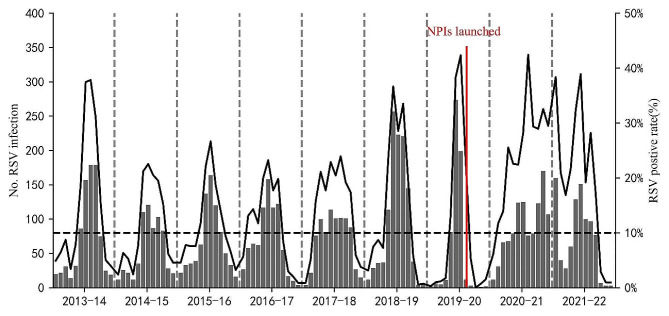
This study investigated the seasonal characteristics of RSV infection in children hospitalized with acute lower respiratory tract infections (ALRTIs). The RSV epidemic season was defined as RSV positivity in > 10% of the hospitalized ALRTI cases each week. Nine RSV seasons were identified between 2013 and 2022, and nonlinear ordinary least squares regression models were used to assess the differences in year-to-year epidemic seasonality trends.
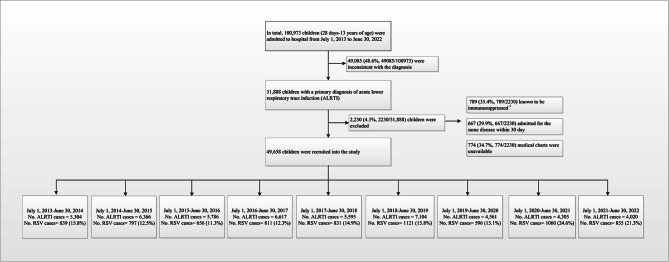
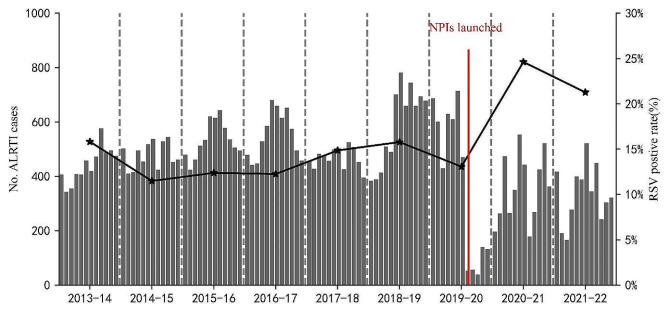
We enrolled 49,658 hospitalized children diagnosed with ALRTIs over a 9-year period, and the RSV antigen-positive rate was 15.2% (n = 7,566/49,658). Between 2013 and 2022, the average onset and end of the RSV season occurred in week 44 (late October) and week 17 of the following year, respectively, with a typical duration of 27 weeks. However, at the onset of the COVID-19 pandemic, the usual spring RSV peak did not occur. Instead, the 2020 epidemic started in week 32, and RSV seasonality persisted into 2021, lasting for an unprecedented 87 weeks before concluding in March 2022.
RSV seasonality was disrupted during the COVID-19 pandemic, and the season exhibited an unusually prolonged duration. These findings may provide valuable insights for clinical practice and public health considerations.
在中国,呼吸道合胞病毒(RSV)感染传统上发生在春季和冬季。然而,在 2020-2022 年 COVID-19 大流行期间,季节性趋势发生了变化。
本研究调查了因急性下呼吸道感染(ALRTI)住院的儿童中 RSV 感染的季节性特征。RSV 流行季节定义为每周住院 ALRTI 病例中 RSV 阳性率>10%。在 2013 年至 2022 年期间确定了 9 个 RSV 季节,并使用非线性普通最小二乘回归模型评估了逐年流行季节趋势的差异。
我们纳入了 49658 名因 ALRTI 住院的儿童,9 年期间 RSV 抗原阳性率为 15.2%(n=7566/49658)。2013 年至 2022 年期间,RSV 季节的平均开始和结束时间分别为第 44 周(10 月底)和次年的第 17 周,典型持续时间为 27 周。然而,在 COVID-19 大流行开始时,通常的春季 RSV 高峰并未出现。相反,2020 年的流行于第 32 周开始,RSV 季节性持续到 2021 年,在 2022 年 3 月结束前持续了前所未有的 87 周。
在 COVID-19 大流行期间,RSV 季节性受到干扰,季节持续时间异常延长。这些发现可能为临床实践和公共卫生考虑提供有价值的见解。