School of Medical Laboratory Sciences, Faculty of Health Sciences, Institute of Health, Jimma University, Jimma, Ethiopia.
Tropical and Infectious Diseases Research Center (TIRC), Jimma University, Jimma, Ethiopia.
Malar J. 2023 Oct 16;22(1):311. doi: 10.1186/s12936-023-04736-7.
Schoolchildren with asymptomatic malaria infections often go undiagnosed and untreated, serving as reservoirs for infection that hamper malaria control and elimination efforts. In this context, little is known about the magnitude of asymptomatic malaria infections in apparently healthy schoolchildren in Ethiopia. This study was aimed at determining the prevalence of asymptomatic malaria infection and its associated factors in apparently healthy schoolchildren in Ethiopia.
From September 2021 to January 2022, a school-based cross-sectional study was conducted on 994 apparently healthy schoolchildren (aged 6-15 years) selected from 21 primary schools in the Gomma district, of Jimma zone, southwestern Oromia, Ethiopia. A multi-stage sampling technique was used to select schools and participants. After allocating the total sample proportionally to each school and then to each grade, participants were selected using the lottery method from a list of student records (rosters). Finger-pricked blood samples were collected for microscopy blood film preparation and malaria rapid diagnostic test (RDT) (SD Bioline Malaria Ag Pf/Pv). Moreover, dry blood spots (DBSs) were prepared onto filter papers for quantitative real time polymerase chain reaction (qPCR) analysis.
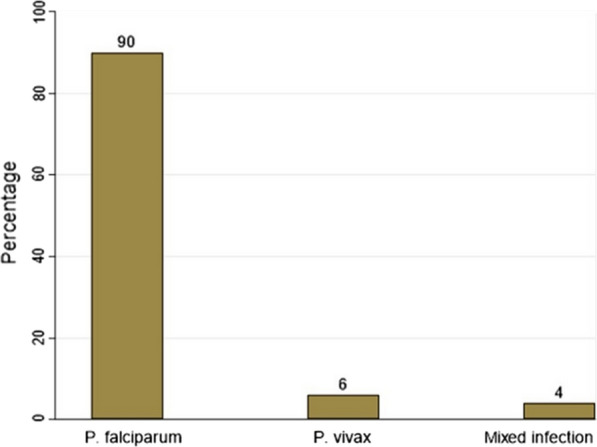
As determined by RDT and microscopy, the prevalence of asymptomatic malaria was 2.20% and 1.51%, respectively. Using qPCR, the overall prevalence was 5.03% (50/994). Of this, Plasmodium falciparum, Plasmodium vivax and mixed infections accounted for 90%, 6% and 4%, respectively. Submicroscopic asymptomatic malaria infection was also accounted for 70% (35/50) of the overall prevalence. Household head age, nighttime outdoor activities of household heads, family history of malaria, absence of insecticide-treated nets (ITN), and presence of stagnant water around the houses are all significantly associated with asymptomatic malaria infections among schoolchildren.
This study found that both RDT and microscopy underestimated the prevalence of asymptomatic malaria in schoolchildren. However, qPCR was able to detect even low levels of parasitaemia and revealed a higher prevalence of asymptomatic submicroscopic malaria infections. The findings imply that schoolchildren with asymptomatic malaria infection are potential hotspot for malaria reservoir that fuels ongoing transmission. Therefore, it is imperative to include schoolchildren and schools in malaria intervention package and equally important is the adoption of more advanced and sensitive diagnostic tools, which would be crucial for successful malaria control and elimination efforts. Targeted interventions for asymptomatic malaria-infected schoolchildren can provide invaluable support to the National Malaria Control Programme in controlling and eventually eliminating the disease.
无症状疟疾病例的学龄儿童常未被诊断和治疗,成为感染源,阻碍疟疾防控和消除工作。在这种情况下,人们对埃塞俄比亚健康学龄儿童中无症状疟疾感染的程度知之甚少。本研究旨在确定埃塞俄比亚健康学龄儿童中无症状疟疾感染的流行率及其相关因素。
2021 年 9 月至 2022 年 1 月,在埃塞俄比亚西南部奥罗米亚地区吉马区的戈马区,从 21 所小学中选择了 994 名看似健康的学龄儿童(年龄在 6-15 岁之间),开展了一项基于学校的横断面研究。采用多阶段抽样技术选择学校和参与者。在按比例将总样本分配给每所学校,然后分配给每个年级后,从学生记录(名册)中使用抽签法选择参与者。采集指血样制备显微镜血片和疟疾快速诊断检测(RDT)(SD Bioline Malaria Ag Pf/Pv)。此外,还在滤纸上制备干血斑(DBS),用于定量实时聚合酶链反应(qPCR)分析。
根据 RDT 和显微镜检查,无症状疟疾的流行率分别为 2.20%和 1.51%。使用 qPCR,总体流行率为 5.03%(50/994)。其中,恶性疟原虫、间日疟原虫和混合感染分别占 90%、6%和 4%。亚显微镜无症状疟疾感染也占总流行率的 70%(35/50)。家庭户主年龄、家庭户主夜间户外活动、疟疾家族史、无驱虫蚊帐(ITN)和房屋周围有死水均与学龄儿童的无症状疟疾感染显著相关。
本研究发现,RDT 和显微镜都低估了学龄儿童无症状疟疾的流行率。然而,qPCR 能够检测到即使很低水平的寄生虫血症,并显示出更高的无症状亚显微镜疟疾感染率。研究结果表明,无症状疟疾病例的学龄儿童是疟疾传播的潜在热点,是持续传播的动力。因此,必须将学龄儿童和学校纳入疟疾干预措施中,同样重要的是,需要采用更先进和敏感的诊断工具,这对成功控制和最终消除疟疾至关重要。针对无症状疟疾病例感染的学龄儿童进行的针对性干预措施,可为国家疟疾控制规划在控制和最终消除疟疾方面提供宝贵支持。
