Malaria and Neglected Tropical Diseases Directorate, Armauer Hansen Research Institute, PO Box 1005, Addis Ababa, Ethiopia.
Department of Biomedical Sciences, College of Natural and Computational Sciences, Addis Ababa University, PO Box 1176, Addis Ababa, Ethiopia.
Malar J. 2021 Jan 22;20(1):59. doi: 10.1186/s12936-021-03587-4.
As countries move to malaria elimination, detecting and targeting asymptomatic malaria infections might be needed. Here, the epidemiology and detectability of asymptomatic Plasmodium falciparum and Plasmodium vivax infections were investigated in different transmission settings in Ethiopia.
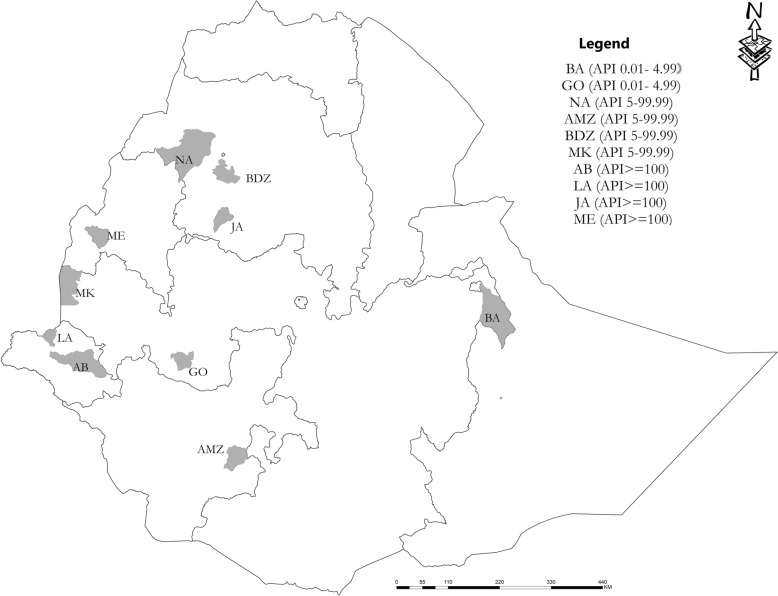
A total of 1093 dried blood spot (DBS) samples were collected from afebrile and apparently healthy individuals across ten study sites in Ethiopia from 2016 to 2020. Of these, 862 were from community and 231 from school based cross-sectional surveys. Malaria infection status was determined by microscopy or rapid diagnostics tests (RDT) and 18S rRNA-based nested PCR (nPCR). The annual parasite index (API) was used to classify endemicity as low (API > 0 and < 5), moderate (API ≥ 5 and < 100) and high transmission (API ≥ 100) and detectability of infections was assessed in these settings.
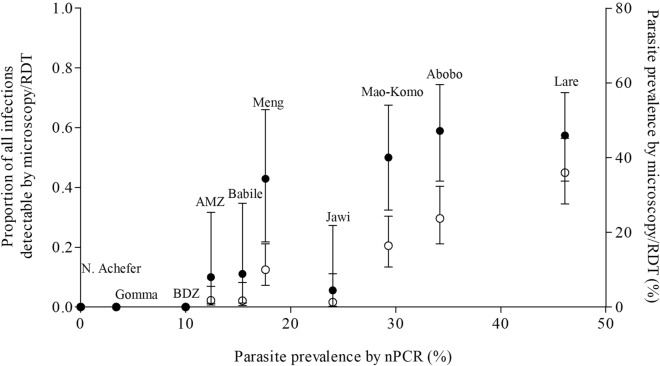
In community surveys, the overall prevalence of asymptomatic Plasmodium infections by microscopy/RDT, nPCR and all methods combined was 12.2% (105/860), 21.6% (183/846) and 24.1% (208/862), respectively. The proportion of nPCR positive infections that was detectable by microscopy/RDT was 48.7% (73/150) for P. falciparum and 4.6% (2/44) for P. vivax. Compared to low transmission settings, the likelihood of detecting infections by microscopy/RDT was increased in moderate (Adjusted odds ratio [AOR]: 3.4; 95% confidence interval [95% CI] 1.6-7.2, P = 0.002) and high endemic settings (AOR = 5.1; 95% CI 2.6-9.9, P < 0.001). After adjustment for site and correlation between observations from the same survey, the likelihood of detecting asymptomatic infections by microscopy/RDT (AOR per year increase = 0.95, 95% CI 0.9-1.0, P = 0.013) declined with age.
Conventional diagnostics missed nearly half of the asymptomatic Plasmodium reservoir detected by nPCR. The detectability of infections was particularly low in older age groups and low transmission settings. These findings highlight the need for sensitive diagnostic tools to detect the entire parasite reservoir and potential infection transmitters.
随着各国向疟疾消除迈进,可能需要检测和针对无症状疟疾感染。本研究在埃塞俄比亚的不同传播环境中,调查了无症状间日疟原虫和恶性疟原虫感染的流行病学和可检测性。
2016 年至 2020 年,共从埃塞俄比亚 10 个研究点的无发热和明显健康个体采集了 1093 份干血斑(DBS)样本。其中,862 份来自社区,231 份来自学校的横断面调查。通过显微镜或快速诊断检测(RDT)和 18S rRNA 巢式 PCR(nPCR)确定疟疾感染状况。用年寄生虫指数(API)来分类流行程度为低(API>0 且<5)、中(API≥5 且<100)和高(API≥100),并评估在这些环境中感染的可检测性。
在社区调查中,通过显微镜/RDT、nPCR 和所有方法联合检测的无症状间日疟原虫感染的总体患病率分别为 12.2%(105/860)、21.6%(183/846)和 24.1%(208/862)。通过显微镜/RDT 检测到的 nPCR 阳性感染比例为 48.7%(73/150)的恶性疟原虫和 4.6%(2/44)的间日疟原虫。与低传播环境相比,中度(调整优势比 [AOR]:3.4;95%置信区间 [95%CI] 1.6-7.2,P=0.002)和高流行环境(AOR:5.1;95%CI 2.6-9.9,P<0.001)下通过显微镜/RDT 检测感染的可能性增加。在调整了地点和同一调查中观察结果之间的相关性后,通过显微镜/RDT 检测无症状感染的可能性(每年增加的 AOR=0.95,95%CI 0.9-1.0,P=0.013)随年龄增长而下降。
常规诊断方法错过了近一半通过 nPCR 检测到的无症状间日疟原虫库。感染的可检测性在年龄较大的人群和低传播环境中特别低。这些发现强调需要敏感的诊断工具来检测整个寄生虫库和潜在的感染传播者。