ABL Bio Inc, Seongnam, Korea (the Republic of).
Department of Internal Medicine, Seoul National University Hospital, Jongno-gu, Korea (the Republic of).
J Immunother Cancer. 2023 Oct;11(10). doi: 10.1136/jitc-2023-007494.
Acute myeloid leukemia (AML) is a type of leukemia in adults with a high mortality rate and poor prognosis. Although targeted therapeutics, chemotherapy, and hematopoietic stem cell transplantation can improve the prognosis, the recurrence rate is still high, with a 5-year survival rate of approximately 40%. This study aimed to develop an IgG-based asymmetric bispecific antibody that targets CLL-1 and CD3 for treating AML.
ABL602 candidates were compared in terms of binding activity, T-cell activation, and tumor-killing activities. ABL602-mediated T-cell activation and tumor-killing activities were determined by measuring the expression of activation markers, cytokines, cytolytic proteins, and the proportion of dead cells. We evaluated in vivo tumor growth inhibitory activity in two mouse models bearing subcutaneously and orthotopically engrafted human AML. Direct tumor-killing activity and T-cell activation in patient-derived AML blasts were also evaluated.
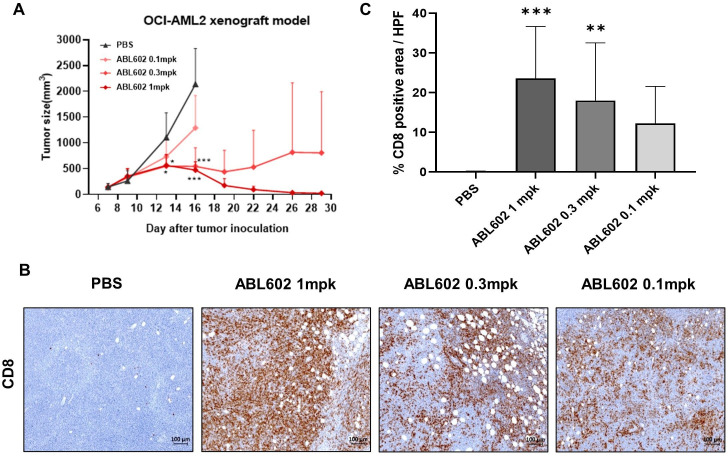
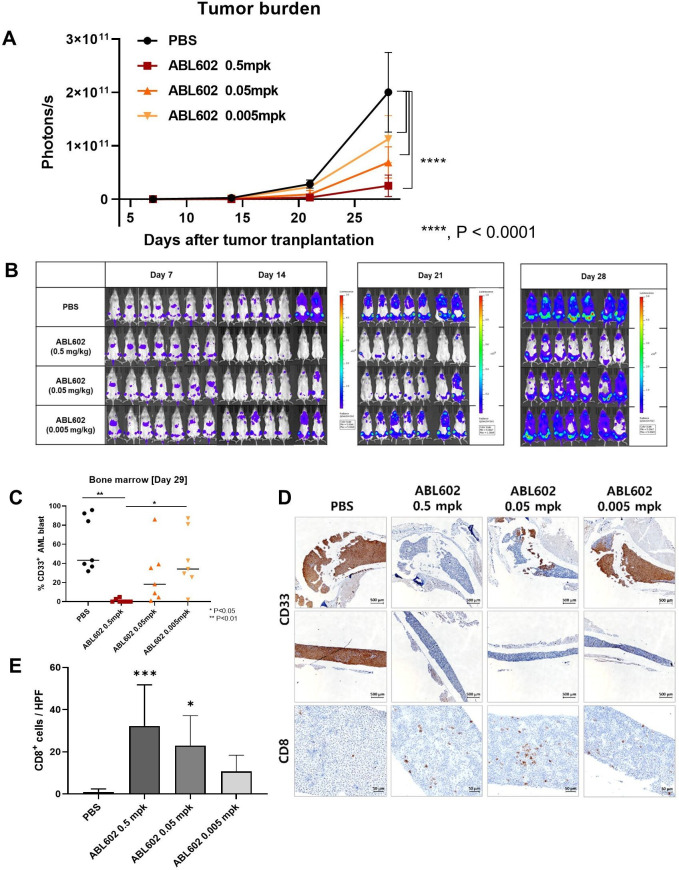
ABL602 2+1 showed a limited CD3 binding in the absence of CLL-1, suggesting that steric hindrance on the CD3 binding arm could reduce CLL-1 expression-independent CD3 binding. Although the CD3 binding activity was attenuated compared with that of 1+1, ABL602 2+1 exhibited much stronger T-cell activation and potent tumor-killing activities in AML cell lines. ABL602 2+1 efficiently inhibited tumor progression in subcutaneously and orthotopically engrafted AML mouse models. In the orthotopic mouse model, tumor growth inhibition was observed by gross measurement of luciferase activity, as well as a reduced proportion of AML blasts in the bone marrow, as determined by flow cytometry and immunohistochemistry (IHC) staining. ABL602 2+1 efficiently activated T cells and induced the lysis of AML blasts, even at very low effector:target (E:T) ratios (eg, 1:50). Compared with the reference 1+1 antibody, ABL602 did not induce the release of cytokines including interleukin-6 and tumor necrosis factor-α in the healthy donor-derived peripheral blood mononuclear cell.
With its potent tumor-killing activity and reduced cytokine release, ABL602 2+1 is a promising candidate for treating patients with AML and warrants further study.
急性髓细胞白血病(AML)是一种成人白血病,死亡率和预后均较差。尽管靶向治疗、化疗和造血干细胞移植可以改善预后,但复发率仍然很高,5 年生存率约为 40%。本研究旨在开发一种针对 CLL-1 和 CD3 的 IgG 型不对称双特异性抗体来治疗 AML。
比较了 ABL602 候选物在结合活性、T 细胞激活和肿瘤杀伤活性方面的差异。通过测量激活标志物、细胞因子、细胞毒性蛋白和死亡细胞比例来确定 ABL602 介导的 T 细胞激活和肿瘤杀伤活性。我们在皮下和原位植入人 AML 的两种小鼠模型中评估了体内肿瘤生长抑制活性。还评估了直接杀伤肿瘤活性和 T 细胞激活在患者来源的 AML blasts 中的作用。
ABL602 2+1 在没有 CLL-1 的情况下表现出有限的 CD3 结合,表明 CD3 结合臂的空间位阻可能会降低 CLL-1 表达非依赖性的 CD3 结合。尽管与 1+1 相比,CD3 结合活性减弱,但 ABL602 2+1 在 AML 细胞系中表现出更强的 T 细胞激活和强大的肿瘤杀伤活性。ABL602 2+1 能有效抑制皮下和原位植入 AML 小鼠模型中的肿瘤进展。在原位小鼠模型中,通过对荧光素酶活性的大体测量以及通过流式细胞术和免疫组化(IHC)染色确定骨髓中 AML blasts 比例降低,观察到肿瘤生长抑制。ABL602 2+1 能有效激活 T 细胞并诱导 AML blasts 溶解,即使在非常低的效应物:靶标(E:T)比(例如,1:50)下也是如此。与参考 1+1 抗体相比,ABL602 不会在健康供体来源的外周血单核细胞中诱导包括白细胞介素-6 和肿瘤坏死因子-α在内的细胞因子释放。
ABL602 2+1 具有强大的肿瘤杀伤活性和减少细胞因子释放,是治疗 AML 患者的有前途的候选药物,值得进一步研究。