Department of Epidemiology and Health Statistics, School of Public Health, Xinxiang Medical University, Xinxiang, 453000, Henan Province, People's Republic of China.
BMC Infect Dis. 2023 Oct 17;23(1):691. doi: 10.1186/s12879-023-08635-9.
Hepatitis C presents a profound global health challenge. The impact of COVID-19 on hepatitis C, however, remain uncertain. This study aimed to ascertain the influence of COVID-19 on the hepatitis C epidemic trend in Henan Province.
We collated the number of monthly diagnosed cases in Henan Province from January 2013 to September 2022. Upon detailing the overarching epidemiological characteristics, the interrupted time series (ITS) analysis using autoregressive integrated moving average (ARIMA) models was employed to estimate the hepatitis C diagnosis rate pre and post the COVID-19 emergence. In addition, we also discussed the model selection process, test model fitting, and result interpretation.
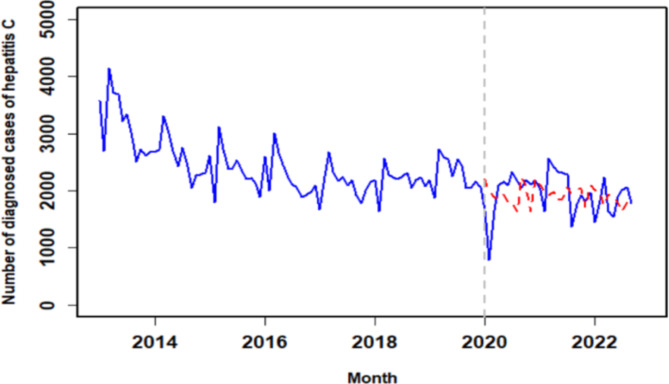
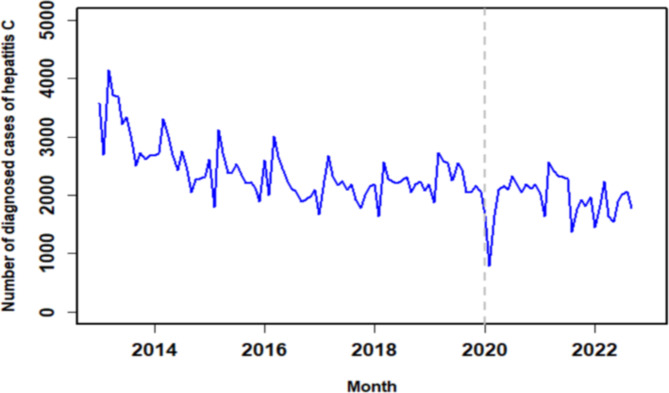
Between January 2013 and September 2022, a total of 267,968 hepatitis C cases were diagnosed. The yearly average diagnosis rate stood at 2.42/100,000 persons. While 2013 witnessed the peak diagnosis rate at 2.97/100,000 persons, 2020 reported the least at 1.7/100,000 persons. The monthly mean hepatitis C diagnosed numbers culminated in 2291 cases. The optimal ARIMA model chosen was ARIMA (0,1,1) (0,1,1) with AIC = 1459.58, AICc = 1460.19, and BIC = 1472.8; having coefficients MA1=-0.62 (t=-8.06, P < 0.001) and SMA1=-0.79 (t=-6.76, P < 0.001). The final model's projected step change was - 800.0 (95% confidence interval [CI] -1179.9 ~ -420.1, P < 0.05) and pulse change was 463.40 (95% CI 191.7 ~ 735.1, P < 0.05) per month.
The measures undertaken to curtail COVID-19 led to a diminishing trend in the diagnosis rate of hepatitis C. The ARIMA model is a useful tool for evaluating the impact of large-scale interventions, because it can explain potential trends, autocorrelation, and seasonality, and allow for flexible modeling of different types of impacts.
丙型肝炎对全球健康构成了严重挑战。然而,COVID-19 对丙型肝炎的影响仍不确定。本研究旨在确定 COVID-19 对河南省丙型肝炎流行趋势的影响。
我们整理了 2013 年 1 月至 2022 年 9 月河南省每月诊断病例数。在详细描述总体流行病学特征后,采用自回归积分移动平均(ARIMA)模型的中断时间序列(ITS)分析来估计 COVID-19 出现前后丙型肝炎的诊断率。此外,我们还讨论了模型选择过程、检验模型拟合和结果解释。
2013 年 1 月至 2022 年 9 月,共诊断出 267968 例丙型肝炎病例。年平均诊断率为 2.42/100000 人。虽然 2013 年的峰值诊断率为 2.97/100000 人,但 2020 年的最低诊断率为 1.7/100000 人。每月平均丙型肝炎诊断数最高达到 2291 例。选择的最佳 ARIMA 模型为 ARIMA(0,1,1)(0,1,1),AIC=1459.58,AICc=1460.19,BIC=1472.8;系数 MA1=-0.62(t=-8.06,P<0.001)和 SMA1=-0.79(t=-6.76,P<0.001)。最终模型的预测阶跃变化为-800.0(95%置信区间[CI] -1179.9-420.1,P<0.05),脉冲变化为 463.40(95%CI 191.7735.1,P<0.05)/月。
为遏制 COVID-19 而采取的措施导致丙型肝炎诊断率呈下降趋势。ARIMA 模型是评估大规模干预措施影响的有用工具,因为它可以解释潜在趋势、自相关和季节性,并允许对不同类型的影响进行灵活建模。