Kondili Loreta A, Buti Maria, Riveiro-Barciela Mar, Maticic Mojca, Negro Francesco, Berg Thomas, Craxì Antonio
Center for Global Health, Istituto Superiore di Sanità, Rome, Italy.
Liver Unit, Hospital Universitario Vall d'Hebrón, Vall d'Hebron Barcelona Hospital Campus, Barcelona, Spain.
JHEP Rep. 2022 Sep;4(9):100531. doi: 10.1016/j.jhepr.2022.100531. Epub 2022 Jul 27.
BACKGROUND & AIMS: The World Health Organization (WHO) HBV and HCV elimination targets, set in 2016 and based on projections to 2030, were unable to consider the impact of intervening factors. To evaluate the impact of the COVID-19 pandemic on viral hepatitis elimination programs, the European Association for the Study of the Liver (EASL) conducted a survey in liver centers worldwide in 2021.
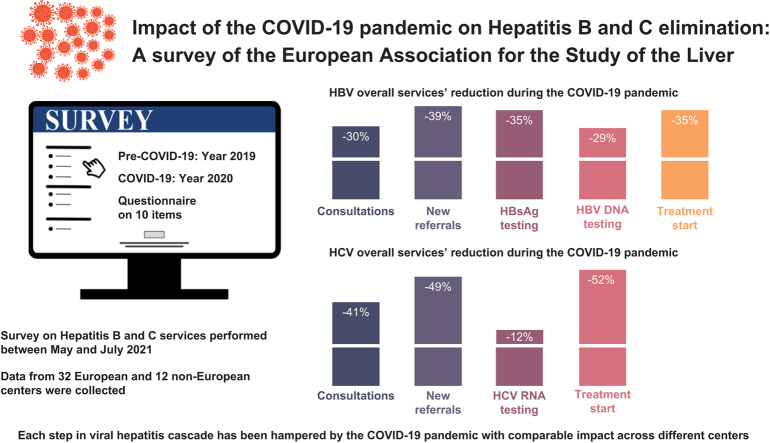
A web-based questionnaire was distributed (May-July 2021) to all EASL members representing clinical units providing HBV and HCV hepatitis care. Results are expressed as absolute numbers and reduction rates for each care activity.
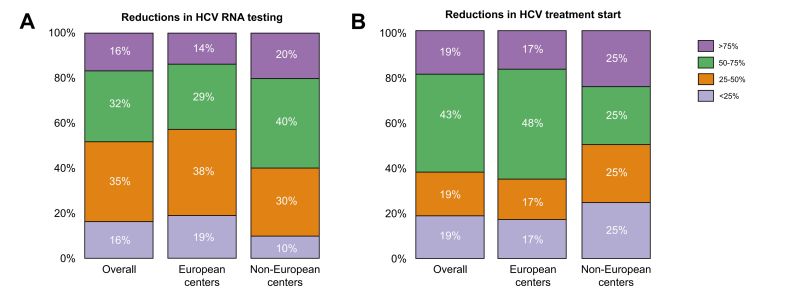
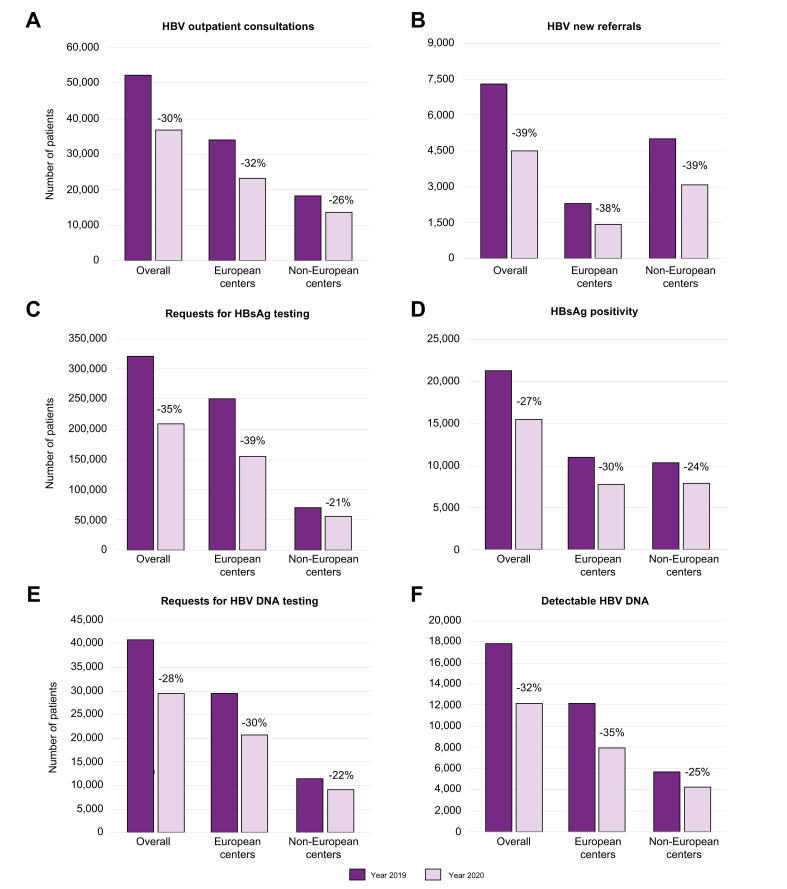
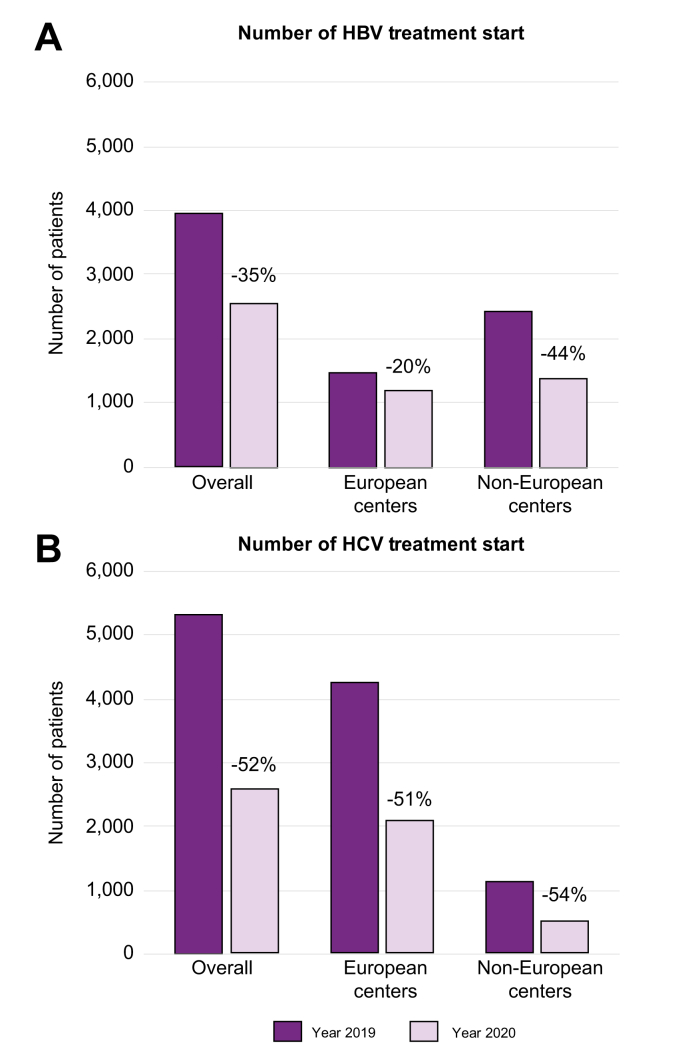
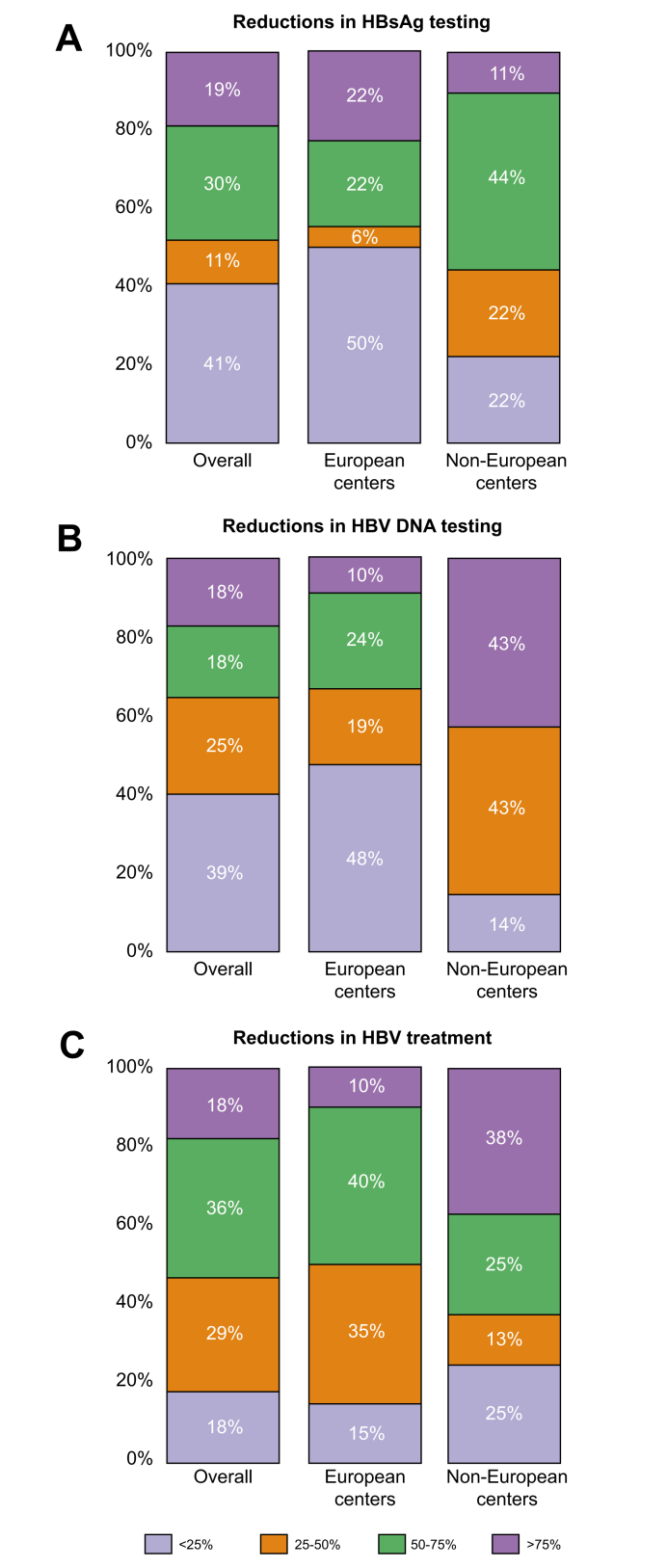
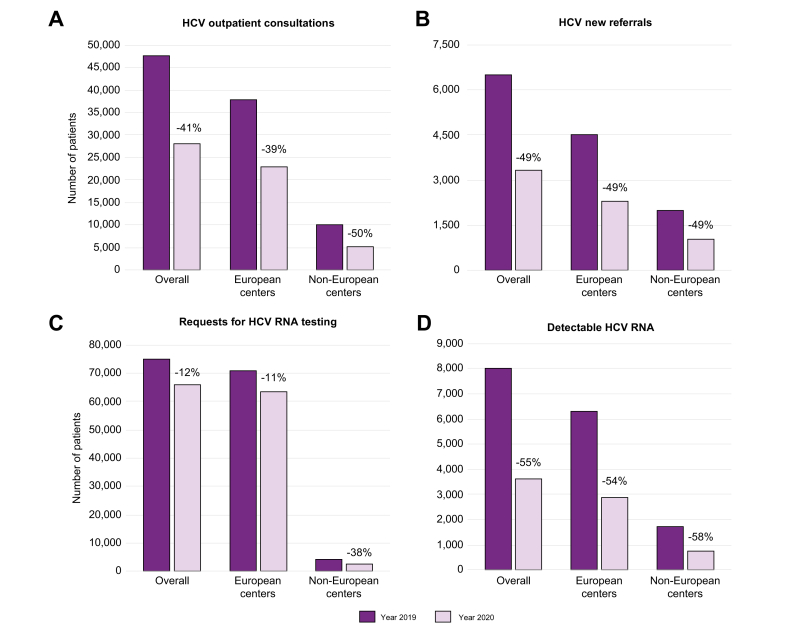
Data were collected from 32 European and 12 non-European clinical centers. Between January 2019 (pre-pandemic) and December 2020 (during the pandemic), chronic HBV consultations decreased by 32% and 26%, new referrals by 38% and 39%, HBV testing rates by 39% and 21% (for HBsAg detection) and 30% and 22% (for HBV DNA detection), and new HBV treatments by 20% and 44% ( = 0.328) in European and non-European centers, respectively. With regard to HCV during the same time frame, the overall reductions were 39% and 50% for consultations, 49% and 49% for new referrals, 11% and 38% for HCV RNA detection, and 51% and 54% for new HCV antiviral treatments for European and non-European Centers, respectively ( = 0.071).
All steps in the viral hepatitis care cascade have been hampered by the COVID-19 pandemic, with a comparable impact across different centers. These data reaffirm the pandemic's major effect on global viral hepatitis elimination programs and suggest that actions to achieve the WHO 2030 targets should be reconsidered and revised to account for each country's progress relative to pre-pandemic values.
The EASL multinational survey conclusively shows that viral hepatitis elimination programs, expected to provide control of hepatitis B and hepatitis C worldwide by 2030, have been held back by the COVID-19 pandemic in clinical centers from several European and non-European countries, with a comparable impact across centers. Limitations in the cascade of care for both HBV and HCV were linked to limited access to screening, consultations, specific testing, and actual treatment. As restrictions for COVID-19 begin to lift, efforts to diagnose and provide treatment for viral hepatitis should remain high on the list of priorities for public health officials to maintain the WHO elimination efforts. Measures that have been put in place to control the COVID-19 pandemic could be transferred to increasing the diagnosis and linkage to care of people with hepatitis.
世界卫生组织(WHO)于2016年设定的、基于对2030年预测的乙肝和丙肝消除目标,未能考虑干预因素的影响。为评估新冠疫情对病毒性肝炎消除计划的影响,欧洲肝脏研究协会(EASL)于2021年在全球肝脏中心开展了一项调查。
(2021年5月至7月)向所有代表提供乙肝和丙肝肝炎护理临床单位的EASL成员发放了一份基于网络的调查问卷。结果以每项护理活动的绝对数和减少率表示。
从32个欧洲临床中心和12个非欧洲临床中心收集了数据。在2019年1月(疫情前)至2020年12月(疫情期间),欧洲中心慢性乙肝咨询量分别下降了32%和26%,新转诊量分别下降了38%和39%,乙肝检测率(乙肝表面抗原检测)分别下降了39%和21%,(乙肝病毒DNA检测)分别下降了30%和22%,新的乙肝治疗量分别下降了20%和44%(P = 0.328)。在同一时间段内,对于丙肝,欧洲和非欧洲中心的咨询量总体降幅分别为39%和50%,新转诊量降幅分别为49%和49%,丙肝RNA检测降幅分别为11%和38%,新的丙肝抗病毒治疗量降幅分别为51%和54%(P = 0.071)。
新冠疫情阻碍了病毒性肝炎护理流程的所有环节,不同中心受到的影响相当。这些数据再次证明了疫情对全球病毒性肝炎消除计划的重大影响,并表明应重新考虑和修订为实现WHO 2030年目标而采取的行动,以考虑每个国家相对于疫情前水平的进展情况。
EASL的多国调查最终表明,预计到2030年在全球控制乙肝和丙肝的病毒性肝炎消除计划,在几个欧洲和非欧洲国家的临床中心受到了新冠疫情的阻碍,各中心受到的影响相当。乙肝和丙肝护理流程中的限制与筛查、咨询、特定检测及实际治疗的可及性受限有关。随着新冠疫情限制措施开始解除,诊断和治疗病毒性肝炎的工作应继续作为公共卫生官员的优先事项,以维持WHO的消除工作。为控制新冠疫情而采取的措施可转而用于增加肝炎患者的诊断和护理联系。