Burgard Caroline, Zacherl Mathias Johannes, Todica Andrei, Hornung Julia, Grawe Freba, Pekrul Isabell, Zimmermann Petra, Schmid-Tannwald Christine, Ladurner Roland, Krenz Detlef, Trupka Arnold, Wagner Johanna, Bartenstein Peter, Spitzweg Christine, Wenter Vera
Department of Nuclear Medicine, LMU University Hospital, LMU Munich, Munich, Germany.
Department of Nuclear Medicine, Saarland University, UdS, Homburg, Germany.
Front Oncol. 2023 Oct 2;13:1237472. doi: 10.3389/fonc.2023.1237472. eCollection 2023.
Differentiated thyroid carcinoma (DTC) in childhood and during adolescence is extremely rare. Pediatric DTC commonly presents with advanced disease at diagnosis including a high prevalence of cervical lymph node metastases and pulmonary metastases. Studies in children with DTC are limited. Therefore, we aimed to evaluate the initial presentation, effectiveness of radioiodine therapy (RIT), and long-term outcome of prepubertal in comparison to pubertal/postpubertal patients.
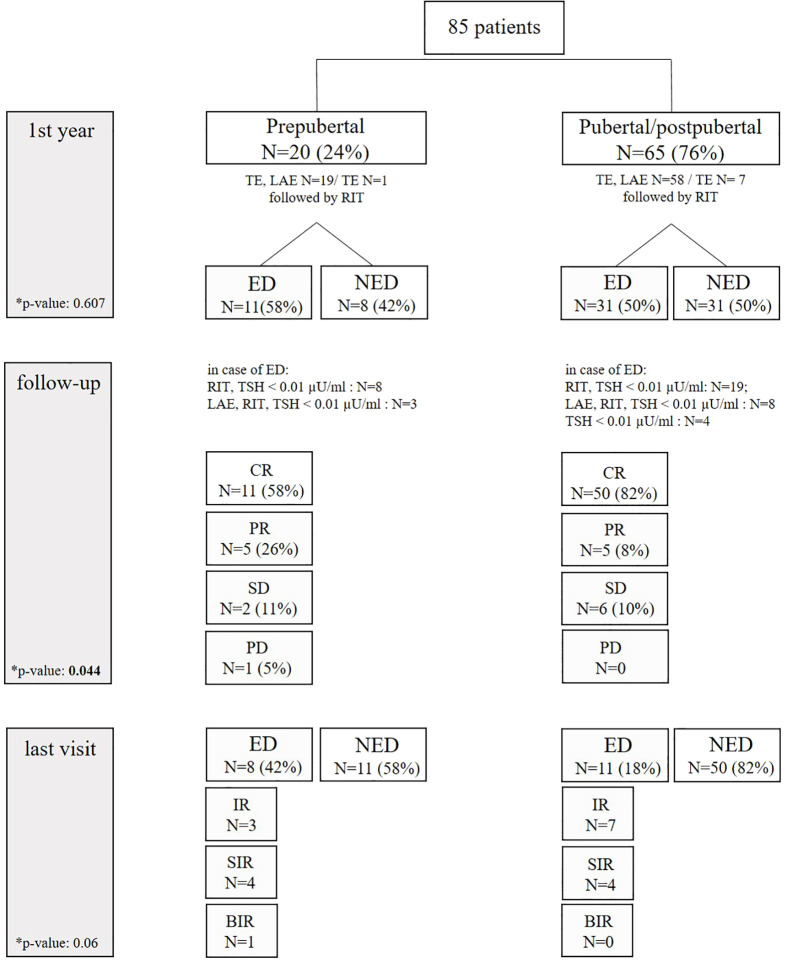
Eighty-five pediatric and young patients aged 6.4 to 21.9 years with histopathologically confirmed DTC were retrospectively included. They all underwent total thyroidectomy followed by RIT. Initial presentation and outcome of prepubertal and pubertal/postpubertal patients were compared 1 year after RIT, during follow-up, and at the last visit of follow-up.
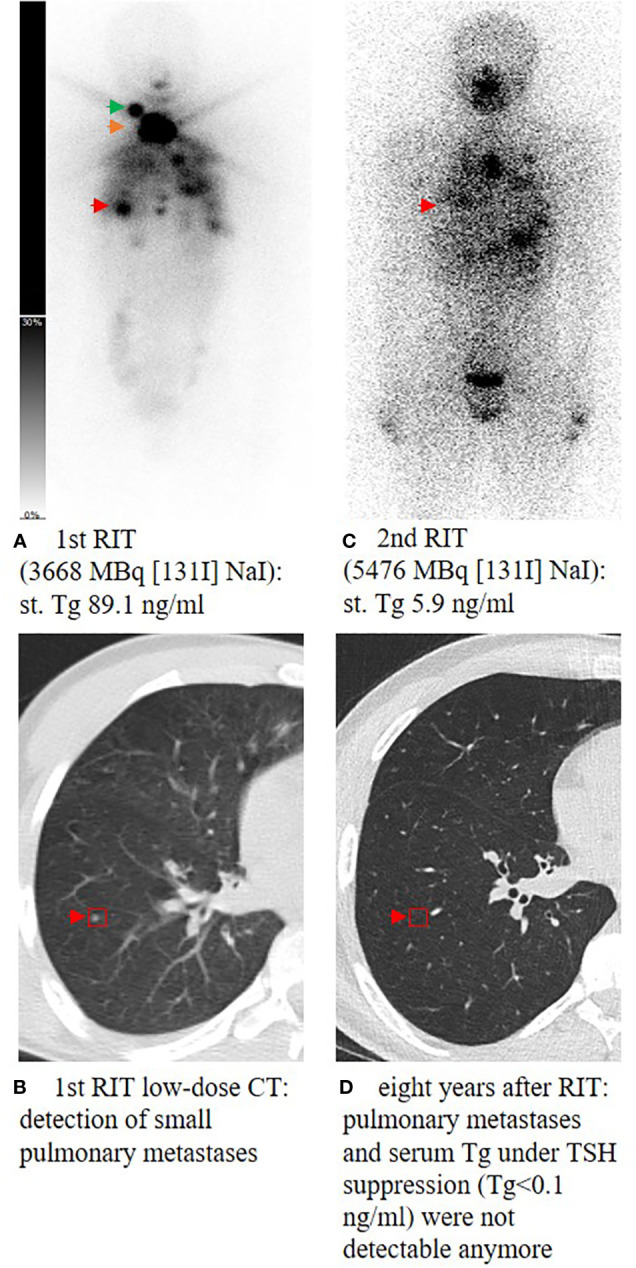
Prepubertal patients presented with significantly higher T and M stages. One year after RIT, 42/81 (52%) patients still presented with evidence of disease (ED). During follow-up of a median of 7.9 years, prepubertal patients were less often in complete remission (58% vs. 82% in pubertal patients). At the last visit of follow-up, 19/80 (24%) patients still had ED without statistical differences between the two groups (42% prepubertal vs. 18% pubertal/postpubertal, -value 0.06). None of our patients died disease-related over the observed period.
Prepubertal children with DTC presented with a more advanced tumor stage at the initial presentation. During follow-up, they present more often with ED. However, at the end of our study, we did not observe statistically relevant differences in patient outcomes between the prepubertal and pubertal/postpubertal groups.
儿童期和青春期的分化型甲状腺癌(DTC)极为罕见。儿童DTC在诊断时通常表现为疾病进展,包括颈部淋巴结转移和肺转移的高发生率。关于儿童DTC的研究有限。因此,我们旨在评估青春期前与青春期/青春期后患者相比的初始表现、放射性碘治疗(RIT)的有效性以及长期预后。
回顾性纳入85例年龄在6.4至21.9岁、组织病理学确诊为DTC的儿科和年轻患者。他们均接受了全甲状腺切除术,随后进行RIT。在RIT后1年、随访期间以及随访的最后一次就诊时,比较青春期前和青春期/青春期后患者的初始表现和预后。
青春期前患者的T和M分期明显更高。RIT后1年,42/81(52%)的患者仍有疾病证据(ED)。在中位随访7.9年期间,青春期前患者完全缓解的情况较少(58%,而青春期患者为82%)。在随访的最后一次就诊时,19/80(24%)的患者仍有ED,两组之间无统计学差异(青春期前为42%,青春期/青春期后为18%,P值0.06)。在观察期内,我们的患者均未死于与疾病相关的原因。
青春期前患有DTC的儿童在初始表现时肿瘤分期更晚。在随访期间,他们更常出现ED。然而,在我们研究结束时,我们未观察到青春期前和青春期/青春期后组之间患者预后的统计学显著差异。