Yuan Guoliang, Hassan Md Mahmudul, Liu Degao, Lim Sung Don, Yim Won Cheol, Cushman John C, Markel Kasey, Shih Patrick M, Lu Haiwei, Weston David J, Chen Jin-Gui, Tschaplinski Timothy J, Tuskan Gerald A, Yang Xiaohan
Biosciences Division, Oak Ridge National Laboratory, Oak Ridge, TN 37831, USA.
The Center for Bioenergy Innovation, Oak Ridge National Laboratory, Oak Ridge, TN 37831, USA.
Biodes Res. 2020 Oct 10;2020:3686791. doi: 10.34133/2020/3686791. eCollection 2020.
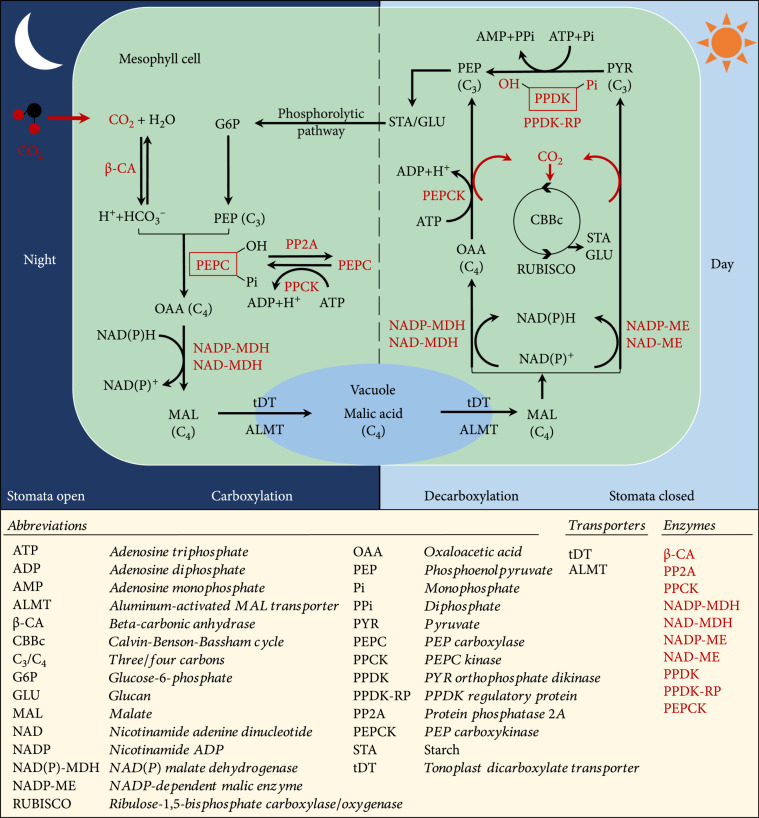
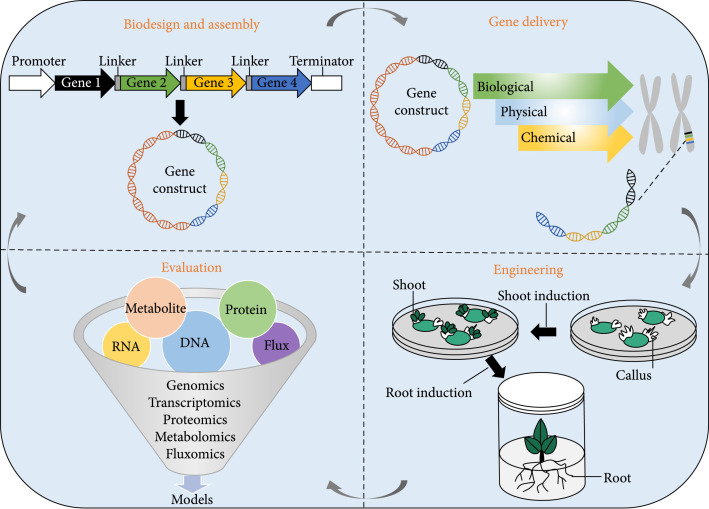
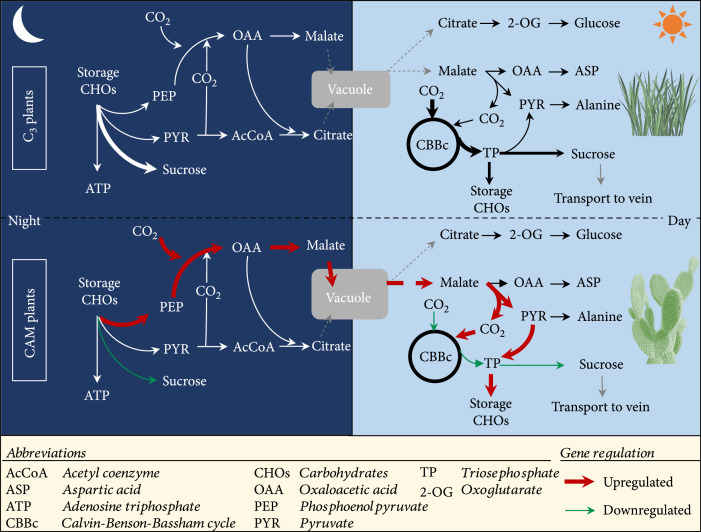
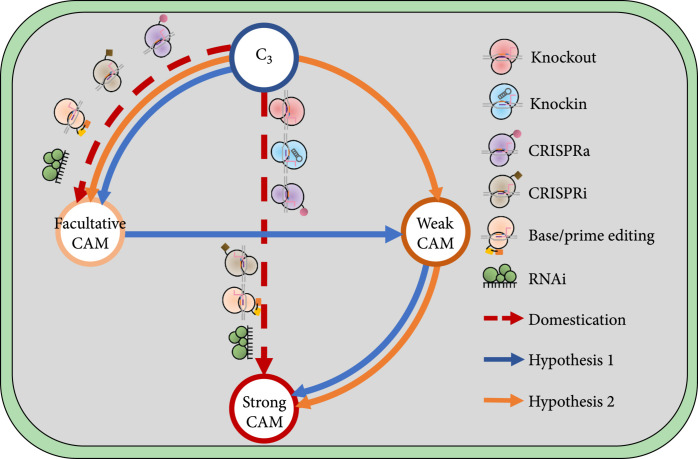
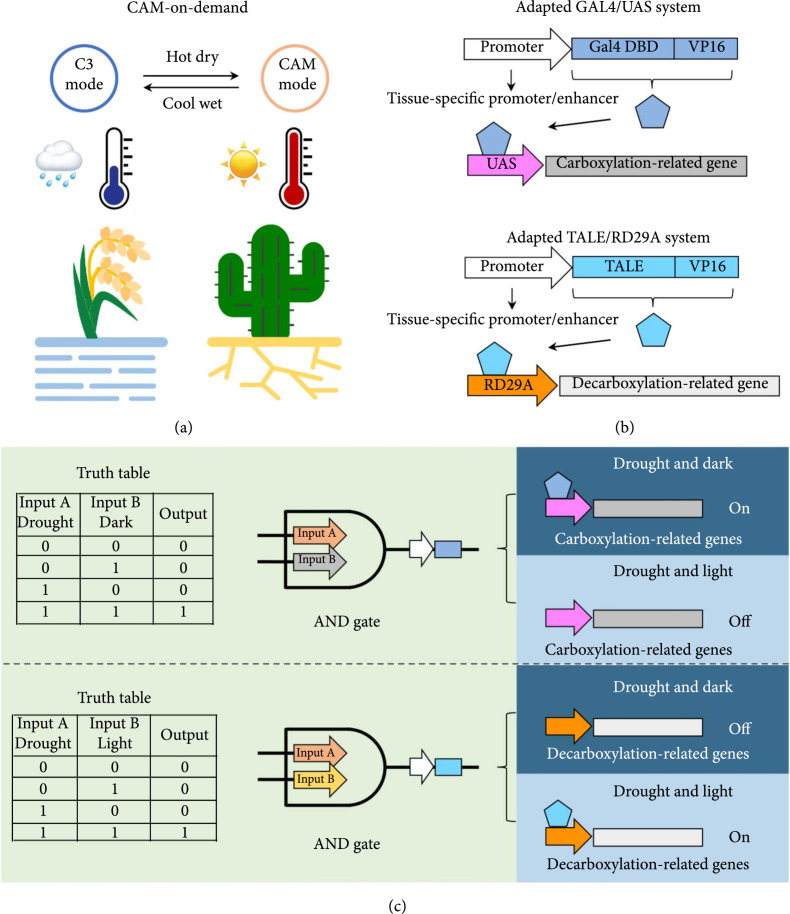
Global demand for food and bioenergy production has increased rapidly, while the area of arable land has been declining for decades due to damage caused by erosion, pollution, sea level rise, urban development, soil salinization, and water scarcity driven by global climate change. In order to overcome this conflict, there is an urgent need to adapt conventional agriculture to water-limited and hotter conditions with plant crop systems that display higher water-use efficiency (WUE). Crassulacean acid metabolism (CAM) species have substantially higher WUE than species performing C or C photosynthesis. CAM plants are derived from C photosynthesis ancestors. However, it is extremely unlikely that the C or C crop plants would evolve rapidly into CAM photosynthesis without human intervention. Currently, there is growing interest in improving WUE through transferring CAM into C crops. However, engineering a major metabolic plant pathway, like CAM, is challenging and requires a comprehensive deep understanding of the enzymatic reactions and regulatory networks in both C and CAM photosynthesis, as well as overcoming physiometabolic limitations such as diurnal stomatal regulation. Recent advances in CAM evolutionary genomics research, genome editing, and synthetic biology have increased the likelihood of successful acceleration of C-to-CAM progression. Here, we first summarize the systems biology-level understanding of the molecular processes in the CAM pathway. Then, we review the principles of CAM engineering in an evolutionary context. Lastly, we discuss the technical approaches to accelerate the C-to-CAM transition in plants using synthetic biology toolboxes.
全球对粮食和生物能源生产的需求迅速增长,而由于侵蚀、污染、海平面上升、城市发展、土壤盐渍化以及全球气候变化导致的水资源短缺所造成的破坏,耕地面积在数十年来一直在减少。为了克服这一矛盾,迫切需要使传统农业适应水资源有限和温度更高的条件,采用具有更高水分利用效率(WUE)的植物作物系统。景天酸代谢(CAM)物种的水分利用效率比进行C3或C4光合作用的物种高得多。CAM植物起源于C3光合作用的祖先。然而,在没有人为干预的情况下,C3或C4作物植物极不可能迅速进化为CAM光合作用。目前,通过将CAM转移到C3作物中来提高水分利用效率的兴趣日益浓厚。然而,改造像CAM这样的主要植物代谢途径具有挑战性,需要全面深入了解C3和CAM光合作用中的酶促反应和调控网络,以及克服诸如昼夜气孔调节等生理代谢限制。CAM进化基因组学研究、基因组编辑和合成生物学的最新进展增加了成功加速C3向CAM转变的可能性。在这里,我们首先总结对CAM途径中分子过程的系统生物学层面的理解。然后,我们在进化背景下回顾CAM工程的原理。最后,我们讨论使用合成生物学工具箱加速植物从C3向CAM转变的技术方法。