Magnuson Matthew, Stilman Terry, Serre Shannon, Archer John, James Ryan, Xia Xiaoyan, Lawrence Mitchell, Tamargo Erin, Raveh-Amit Hadas, Sharon Avi
EPA Office of Research and Development, Homeland Security Materials and Management Division, 26 W Martin Luther King Dr., Cincinnati, OH 45268, USA.
EPA Region 4, 61 Forsyth St., SW, Atlanta, GA 30303, USA.
Appl Sci (Basel). 2022 Apr 11;12(8):1-23. doi: 10.3390/app12083861.
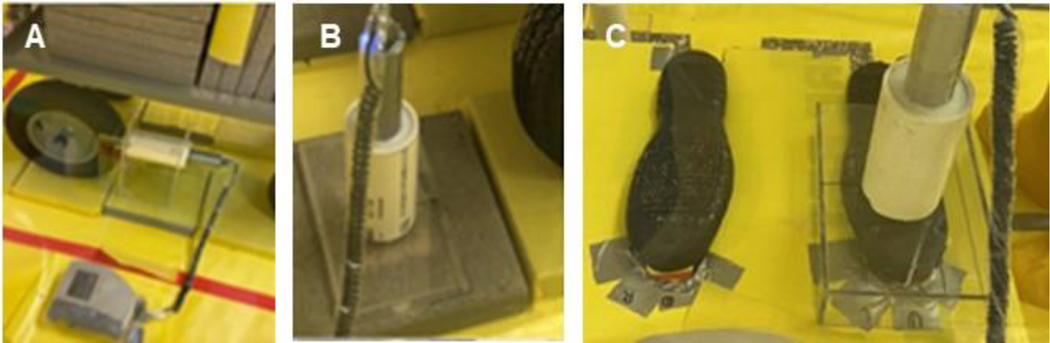
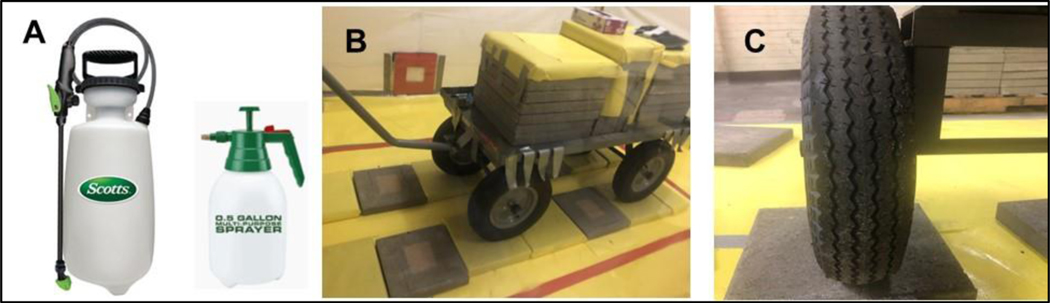
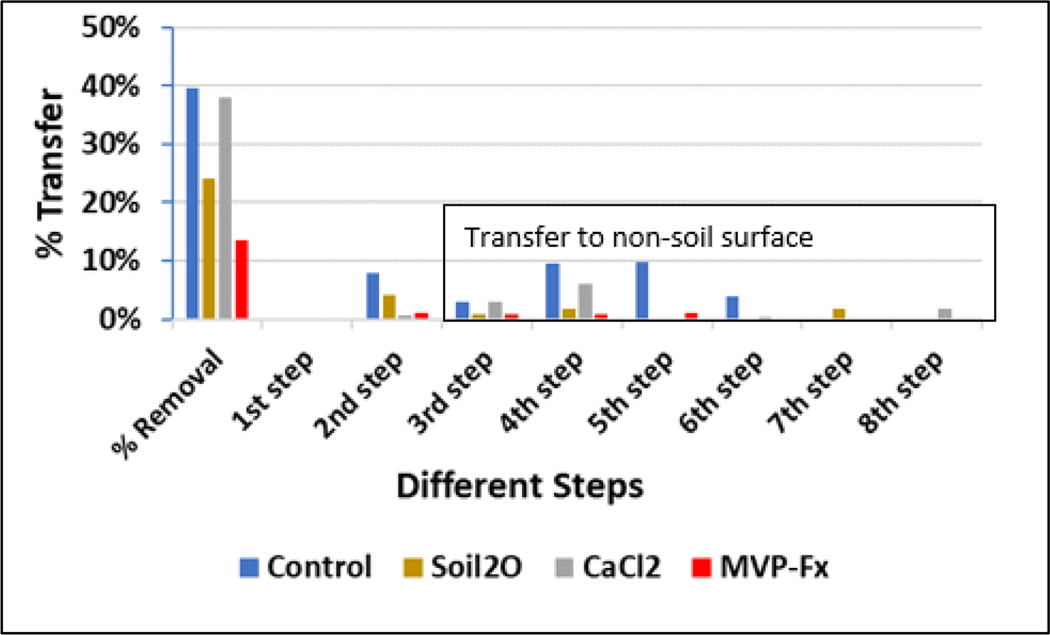
The application of stabilization technologies to a radiologically contaminated surface has the potential for reducing the spread of contamination and, as a result, decreasing worker exposure to radiation. Three stabilization technologies, calcium chloride (CaCl), flame retardant Phos-Chek MVP-Fx, and SoilO™ were investigated to evaluate their ability to reduce the resuspension and tracking of radiological contamination during response activities such as vehicle and foot traffic. Concrete pavers, asphalt pavers, and sandy soil walking paths were used as test surfaces, along with simulated fallout material (SFM) tagged with radiostrontium (Sr-85) applied as the contaminant. Radiological activities were measured using gamma spectrometry before and after simulated vehicle operation and foot traffic experiments, conducted with each stabilization technology and without application as a nonstabilized control. These measurements were acquired separately for each combination of surface and vehicle/foot traffic experiment. The resulting data describes the extent of SFM removed from each surface onto the tires or boots, the extent of SFM transferred to adjacent surfaces, and the residual SFM remaining on the tires or boots after each experiment. The type of surface and response worker actions influenced the stabilization results. For instance, when walked over, less than 2% of particles were removed from nonstabilized concrete, 4% from asphalt, and 40% of the particles were removed from the sand surface. By contrast, for vehicle experiments, ~40% of particles were again removed from the sand, but 7% and 15% from concrete and asphalt, respectively. In most cases, the stabilization technologies did provide improved stabilization. The improvement was related to the type of surface, worker actions, and stabilizer; a statistical analysis of these variables is presented. Overall, the results suggest an ability to utilize these technologies during the planning and implementation of response activities involving foot and vehicle traffic. In addition, resuspension of aerosolizable range SFM was monitored during walking path foot traffic experiments, and all stabilizing agents decreased the measured radioactivity, with the SoilO™ decrease being 3 fold, whereas the CaCl and Phos-Chek MVP-Fx surfaces generated no detectable radioactivity. Overall, these results suggest that the stabilization technologies decrease the availability of particles respirable by response workers under these conditions.
将稳定化技术应用于受放射性污染的表面,有可能减少污染物的扩散,从而减少工作人员受到的辐射暴露。研究了三种稳定化技术,即氯化钙(CaCl)、阻燃剂Phos-Chek MVP-Fx和SoilO™,以评估它们在车辆和行人交通等应对活动中减少放射性污染物再悬浮和转移的能力。使用混凝土摊铺机、沥青摊铺机和沙土步行道作为测试表面,并使用标记有放射性锶(Sr-85)的模拟沉降物材料(SFM)作为污染物。在使用每种稳定化技术以及不使用稳定化技术作为非稳定化对照进行模拟车辆行驶和行人交通实验之前和之后,使用伽马能谱法测量放射性活度。这些测量是针对每种表面与车辆/行人交通实验的组合分别进行的。所得数据描述了从每个表面转移到轮胎或靴子上的SFM的程度、转移到相邻表面的SFM的程度以及每次实验后残留在轮胎或靴子上的SFM。表面类型和应对工作人员的行动会影响稳定化结果。例如,在行人走过时,未稳定化的混凝土表面去除的颗粒不到2%,沥青表面为4%,沙土表面为40%。相比之下,在车辆实验中,沙土表面再次去除了约40%的颗粒,但混凝土和沥青表面分别为7%和15%。在大多数情况下,稳定化技术确实提供了更好的稳定效果。这种改善与表面类型、工作人员行动和稳定剂有关;对这些变量进行了统计分析。总体而言,结果表明在涉及行人与车辆交通的应对活动的规划和实施过程中能够利用这些技术。此外,在步行道行人交通实验期间监测了可气溶胶化范围的SFM的再悬浮情况,所有稳定剂都降低了测量到的放射性,其中SoilO™降低了3倍,而氯化钙和Phos-Chek MVP-Fx表面未检测到放射性。总体而言,这些结果表明在这些条件下,稳定化技术降低了应对工作人员可吸入颗粒的可用性。