Hepler Katherine, Kaminski Michael D, Escamilla Noemy, Magnuson Matthew
Strategic Security Sciences Division, Argonne National Laboratory, 9700 S. Cass Ave., Lemont, IL, 60439, USA.
Department of Chemical and Biomolecular Engineering, University of Illinois, 1406 W. Green St., Urbana, IL, 61801, USA.
Heliyon. 2024 Jul 14;10(14):e34447. doi: 10.1016/j.heliyon.2024.e34447. eCollection 2024 Jul 30.
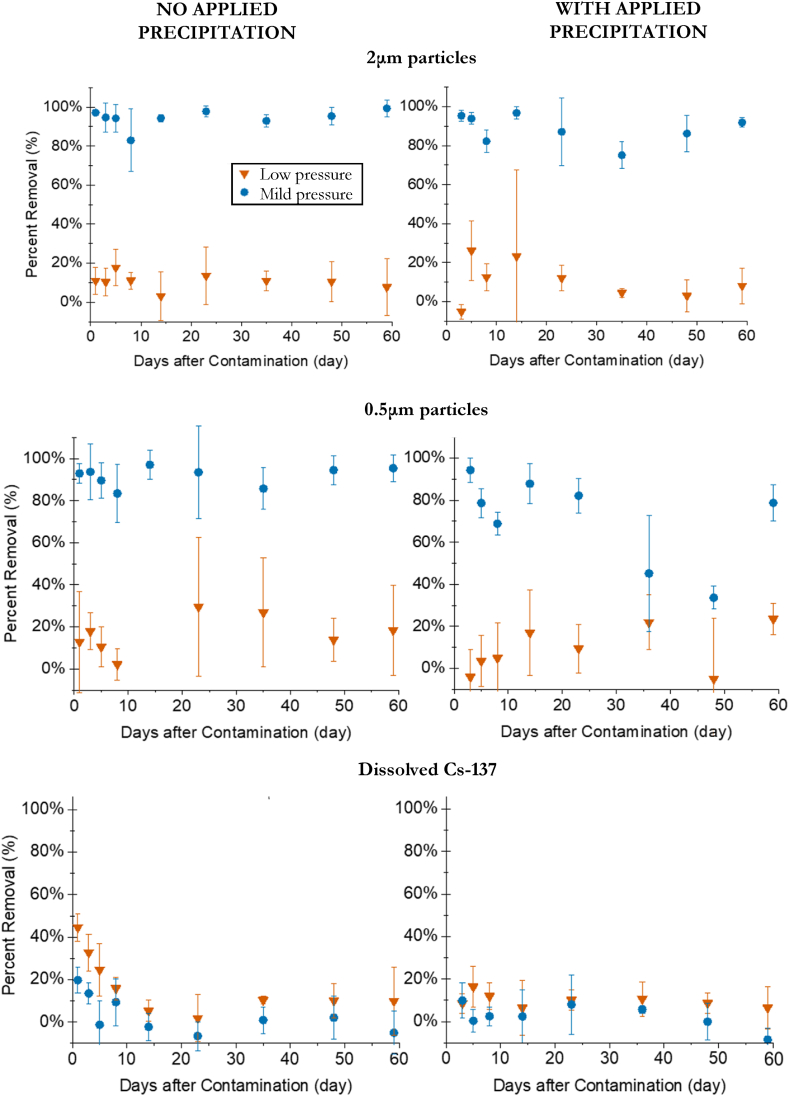
Timely decontamination will reduce the consequences of a radiological contamination event. For this purpose, pressure washing can be rapidly deployed, but its effectiveness will change if the interactions between the surface and radionuclides changes as the contamination "ages" under the influence of time and precipitation. While effects of this aging have been reported for dissolved cesium, they have not been studied for radionuclides present as particulate, e.g., fallout. This work studied the effects of aging on decontamination with low (<280 kPa/40 psi) and mild (14,000 kPa/2000 psi) pressure washing, on concrete contaminated with surrogate fallout consisting of soluble Cs-137, 0.5 μm silica particles, and 2 μm silica particles. The samples were aged up to 59 days (time between contamination and decontamination) with and without simulated precipitation. The percent removal following decontamination of the soluble cesium decreased over the first ten days of aging until the removals were less than 10 % for both low and mild pressure washing. The particle decontamination was independent of aging time but decontaminating via mild pressure washing (>80 % particle removal) significantly outperformed decontaminating by low pressure washing by flowing solution across (parallel to) the contaminated surface (<25 % particle removal). The observed changes in decontamination efficacy are explained via measurements of the penetration depth of contaminants. For soluble cesium, the results compared favorably with prior studies and theoretical treatment of cesium penetration, and they yielded additional insight into the effect of washing pressures on decontamination. There are no comparable studies for particulate contamination, so this study resulted in several novel observations which are operationally important for timely decontamination of surfaces following a radiological incident. It also suggests an evidence-based pressure washing procedure for timely decontamination of soluble and insoluble radionuclides which can be used throughout the emergency phase and into the early recovery phase.
及时去污将减少放射性污染事件的后果。为此,可以迅速部署压力清洗,但如果在时间和降水的影响下,随着污染“老化”,表面与放射性核素之间的相互作用发生变化,其效果将会改变。虽然已经报道了这种老化对溶解态铯的影响,但对于以颗粒物形式存在的放射性核素,如沉降物,尚未进行研究。这项工作研究了老化对用低(<280 kPa/40 psi)和中(14,000 kPa/2000 psi)压力清洗去污的影响,清洗对象是被由可溶性Cs-137、0.5微米二氧化硅颗粒和2微米二氧化硅颗粒组成的模拟沉降物污染的混凝土。样品在有和没有模拟降水的情况下老化长达59天(污染与去污之间的时间)。在老化的前十天里,可溶性铯去污后的去除百分比下降,直到低压力和中压力清洗的去除率均低于10%。颗粒去污与老化时间无关,但通过中压力清洗去污(颗粒去除率>80%)明显优于通过让溶液流经(平行于)受污染表面的低压力清洗(颗粒去除率<25%)。通过测量污染物的渗透深度来解释观察到的去污效果变化。对于可溶性铯,结果与先前关于铯渗透的研究和理论处理结果相比很有利,并且它们对清洗压力对去污的影响有了更多的见解。对于颗粒污染没有可比的研究,因此这项研究得出了几个新的观察结果,这些结果对于放射性事件后及时对表面进行去污在操作上具有重要意义。它还提出了一种基于证据的压力清洗程序,用于及时去除可溶性和不可溶性放射性核素,该程序可在整个应急阶段及早期恢复阶段使用。