First Department of Internal Medicine, Shinshu University School of Medicine, Matsumoto, Japan.
Department of Hematology and Medical Oncology, Shinshu University School of Medicine, Matsumoto, Japan.
ESMO Open. 2023 Dec;8(6):102030. doi: 10.1016/j.esmoop.2023.102030. Epub 2023 Oct 16.
Immune checkpoint inhibitors (ICIs) are indicated for various cancers and are the mainstay of cancer immunotherapy. They are often associated with ICI-related pneumonitis (CIP), however, hindering a favorable clinical course. Recently, non-oncology concomitant drugs have been reported to affect the efficacy and toxicity of ICIs; however, the association between these drugs and the risk for CIP is uncertain. The aim of this study was to assess the impact of baseline concomitant drugs on CIP incidence in ICI-treated advanced cancer patients.
This was a single-center retrospective study that included a cohort of 511 patients with advanced cancer (melanoma and non-small-cell lung, head and neck, genitourinary, and other types of cancer) treated with ICIs. Univariable analysis was conducted to identify baseline co-medications associated with CIP incidence. A propensity score matching analysis was used to adjust for potential CIP risk factors, and multivariable analysis was carried out to assess the impact of the identified co-medications on CIP risk.
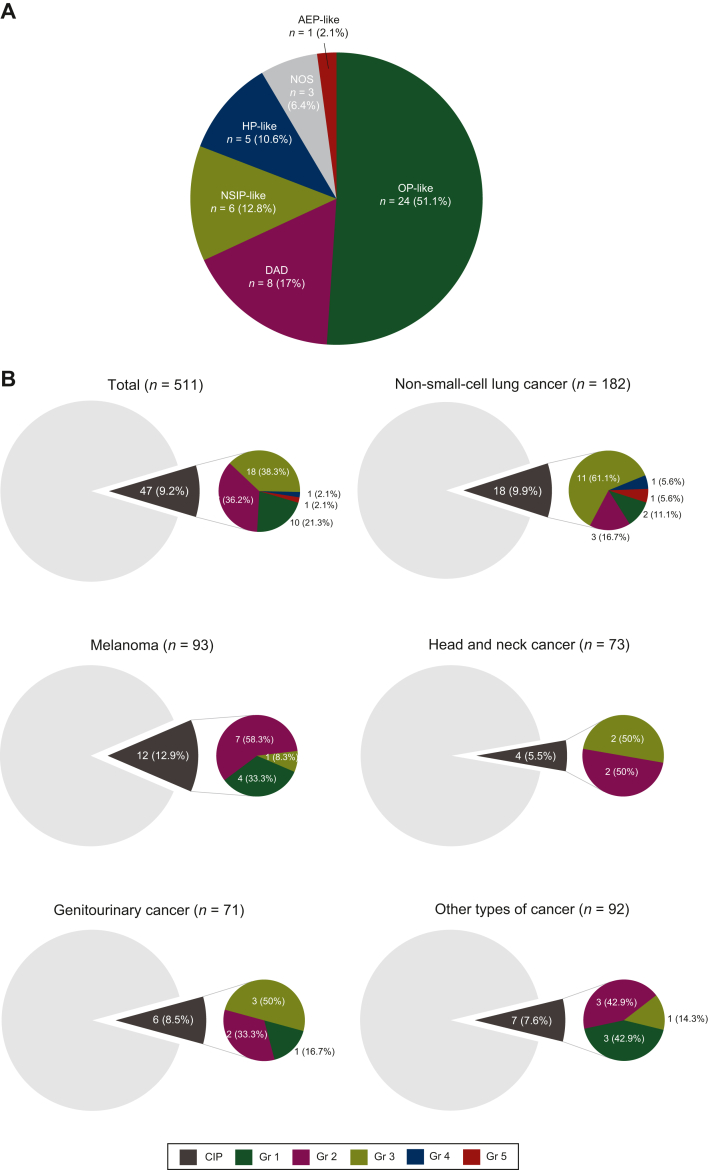
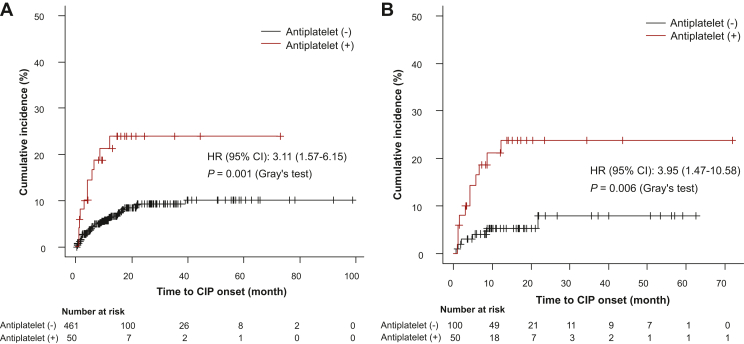
Forty-seven (9.2%) patients developed CIP. In these patients, the organizing pneumonia pattern was the dominant radiological phenotype, and 42.6% had grade ≥3 CIP, including one patient with grade 5. Of the investigated baseline co-medications, the proportion of antiplatelet drugs (n = 50, 9.8%) was higher in patients with CIP (23.4% versus 8.4%). After propensity score matching, the CIP incidence was higher in patients with baseline antiplatelet drugs (22% versus 6%). Finally, baseline antiplatelet drug use was demonstrated to increase the risk for CIP incidence regardless of cancer type (hazard ratio, 3.46; 95% confidence interval 1.21-9.86).
An association between concomitant antiplatelet drug use at baseline and an increased risk for CIP was seen in our database. This implies the importance of assessing concomitant medications for CIP risk management.
免疫检查点抑制剂(ICI)适用于各种癌症,是癌症免疫治疗的主要方法。它们常与免疫检查点抑制剂相关的肺炎(CIP)相关,然而,这会影响患者的临床转归。最近,非肿瘤伴随药物已被报道会影响 ICI 的疗效和毒性;然而,这些药物与 CIP 风险之间的关系尚不确定。本研究旨在评估基线伴随药物对接受 ICI 治疗的晚期癌症患者 CIP 发生率的影响。
这是一项单中心回顾性研究,纳入了 511 名接受 ICI 治疗的晚期癌症(黑色素瘤和非小细胞肺癌、头颈部癌、泌尿生殖系统癌和其他类型的癌症)患者的队列。进行单变量分析以确定与 CIP 发生率相关的基线合并用药。采用倾向评分匹配分析调整潜在的 CIP 风险因素,并进行多变量分析以评估确定的合并用药对 CIP 风险的影响。
47 名(9.2%)患者发生 CIP。在这些患者中,机化性肺炎模式是主要的影像学表型,23.4%的患者有≥3 级 CIP,其中 1 名患者为 5 级。在研究的基线合并药物中,抗血小板药物(n=50,9.8%)的比例在 CIP 患者中更高(23.4%比 8.4%)。在进行倾向评分匹配后,基线使用抗血小板药物的患者 CIP 发生率更高(22%比 6%)。最后,无论癌症类型如何,基线使用抗血小板药物均显示出增加 CIP 发生率的风险(风险比,3.46;95%置信区间,1.21-9.86)。
在我们的数据库中,基线时使用抗血小板药物与 CIP 风险增加之间存在关联。这意味着评估伴随药物对于 CIP 风险管理非常重要。