SCQM Foundation, Aargauerstrasse 250, 8048, Zurich, Switzerland.
Inselspital und Universitätsspital Bern, Bern, Switzerland.
Sci Rep. 2023 Oct 18;13(1):17776. doi: 10.1038/s41598-023-44841-w.
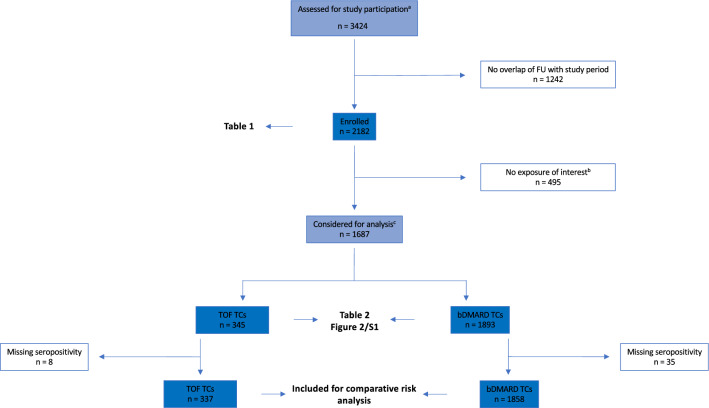
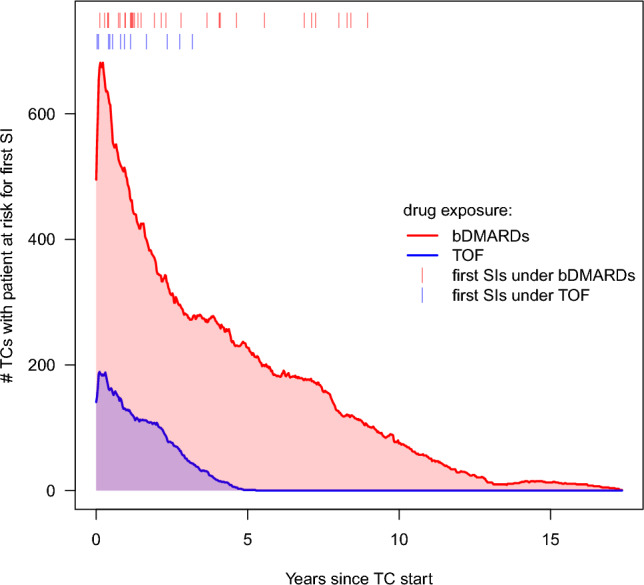
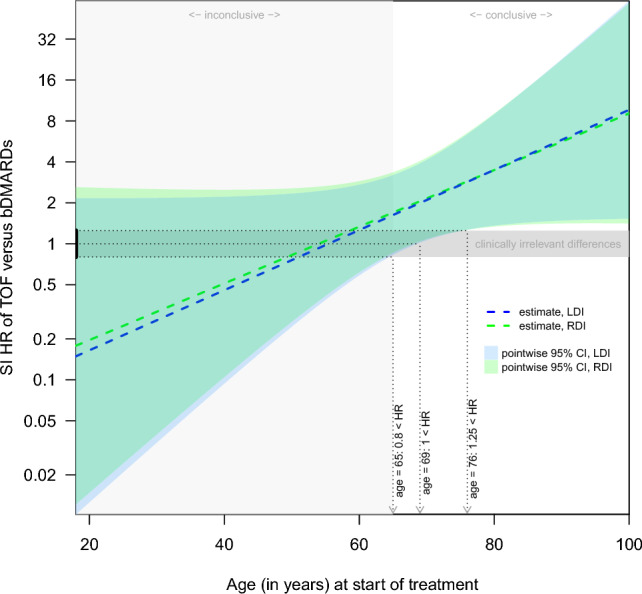
Recently, serious infections related to the use of tofacitinib (TOF) for treatment of rheumatoid arthritis (RA) have raised considerable interest. This study aimed to compare the risk for serious infections in patients with RA upon receiving TOF versus biologic disease-modifying antirheumatic drugs (bDMARDs) by age at treatment initiation. We identified adult RA patients exposed to TOF or bDMARDs using data collected by the Swiss registry for inflammatory rheumatic diseases (SCQM) from 2015 to 2018. The event of interest was the first non-fatal serious infection (SI) during drug exposure. Missing or incomplete SI dates were imputed as either the lower (left) or upper (right) limit of the known occurrence interval. The ratio of SI hazards (HR) of TOF versus bDMARDs was estimated as a function of age using covariate-adjusted Cox regression applied to each type of imputed time-to-SI. A total of 1687 patients provided time at risk for a first SI during study participation and drug exposure for 2238 different treatment courses, 345 for TOF and 1893 for bDMARDs. We identified 44 (left imputation) or 43 (right imputation), respectively, first SIs (12/12 on TOF versus 32/31 on bDMARDs). Left and right imputation produced similar results. For patients aged ≥ 69 years, the treatment HR started to be increased (lower limit of 95% confidence intervals (LLCIs) > 1). By the age of 76, the difference between TOF and bDMARDs started to be clinically relevant (LLCIs > 1.25). For patients aged < 65 years, the data were insufficient to draw conclusions. Our results suggest that we should expect an increased risk for SIs in older patients treated with TOF compared to bDMARDs supporting a cautious use of TOF in these patients.
最近,与托法替尼(TOF)治疗类风湿关节炎(RA)相关的严重感染引起了相当大的关注。本研究旨在比较在治疗开始时按年龄比较接受 TOF 与生物疾病修饰抗风湿药物(bDMARDs)治疗的 RA 患者发生严重感染的风险。我们使用瑞士炎症性风湿病登记处(SCQM)在 2015 年至 2018 年期间收集的数据,确定了接受 TOF 或 bDMARDs 治疗的成年 RA 患者。感兴趣的事件是药物暴露期间首次非致命性严重感染(SI)。缺失或不完整的 SI 日期被推断为已知发生间隔的下限(左)或上限(右)。TOF 与 bDMARDs 的 SI 危害比(HR)通过对每种类型的推断时间至 SI 的协变量调整 Cox 回归,根据年龄进行估计。共有 1687 名患者在研究参与和药物暴露期间提供了首次 SI 的风险时间,2238 种不同的治疗疗程中,有 345 种是 TOF,1893 种是 bDMARDs。我们分别确定了 44 例(左推断)或 43 例(右推断)首次 SI(TOF 上 12/12,bDMARDs 上 32/31)。左推断和右推断得出了相似的结果。对于年龄≥69 岁的患者,治疗 HR 开始增加(95%置信区间下限(LLCI)>1)。到 76 岁时,TOF 与 bDMARDs 之间的差异开始具有临床意义(LLCI>1.25)。对于年龄<65 岁的患者,数据不足以得出结论。我们的结果表明,与 bDMARDs 相比,我们应该预计接受 TOF 治疗的老年患者发生 SI 的风险增加,支持在这些患者中谨慎使用 TOF。