Department of Medicine, Hospital for Special Surgery, New York, New York, USA.
Forward, The National Databank for Rheumatic Diseases, Wichita, Kansas, USA.
RMD Open. 2019 Jun 9;5(1):e000935. doi: 10.1136/rmdopen-2019-000935. eCollection 2019.
To identify serious infection (SI) risk by aetiology and site in patients with rheumatoid arthritis (RA) compared with those with non-inflammatory rheumatic and musculoskeletal diseases (NIRMD).
Patients participating in FORWARD from 2001 to 2016 were assessed for SIs; defined by infections requiring hospitalisation, intravenous antibiotics or followed by death. SIs were categorised by aetiology and site. SI risk was assessed through Cox proportional hazards models. Best models were selected using machine learning Least Absolute Shrinkage and Selection Operator (LASSO) methodology.
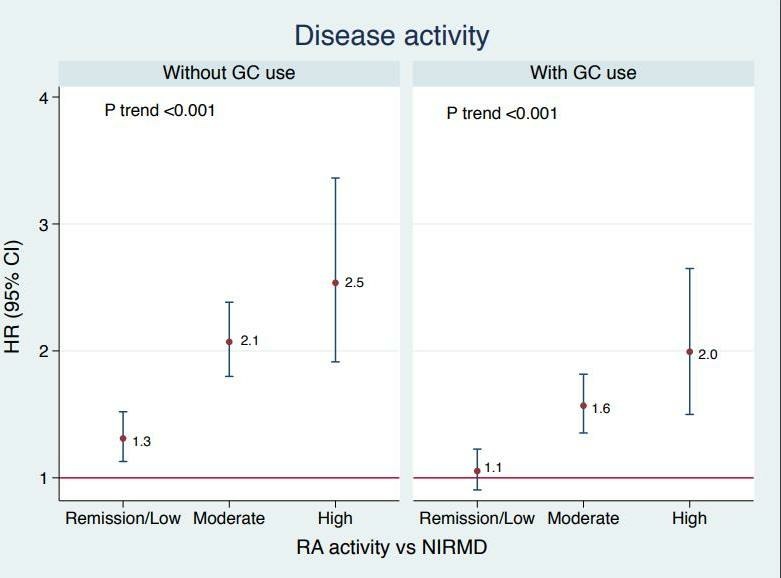
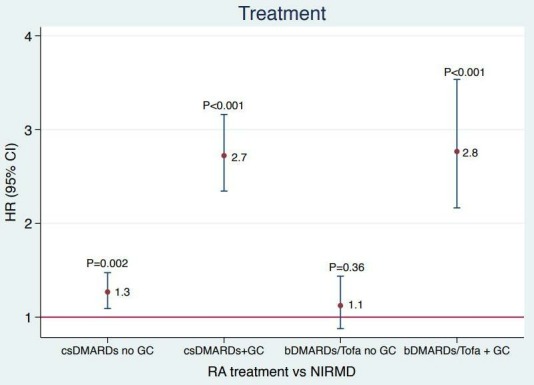
Among 20 361 patients with RA and 6176 patients with NIRMD, 1600 and 276 first SIs were identified, respectively. Incidence of SIs was higher in RA compared with NIRMD (IRR = 1.5; 95% CI 1.2 to 1.5). The risk persisted after adjusting using the LASSO model (HR 1.7; 95% CI 1.5 to 1.8), but attenuated when additionally adjusted for glucocorticoid use (HR 1.3; 95% CI 1.2 to 1.5). SI risk was significantly higher in RA versus NIRMD for bacterial infections as well as for respiratory, skin, bone, joint, bloodstream infections and sepsis irrespective of glucocorticoid use. Compared with NIRMD, SI risk was significantly increased in patients with RA who were in moderate and high disease activity but was similar to those in low disease activity/remission (p trend < 0.001).
The risk of all SIs, particularly bacterial, respiratory, bloodstream, sepsis, skin, bone and joint infections are significantly increased in patients with RA compared with patients with NIRMD. This infection risk appears to be greatest in those with higher RA disease activity.
与非炎症性风湿和肌肉骨骼疾病(NIRMD)患者相比,确定类风湿关节炎(RA)患者感染的病因和部位的严重感染(SI)风险。
评估 2001 年至 2016 年期间参与 FORWARD 研究的患者的 SI;感染定义为需要住院治疗、静脉使用抗生素或随后死亡的感染。根据病因和部位对 SI 进行分类。通过 Cox 比例风险模型评估 SI 风险。使用机器学习最小绝对收缩和选择算子(LASSO)方法选择最佳模型。
在 20361 例 RA 患者和 6176 例 NIRMD 患者中,分别确定了 1600 例和 276 例首次 SI。与 NIRMD 相比,RA 患者的 SI 发生率更高(IRR=1.5;95%CI 1.2 至 1.5)。使用 LASSO 模型调整后风险仍然存在(HR 1.7;95%CI 1.5 至 1.8),但当进一步调整糖皮质激素使用时风险减弱(HR 1.3;95%CI 1.2 至 1.5)。无论糖皮质激素使用情况如何,RA 患者的细菌感染以及呼吸道、皮肤、骨骼、关节、血流感染和败血症的 SI 风险均显著高于 NIRMD。与 NIRMD 相比,中重度疾病活动的 RA 患者的 SI 风险显著增加,但与疾病活动度低/缓解的患者相似(趋势检验 p<0.001)。
与 NIRMD 患者相比,RA 患者所有 SI(尤其是细菌感染、呼吸道感染、血流感染、败血症、皮肤感染、骨骼和关节感染)的风险显著增加。这种感染风险在疾病活动度较高的患者中似乎最大。