Department of Cellular Genomics, Institute of Gene Biology of the Russian Academy of Sciences, Moscow 119334, Russia.
Department of Cell Stress Biology, Roswell Park Comprehensive Cancer Center, Elm and Carlton Sts, Buffalo, NY 14263, USA.
Nucleic Acids Res. 2023 Nov 27;51(21):11836-11855. doi: 10.1093/nar/gkad865.
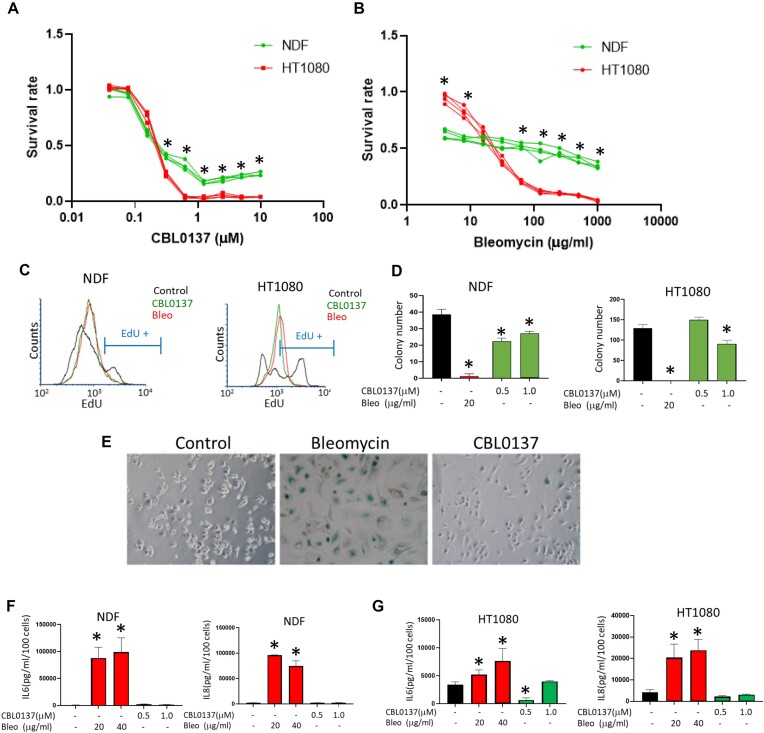
DNA-targeting drugs are widely used for anti-cancer treatment. Many of these drugs cause different types of DNA damage, i.e. alterations in the chemical structure of DNA molecule. However, molecules binding to DNA may also interfere with DNA packing into chromatin. Interestingly, some molecules do not cause any changes in DNA chemical structure but interfere with DNA binding to histones and nucleosome wrapping. This results in histone loss from chromatin and destabilization of nucleosomes, a phenomenon that we call chromatin damage. Although the cellular response to DNA damage is well-studied, the consequences of chromatin damage are not. Moreover, many drugs used to study DNA damage also cause chromatin damage, therefore there is no clarity on which effects are caused by DNA or chromatin damage. In this study, we aimed to clarify this issue. We treated normal and tumor cells with bleomycin, nuclease mimicking drug which cut predominantly nucleosome-free DNA and therefore causes DNA damage in the form of DNA breaks, and CBL0137, which causes chromatin damage without direct DNA damage. We describe similarities and differences between the consequences of DNA and chromatin damage. Both agents were more toxic for tumor than normal cells, but while DNA damage causes senescence in both normal and tumor cells, chromatin damage does not. Both agents activated p53, but chromatin damage leads to the accumulation of higher levels of unmodified p53, which transcriptional activity was similar to or lower than that of p53 activated by DNA damage. Most importantly, we found that while transcriptional changes caused by DNA damage are limited by p53-dependent activation of a small number of p53 targets, chromatin damage activated many folds more genes in p53 independent manner.
DNA 靶向药物被广泛用于癌症治疗。这些药物中的许多都会导致不同类型的 DNA 损伤,即 DNA 分子化学结构的改变。然而,与 DNA 结合的分子也可能干扰 DNA 包装成染色质。有趣的是,一些分子不会引起 DNA 化学结构的任何变化,但会干扰 DNA 与组蛋白的结合和核小体的包裹。这导致染色质中组蛋白的丢失和核小体的不稳定性,这种现象我们称之为染色质损伤。尽管细胞对 DNA 损伤的反应已经得到了很好的研究,但染色质损伤的后果却没有得到很好的研究。此外,许多用于研究 DNA 损伤的药物也会导致染色质损伤,因此不清楚哪些影响是由 DNA 或染色质损伤引起的。在这项研究中,我们旨在澄清这个问题。我们用博来霉素、模拟核酸酶的药物(主要切割无核小体 DNA,因此以 DNA 断裂的形式造成 DNA 损伤)和 CBL0137 处理正常和肿瘤细胞,CBL0137 会导致染色质损伤而不会直接造成 DNA 损伤。我们描述了 DNA 和染色质损伤的后果的相似之处和不同之处。这两种药物对肿瘤细胞的毒性都比正常细胞大,但 DNA 损伤会导致正常和肿瘤细胞衰老,而染色质损伤不会。这两种药物都激活了 p53,但染色质损伤会导致未修饰的 p53 积累水平更高,其转录活性与 DNA 损伤激活的 p53 相似或更低。最重要的是,我们发现,虽然 DNA 损伤引起的转录变化受到 p53 依赖性激活少数几个 p53 靶基因的限制,但染色质损伤以 p53 独立的方式激活了几十倍更多的基因。