National Institute for Basic Biology, Nishigonaka 38, Myodaiji, Okazaki, Aichi, 444-8585, Japan.
Centre for Organismal Studies, Heidelberg University, Im Neuenheimer Feld 230, 69120, Heidelberg, Germany.
Sci Rep. 2023 Oct 19;13(1):17857. doi: 10.1038/s41598-023-44583-9.
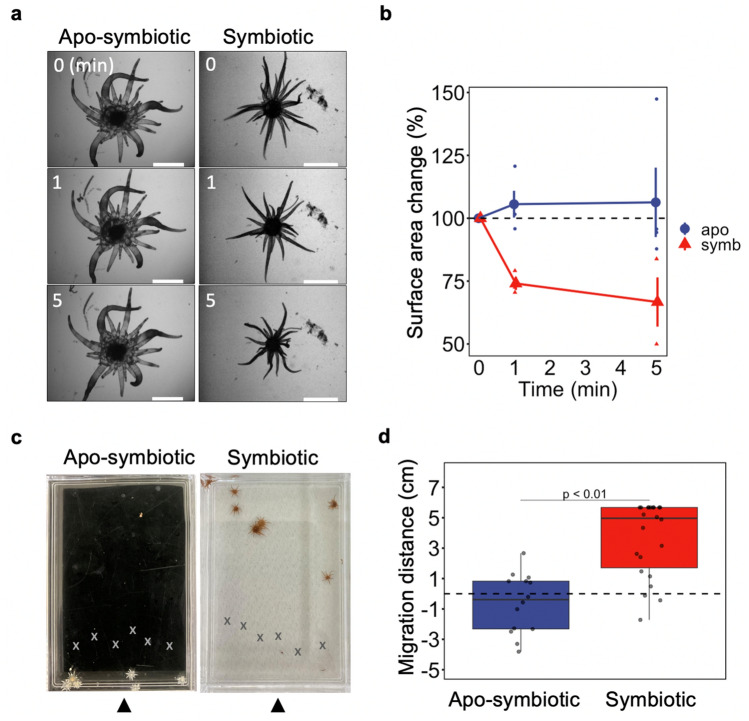
Photosymbiotic cnidarians generally seek bright environments so that their symbionts can be photosynthetically active. However, excess light may result in a breakdown of symbiosis due to the accumulation of photodamage in symbionts causing symbiont loss (bleaching). It is currently unknown if photosymbiotic cnidarians sense light only to regulate spawning time and to facilitate predation, or whether they also use their light-sensing capacities to protect their symbionts from photodamage. In this study, we examined how the sea anemone Aiptasia changes its behaviour when exposed to excess light. We reveal that Aiptasia polyps, when carrying symbionts, contract their bodies when exposed to high light intensities and subsequently migrate away in a direction perpendicular to the light source. Interestingly, this negative phototaxis was only evident under blue light and absent upon UV, green and red light exposure. Non-symbiotic Aiptasia did not exhibit this light response. Our study demonstrates that photosymbiotic Aiptasia polyps display negative phototactic behaviour in response to blue light, and that they also can perceive its direction, despite lacking specialized eye structures. We postulate that Aiptasia uses blue light, which penetrates seawater efficiently, as a general proxy for sunlight exposure to protect its symbionts from photodamage.
共生刺胞动物通常会寻找明亮的环境,以便它们的共生生物能够进行光合作用。然而,过多的光线可能会导致共生关系的破裂,因为共生生物中积累的光损伤会导致共生生物的损失(白化)。目前还不清楚共生刺胞动物是否仅通过感知光线来调节繁殖时间和促进捕食,或者它们是否还利用其感光能力来保护共生生物免受光损伤。在这项研究中,我们研究了共生海葵在暴露于过量光线时如何改变其行为。我们发现,携带共生生物的海葵在暴露于高强度光线下时会收缩身体,然后朝着与光源垂直的方向迁移。有趣的是,这种负向光感性仅在蓝光下明显,而在 UV、绿光和红光下则不存在。非共生的海葵没有表现出这种光反应。我们的研究表明,共生的海葵水螅在蓝光下表现出负向光感性行为,并且尽管它们缺乏专门的眼部结构,也能够感知光的方向。我们推测,海葵利用能够有效穿透海水的蓝光作为太阳光暴露的一般指标,以保护其共生生物免受光损伤。