School of Health and Rehabilitation Sciences, The University of Queensland, St Lucia, QLD, 4072, Australia.
School of Education, The University of Queensland, St Lucia, QLD, 4072, Australia.
J Med Syst. 2023 Oct 20;47(1):109. doi: 10.1007/s10916-023-02005-3.
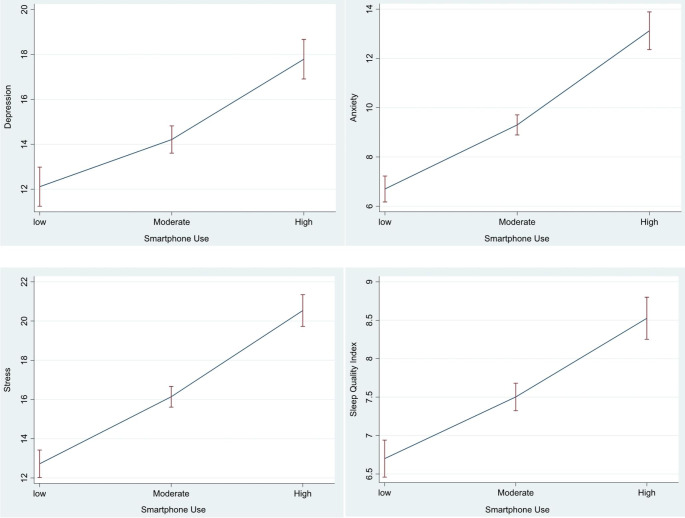
Problematic smartphone use has been associated with poorer mental health in different population groups; however, little is known about how levels of smartphone use were associated with mental health outcomes of adults in Australia. Using data from a cross-sectional survey among Australian adults aged 18-59 years (n = 655, Mean = 24.55 [SD = 5.59] years; 66% female), the current study aimed to examine association between problematic smartphone use and different psychological outcomes. Participants completed measures of problematic smartphone use with Mobile Phone Problem Use Scale (MPPUS), mental health outcomes with Depression, Anxiety, and Stress Scale (DASS-21), and Pittsburgh Sleep Quality Index (PSQI), in addition to some socio-demographics. Smartphone use was categorised into three groups: low-moderate, moderate-high, and high-severe. A total of 160 adults (24.4%) reported high-severe smartphone use. Multivariable linear regression analyses showed that smartphone use was inversely associated with psychological outcomes in a dose-dependent manner with high-severe smartphone uses having the most adverse effects. Compared to low-moderate use, average depression score was 3.5 points higher for moderate-high smartphone use (β = 3.51, 95% CI: 1.63-5.40) and 6.9 points higher for high-severe smartphone use (β = 6.91, 95% CI: 4.74-9.07). Similarly, average stress score was 3.4 points higher for moderate-high smartphone use (β = 3.40, 95% CI: 1.75-5.06) and 7.0 points higher for high-severe smartphone use (β = 7.02, 95% CI: 5.11-8.93). Similar association estimates were found for anxiety and sleep quality. Reducing smartphone use has the potential to optimise depression, anxiety, stress, and sleep quality; however, longitudinal research is warranted to establish directionality of the association.
智能手机使用问题与不同人群的心理健康较差有关;然而,对于澳大利亚成年人的智能手机使用水平如何与心理健康结果相关,知之甚少。本研究使用了一项针对 18-59 岁澳大利亚成年人的横断面调查数据(n=655,平均年龄 24.55 [SD=5.59] 岁;66%为女性),旨在研究智能手机使用问题与不同心理结果之间的关系。参与者使用手机问题使用量表(MPPUS)完成了智能手机使用问题的测量,使用抑郁、焦虑和压力量表(DASS-21)和匹兹堡睡眠质量指数(PSQI)完成了心理健康结果的测量,此外还完成了一些社会人口统计学指标的测量。智能手机使用分为三组:低-中度、中-高度和高-重度。共有 160 名成年人(24.4%)报告存在高-重度智能手机使用问题。多变量线性回归分析表明,智能手机使用与心理结果呈负相关,且呈剂量依赖性,高-重度智能手机使用的影响最不利。与低-中度使用相比,中-高度智能手机使用的平均抑郁评分高 3.5 分(β=3.51,95%CI:1.63-5.40),高-重度智能手机使用的平均抑郁评分高 6.9 分(β=6.91,95%CI:4.74-9.07)。同样,中-高度智能手机使用的平均压力评分高 3.4 分(β=3.40,95%CI:1.75-5.06),高-重度智能手机使用的平均压力评分高 7.0 分(β=7.02,95%CI:5.11-8.93)。对于焦虑和睡眠质量也发现了类似的关联估计。减少智能手机的使用有可能优化抑郁、焦虑、压力和睡眠质量;然而,需要进行纵向研究以确定关联的方向性。