Department of Anatomy and Cell Biology, University of Illinois at Chicago, Chicago, IL, 60612, USA.
Department of Biotechnology and Biosciences, University of Milano-Bicocca, Milan, Italy.
Alzheimers Res Ther. 2023 Oct 19;15(1):181. doi: 10.1186/s13195-023-01330-6.
APOE genotype is the greatest genetic risk factor for sporadic Alzheimer's disease (AD). APOE4 increases AD risk up to 12-fold compared to APOE3, an effect that is greater in females. Evidence suggests that one-way APOE could modulate AD risk and progression through neuroinflammation. Indeed, APOE4 is associated with higher glial activation and cytokine levels in AD patients and mice. Therefore, identifying pathways that contribute to APOE4-associated neuroinflammation is an important approach for understanding and treating AD. Human and in vivo evidence suggests that TLR4, one of the key receptors involved in the innate immune system, could be involved in APOE-modulated neuroinflammation. Consistent with that idea, we previously demonstrated that the TLR4 antagonist IAXO-101 can reduce LPS- and Aβ-induced cytokine secretion in APOE4 glial cultures. Therefore, the goal of this study was to advance these findings and determine whether IAXO-101 can modulate neuroinflammation, Aβ pathology, and behavior in mice that express APOE4.
We used mice that express five familial AD mutations and human APOE3 (E3FAD) or APOE4 (E4FAD). Female and male E4FAD mice and female E3FAD mice were treated with vehicle or IAXO-101 in two treatment paradigms: prevention from 4 to 6 months of age or reversal from 6 to 7 months of age. Learning and memory were assessed by modified Morris water maze. Aβ deposition, fibrillar amyloid deposition, astrogliosis, and microgliosis were assessed by immunohistochemistry. Soluble levels of Aβ and apoE, insoluble levels of apoE and Aβ, and IL-1β were measured by ELISA.
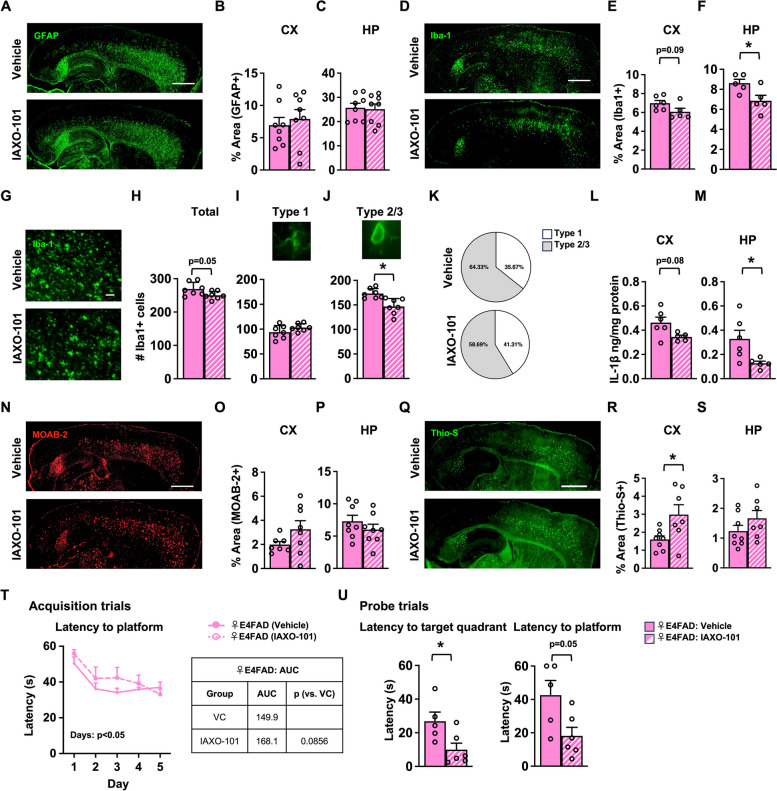
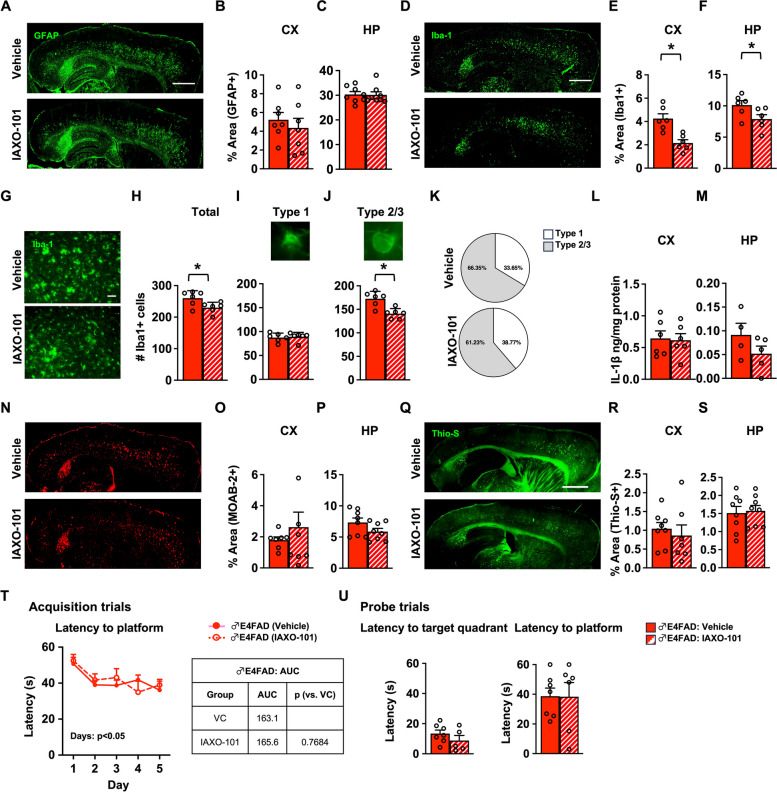
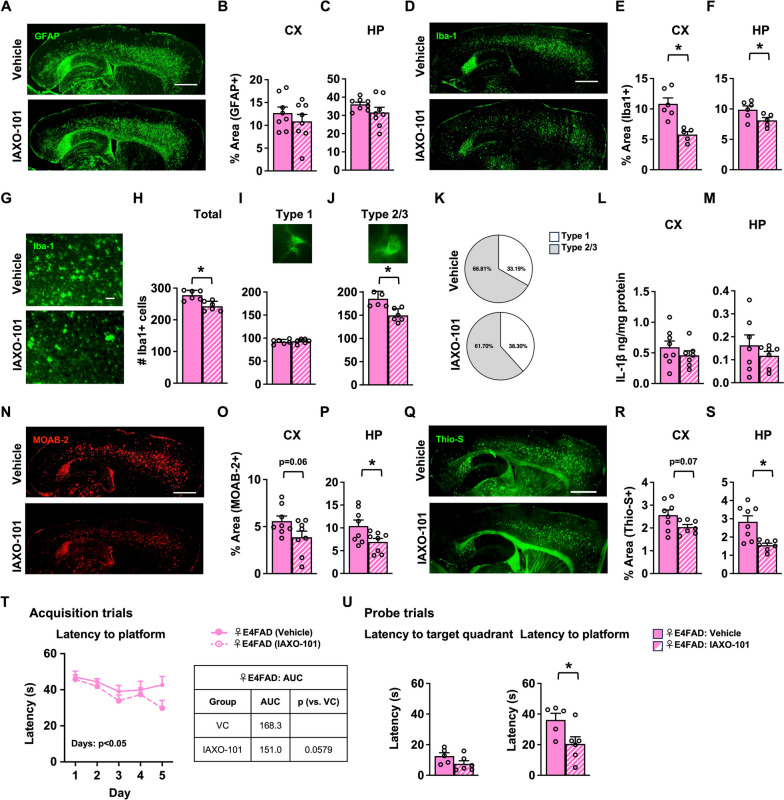
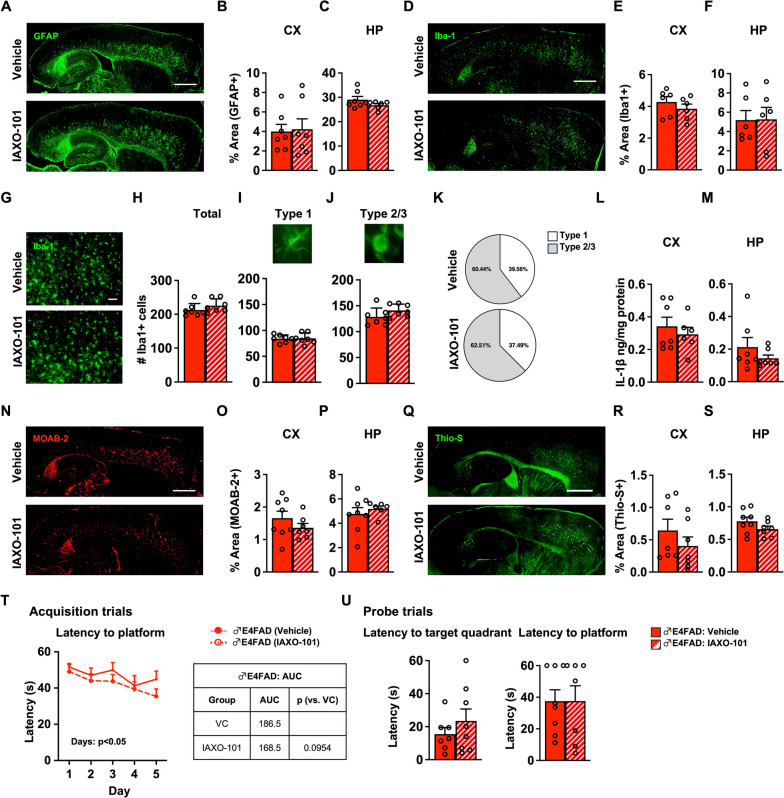
IAXO-101 treatment resulted in lower Iba-1 coverage, lower number of reactive microglia, and improved memory in female E4FAD mice in both prevention and reversal paradigms. IAXO-101-treated male E4FAD mice also had lower Iba-1 coverage and reactivity in the RVS paradigm, but there was no effect on behavior. There was also no effect of IAXO-101 treatment on neuroinflammation and behavior in female E3FAD mice.
Our data supports that TLR4 is a potential mechanistic therapeutic target for modulating neuroinflammation and cognition in APOE4 females.
载脂蛋白 E 基因型是散发性阿尔茨海默病(AD)的最大遗传风险因素。与载脂蛋白 E3 相比,APOE4 使 AD 风险增加了 12 倍,这种影响在女性中更为明显。有证据表明,单向 APOE 可以通过神经炎症调节 AD 风险和进展。事实上,APOE4 与 AD 患者和小鼠中的神经胶质激活和细胞因子水平升高有关。因此,确定导致 APOE4 相关神经炎症的途径是理解和治疗 AD 的重要方法。人类和体内证据表明,TLR4 是先天免疫系统中关键受体之一,可能参与 APOE 调节的神经炎症。与这一观点一致,我们之前证明了 TLR4 拮抗剂 IAXO-101 可以减少 APOE4 神经胶质培养物中 LPS 和 Aβ 诱导的细胞因子分泌。因此,本研究的目的是推进这些发现,并确定 IAXO-101 是否可以调节表达 APOE4 的小鼠的神经炎症、Aβ 病理学和行为。
我们使用表达五种家族性 AD 突变和人载脂蛋白 E3(E3FAD)或载脂蛋白 E4(E4FAD)的小鼠。雌性和雄性 E4FAD 小鼠和雌性 E3FAD 小鼠分别用载体或 IAXO-101 进行两种治疗方案治疗:从 4 到 6 个月龄预防治疗或从 6 到 7 个月龄逆转治疗。通过改良的 Morris 水迷宫评估学习和记忆。通过免疫组织化学评估 Aβ 沉积、纤维状淀粉样蛋白沉积、星形胶质细胞增生和小胶质细胞增生。通过 ELISA 测量可溶性 Aβ 和 apoE、不溶性 apoE 和 Aβ 以及 IL-1β 的水平。
IAXO-101 治疗可降低雌性 E4FAD 小鼠在预防和逆转两种方案中的 Iba-1 覆盖率、反应性小胶质细胞数量和记忆改善。IAXO-101 治疗的雄性 E4FAD 小鼠在 RVS 方案中也具有较低的 Iba-1 覆盖率和反应性,但对行为没有影响。IAXO-101 治疗对雌性 E3FAD 小鼠的神经炎症和行为也没有影响。
我们的数据支持 TLR4 是调节 APOE4 女性神经炎症和认知的潜在机制治疗靶点。