Kumar Purushottam, Kumar Santosh, Abhilasha Abhilasha, Singh Akrity, Kumar Uday
Department of Biochemistry, Nalanda Medical College and Hospital, Patna, IND.
Department of Trauma and Emergency Medicine, Indira Gandhi Institute of Medical Sciences, Patna, IND.
Cureus. 2023 Sep 18;15(9):e45437. doi: 10.7759/cureus.45437. eCollection 2023 Sep.
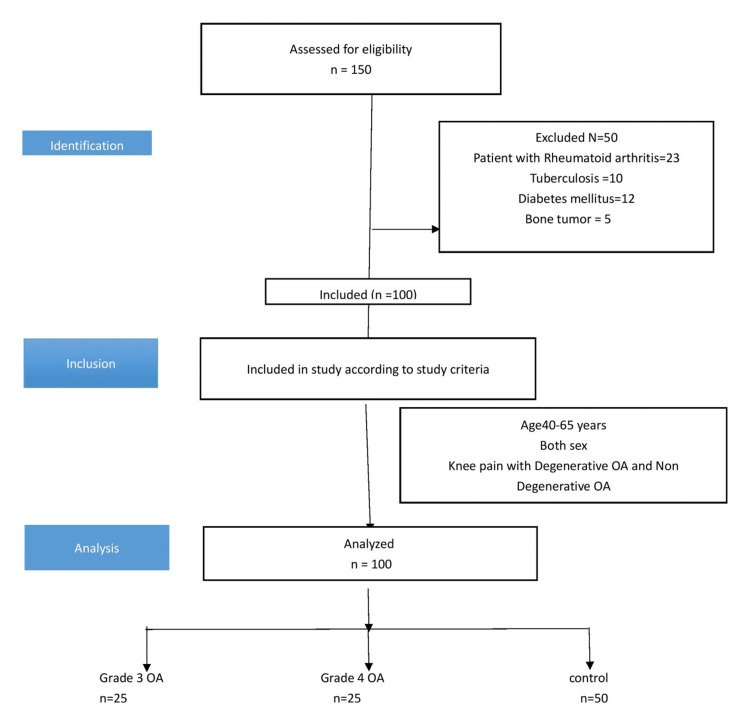
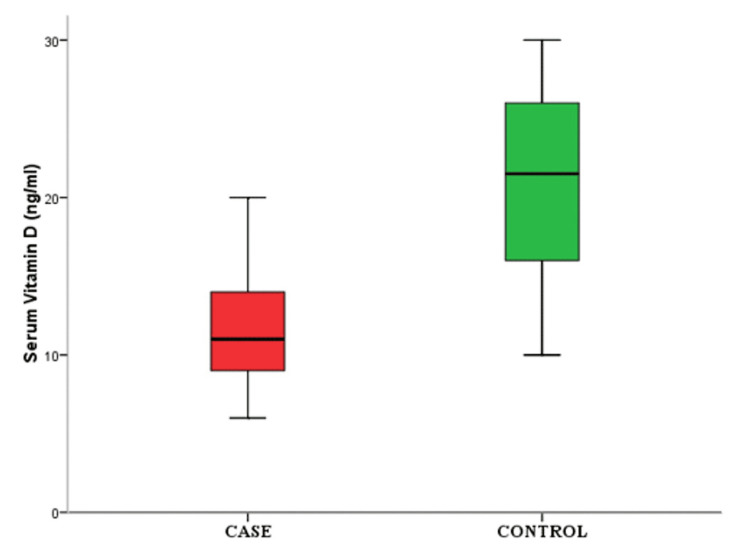
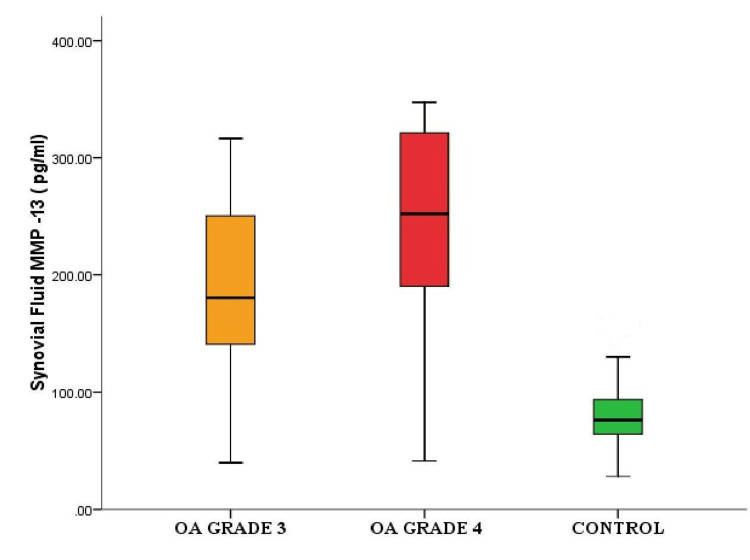
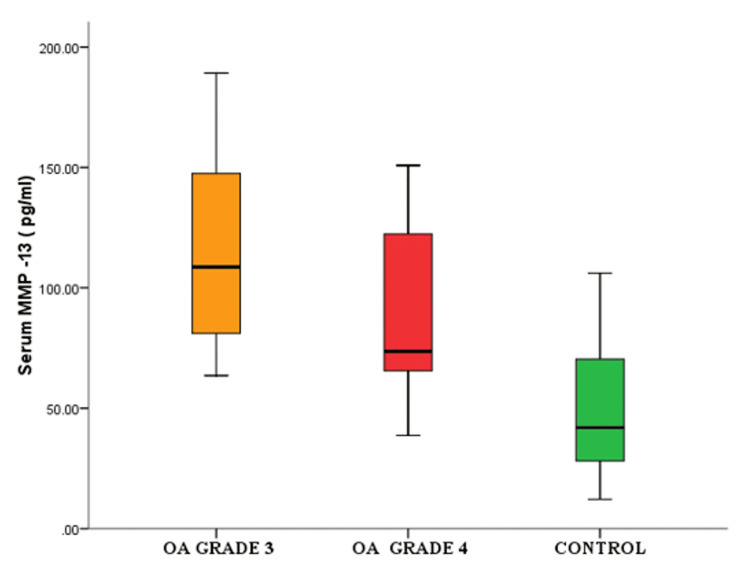
Introduction Osteoarthritis (OA) is the most common form of degenerative joint disease characterized by the progressive degeneration of articular cartilage, osteophyte formation, and joint space narrowing. Matrix metalloproteinases (MMPs) are potential biomarkers for osteoarthritis. Aims and objective The study's aim is the estimation of serum and synovial fluid matrix metalloproteinase (MMP) 13 and serum vitamin D levels in the grade 3 and grade 4 stages of osteoarthritis according to the Kellgren and Lawrence (KL) system of classification. Materials and methods A total of 100 subjects were included; of them, 25 patients with grade 3 and 25 patients with grade 4 knee osteoarthritis diagnosed clinically and radiologically according to the Kellgren and Lawrence criteria have been enrolled in the study, and 50 patients with knee pain having a diagnosis other than degenerative OA of the knee were taken as controls. Venous blood and synovial fluid have been collected from all of them for the estimation of MMP-13 and vitamin D. The enzyme-linked immunosorbent assay (ELISA) and chemiluminescent microparticle immunoassay (CMIA) methods were used for the estimation of MMP-13 and vitamin D, respectively. Results The mean value of synovial fluid MMP-13 was found to be elevated in grade 4 as compared to grade 3 and the control group, whereas the mean value of serum MMP-13 was found to be elevated in grade 3 as compared to grade 4 and control. The level of serum vitamin D was found deficient in OA patients as compared to control. The Kruskal-Wallis test was performed to compare these groups, and there was a significant difference between these groups (p-value of <0.05). Summary and conclusion High synovial and serum MMP-13 is associated with knee structural abnormalities in patients with knee OA as compared to the control group suggesting that MMP-13 can be a biomarker in knee OA, whereas the decreased level of vitamin D may be associated with an increased risk for the progression of OA; hence, serum vitamin D may be a good indicator for the prediction of the initiation of OA.
引言
骨关节炎(OA)是最常见的退行性关节疾病形式,其特征为关节软骨进行性退变、骨赘形成和关节间隙变窄。基质金属蛋白酶(MMPs)是骨关节炎的潜在生物标志物。
目的
本研究旨在根据凯尔格伦和劳伦斯(KL)分类系统,评估骨关节炎3级和4级阶段血清和滑液中基质金属蛋白酶(MMP)13以及血清维生素D水平。
材料与方法
共纳入100名受试者;其中,根据凯尔格伦和劳伦斯标准经临床和放射学诊断为3级膝关节骨关节炎的25例患者以及4级膝关节骨关节炎的25例患者纳入本研究,另外选取50例诊断为非膝关节退行性OA的膝关节疼痛患者作为对照。采集所有受试者的静脉血和滑液以评估MMP - 13和维生素D。分别采用酶联免疫吸附测定(ELISA)和化学发光微粒子免疫测定(CMIA)方法评估MMP - 13和维生素D。
结果
与3级及对照组相比,4级滑液MMP - 13平均值升高;而与4级及对照组相比,3级血清MMP - 13平均值升高。与对照组相比,OA患者血清维生素D水平不足。采用Kruskal - Wallis检验比较这些组,各组之间存在显著差异(p值<0.05)。
总结与结论
与对照组相比,膝关节OA患者滑膜和血清中高MMP - 13与膝关节结构异常相关,提示MMP - 13可能是膝关节OA的生物标志物;而维生素D水平降低可能与OA进展风险增加相关,因此血清维生素D可能是预测OA发病的良好指标。