Postgraduate Programme in Medical Sciences, School of Medical Sciences, State University of Rio de Janeiro, Rio de Janeiro, Brazil.
Clinica Felippe Mattoso, Grupo Fleury, Rio de Janeiro, Brazil.
PLoS One. 2023 Oct 20;18(10):e0291659. doi: 10.1371/journal.pone.0291659. eCollection 2023.
In rheumatoid arthritis (RA), the involvement of the pulmonary interstitium can lead to structural changes in the small airways and alveoli, leading to reduced airflow and maldistribution of ventilation. The single-breath nitrogen washout (SBN2W) test is a measure of the ventilatory distribution heterogeneity and evaluates the small airways. This study aimed to find out which clinical, serological, functional and radiological findings are useful to identify RA patients with pathological values of the phase III slope (SIII) measured by the SBN2W test.
This was a cross-sectional study in which RA patients were assessed using the Health Assessment Questionnaire-Disability Index (HAQ-DI) and the Clinical Disease Activity Index (CDAI) and underwent serological analysis of autoantibodies and inflammatory markers. In addition, they underwent pulmonary function tests (including the SBN2W test) and chest computed tomography (CT).
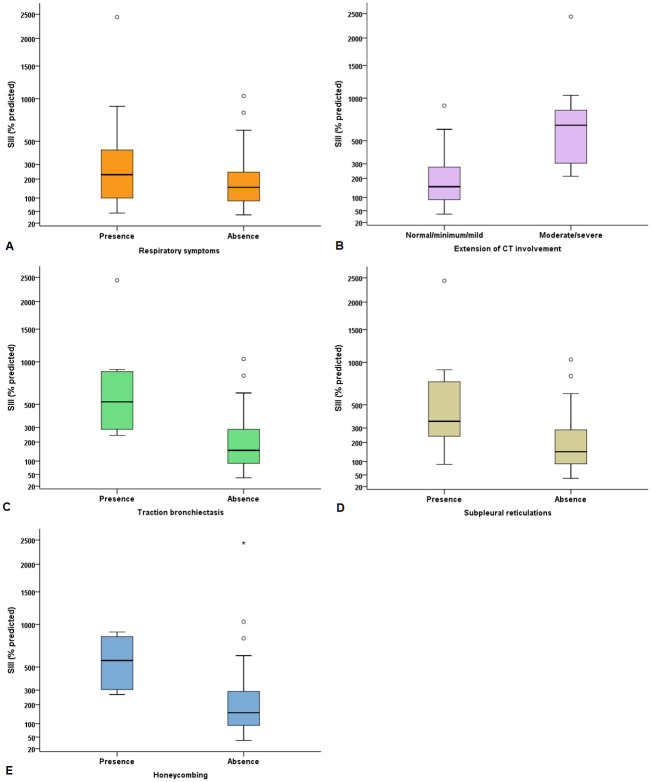
Of the 60 RA patients evaluated, 39 (65%) had an SIII >120% of the predicted value. There were significant correlations between SIII and age (r = 0.56, p<0.0001), HAQ-DI (r = 0.34, p = 0.008), forced vital capacity (FVC, r = -0.67, p<0.0001), total lung capacity (r = -0.46, p = 0.0002), residual volume/total lung capacity (TLC) (r = 0.44, p = 0.0004), and diffusing capacity of the lungs for carbon monoxide (r = -0.45, p = 0.0003). On CT scans, the subgroup with moderate/severe disease had a significantly higher SIII than the normal/minimal/mild subgroup (662 (267-970) vs. 152 (88-283)% predicted, p = 0.0004). In the final multiple regression model, FVC, extent of moderate/severe involvement and age were associated with SIII, explaining 59% of its variability.
In patients with RA, FVC, extent of lung involvement and age, all of which are easily obtained variables in clinical practice, identify poorly distributed ventilation. In addition, the presence of respiratory symptoms and deteriorated physical function are closely related to the distribution of ventilation in these patients.
在类风湿关节炎(RA)中,肺间质的受累可导致小气道和肺泡的结构改变,导致气流受限和通气分布不均。单次呼吸氮冲洗(SBN2W)试验是一种评估通气分布异质性的方法,可评估小气道。本研究旨在探讨哪些临床、血清学、功能和影像学发现有助于识别 SBN2W 试验测量的 III 相斜率(SIII)值异常的 RA 患者。
这是一项横断面研究,其中 RA 患者接受健康评估问卷残疾指数(HAQ-DI)和临床疾病活动指数(CDAI)评估,并进行自身抗体和炎症标志物的血清学分析。此外,他们还进行了肺功能检查(包括 SBN2W 试验)和胸部计算机断层扫描(CT)。
在评估的 60 例 RA 患者中,有 39 例(65%)的 SIII > 预测值的 120%。SIII 与年龄(r = 0.56,p<0.0001)、HAQ-DI(r = 0.34,p = 0.008)、用力肺活量(FVC,r = -0.67,p<0.0001)、总肺容量(r = -0.46,p = 0.0002)、残气量/总肺容量(r = 0.44,p = 0.0004)和一氧化碳弥散量(r = -0.45,p = 0.0003)呈显著相关。在 CT 扫描中,中重度疾病亚组的 SIII 明显高于正常/轻度/轻度亚组(662(267-970)比 152(88-283)%预测值,p = 0.0004)。在最终的多元回归模型中,FVC、中重度受累程度和年龄与 SIII 相关,解释了其变异性的 59%。
在 RA 患者中,FVC、肺受累程度和年龄等在临床实践中很容易获得的变量可识别通气分布不良。此外,呼吸症状和身体功能恶化与这些患者的通气分布密切相关。