Fang Jiafeng, Wei Bo, Zheng Zongheng, Xiao Jian'an, Han Fanghai, Huang Meijin, Xu Qingwen, Wang Xiaozhong, Hong Chuyuan, Wang Gongping, Ju Yongle, Su Guoqiang, Deng Haijun, Zhang Jinxin, Li Jun, Yang Xiaofeng, Chen Tufeng, Huang Yong, Huang Jianglong, Liu Jianpei, Wei Hongbo
Department of Gastrointestinal Surgery, The Third Affiliated Hospital, Sun Yat-sen University, 600 Tianhe Road, Guangzhou, People's Republic of China.
Department of Gastrointestinal Surgery, Anyang Cancer Hospital, the Fourth Affiliated Hospital, Henan University of Science and Technology, 1 Huanbin North Road, Anyang, People's Republic of China.
Nat Commun. 2023 Oct 20;14(1):6667. doi: 10.1038/s41467-023-42367-3.
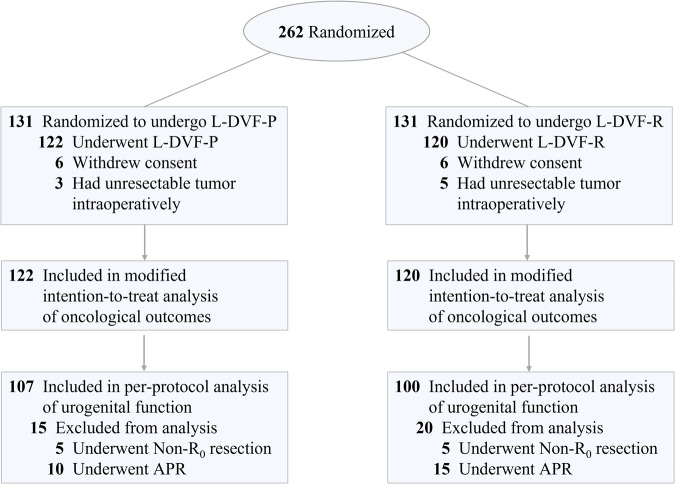
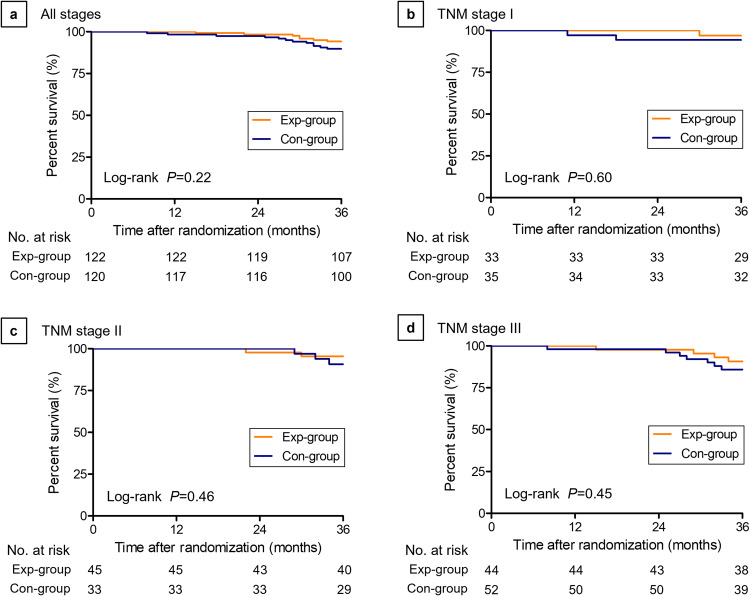
Traditional total mesorectal excision (TME) for rectal cancer requires partial resection of Denonvilliers' fascia (DVF), which leads to injury of pelvic autonomic nerve and postoperative urogenital dysfunction. It is still unclear whether entire preservation of DVF has better urogenital function and comparable oncological outcomes. We conducted a randomized clinical trial to investigate the superiority of DVF preservation over resection (NCT02435758). A total of 262 eligible male patients were randomized to Laparoscopic TME with DVF preservation (L-DVF-P group) or resection procedures (L-DVF-R group), 242 of which completed the study, including 122 cases of L-DVF-P and 120 cases of L-DVF-R. The initial analysis of the primary outcomes of urogenital function has previously been reported. Here, the updated analysis and secondary outcomes including 3-year survival (OS), 3-year disease-free survival (DFS), and recurrence rate between the two groups are reported for the modified intention-to-treat analysis, revealing no significant difference. In conclusion, L-DVF-P reveals better postoperative urogenital function and comparable oncological outcomes for male rectal cancer patients.
传统的直肠癌全直肠系膜切除术(TME)需要部分切除Denonvilliers筋膜(DVF),这会导致盆腔自主神经损伤和术后泌尿生殖功能障碍。DVF的完整保留是否具有更好的泌尿生殖功能以及相当的肿瘤学结局仍不清楚。我们进行了一项随机临床试验,以研究保留DVF相对于切除DVF的优越性(NCT02435758)。共有262例符合条件的男性患者被随机分为保留DVF的腹腔镜TME组(L-DVF-P组)或切除组(L-DVF-R组),其中242例完成了研究,包括122例L-DVF-P组和120例L-DVF-R组。先前已报道了泌尿生殖功能主要结局的初步分析。在此,报告了更新后的分析以及包括两组之间的3年总生存率(OS)、3年无病生存率(DFS)和复发率在内的次要结局,用于修正意向性分析,结果显示无显著差异。总之,对于男性直肠癌患者,L-DVF-P显示出更好的术后泌尿生殖功能和相当的肿瘤学结局。