Department of Orthopedics, Beijing Jishuitan Hospital, Capital Medical University, The Fourth Clinical Medical College of Peking University, No. 31 Xinjiekou East Street, Xicheng District, Beijing, 100035, China.
BMC Musculoskelet Disord. 2023 Oct 20;24(1):829. doi: 10.1186/s12891-023-06962-1.
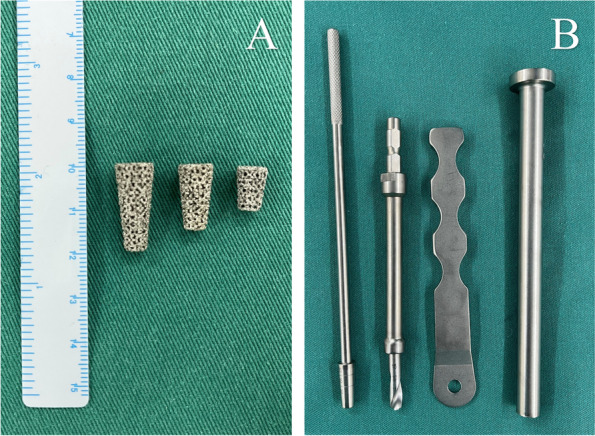
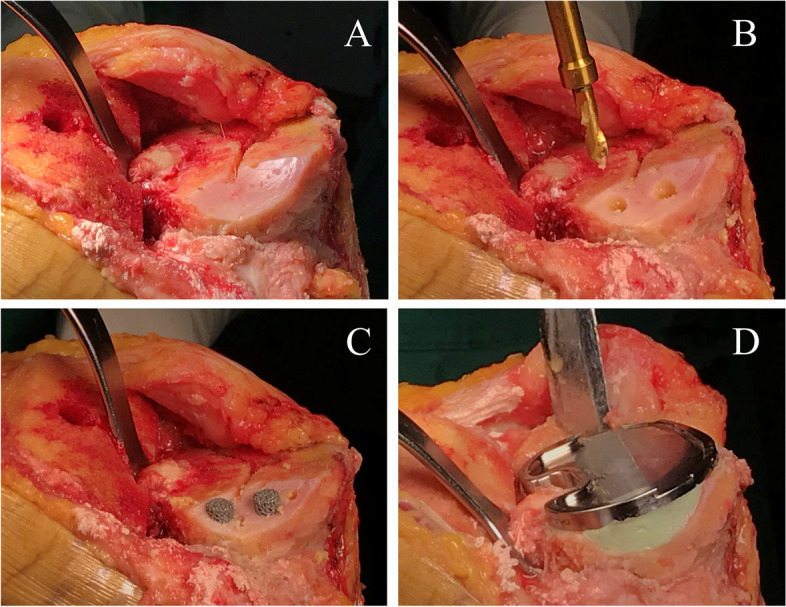
The optimal method to treat tibial bone defects during primary total knee arthroplasty (TKA) is still unclear. A novel technique of porous metal pillar augmentation has been applied recently. This study aimed to assess the short-term outcomes of primary TKA with the use of novel porous metal pillars for tibial bone defects.
A total of 24 cases (22 patients) of primary TKA between January 2019 and December 2020 using porous metal pillars for tibial bone defects were reviewed. Clinical results were evaluated using the Knee Society knee score (KSKS) and function score (KSFS), the Western Ontario and McMaster Universities Osteoarthritis Index (WOMAC), and range of motion (ROM). Hip-knee-ankle angle (HKAA), femorotibial angle (FTA), and radiolucent lines were assessed radiologically.
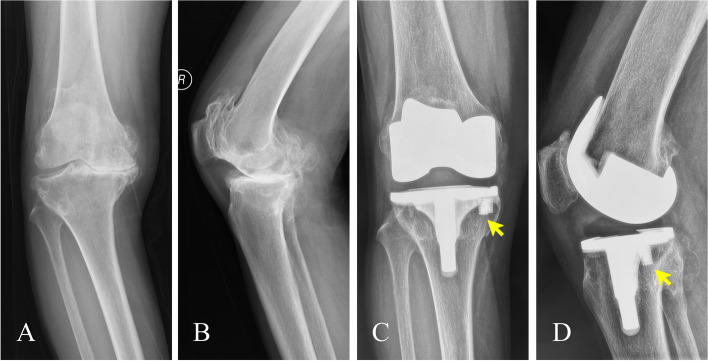
The median follow-up period was 36.0 months (interquartile range: 31-37 months). The KSKS, KSFS, WOMAC score, and ROM improved significantly at the final follow-up assessment compared with the preoperative evaluation. Both of the HKAA and FTA were corrected after surgery. Only one knee had a nonprogressive radiolucent line at the bone-cement interface. No radiolucent lines were detected around the pillar in any of the cases. There were no cases of prosthesis loosening and revision.
The use of novel porous metal pillars yielded satisfactory clinical outcomes and reliable radiological evidence of fixation in this study with a minimum 2-year follow-up. Porous metal pillar augmentation can be considered as a valuable and easy-to-use method for the management of tibial bone defects in primary TKA.
初次全膝关节置换术(TKA)时治疗胫骨骨缺损的最佳方法仍不清楚。最近应用了一种新的多孔金属柱增强技术。本研究旨在评估使用新型多孔金属柱治疗胫骨骨缺损的初次 TKA 的短期结果。
回顾了 2019 年 1 月至 2020 年 12 月期间 24 例(22 例患者)初次 TKA 中使用多孔金属柱治疗胫骨骨缺损的病例。使用膝关节学会膝关节评分(KSKS)和功能评分(KSFS)、西安大略和麦克马斯特大学骨关节炎指数(WOMAC)和活动范围(ROM)评估临床结果。通过放射学评估髋膝踝角(HKAA)、股胫角(FTA)和透光线。
中位随访时间为 36.0 个月(四分位距:31-37 个月)。与术前评估相比,最终随访时 KSKS、KSFS、WOMAC 评分和 ROM 均显著改善。手术后 HKAA 和 FTA 均得到纠正。仅 1 例膝关节出现非进展性骨水泥界面透光线。所有病例均未发现支柱周围有透光线。无假体松动和翻修病例。
在这项至少 2 年随访的研究中,新型多孔金属柱的使用获得了满意的临床结果和可靠的固定影像学证据。多孔金属柱增强可被视为初次 TKA 中胫骨骨缺损管理的一种有价值且易于使用的方法。