Sobngwi Eugene, Zemsi Sylvain, Guewo Magellan, Katte Jean-Claude, Kouanfack Charles, Mfeukeu Liliane, Zemsi Armel, Wasnyo Yves, Ntsama Assiga Antoinette, Ndi Manga Arnaud, Sobngwi-Tambekou Joelle, Ngatchou William, Moussi Omgba Charlotte, Mbanya Jean-Claude, Ongolo Zogo Pierre, Fouda Pierre Joseph
Internal Medicine, Yaoundé Central Hospital, Yaoundé, CMR.
Faculty of Medicine and Biomedical Sciences, University of Yaoundé 1, Yaoundé, CMR.
Cureus. 2023 Sep 20;15(9):e45619. doi: 10.7759/cureus.45619. eCollection 2023 Sep.
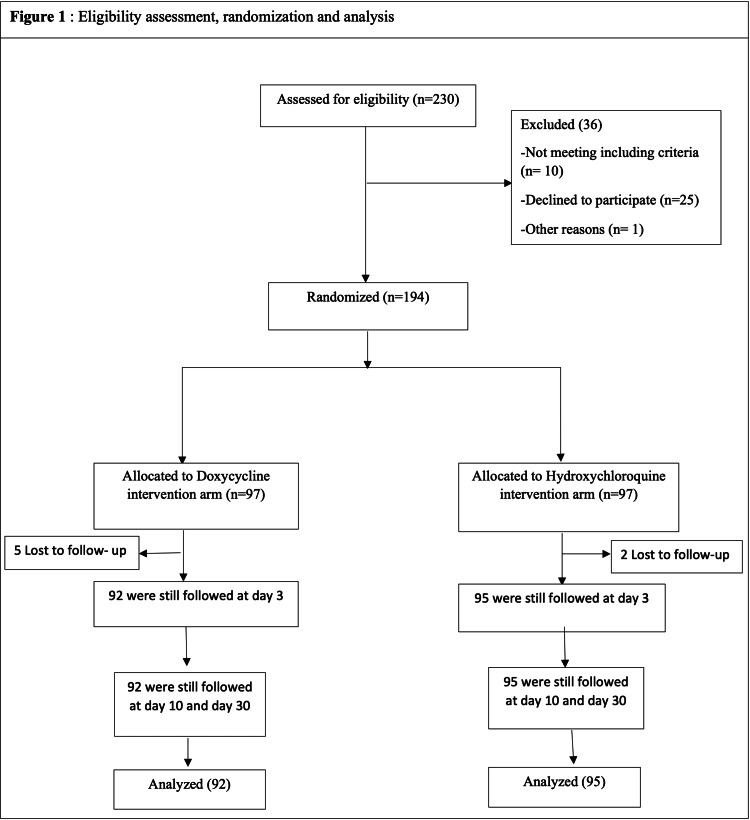
Objective We aimed to compare the safety and efficacy of a doxycycline-based regimen against Cameroon National Standard Guidelines (hydroxychloroquine plus azithromycin) for the treatment of mild symptomatic COVID-19. Methods We conducted an open-label, randomized, non-inferiority trial in Cameroon comparing doxycycline 100 mg, twice daily for seven days versus hydroxychloroquine 400 mg daily for five days and azithromycin 500 mg at day 1 and 250 mg from day 2 through 5 in mild COVID-19 patients. Clinical recovery, biological parameters, and adverse events were assessed. The primary outcome was the proportion of clinical recovery on days 3, 10, and 30. Non-inferiority was determined by the clinical recovery rate between protocols with a 20-percentage points margin. Results One hundred and ninety-four participants underwent randomization and were treated either with doxycycline (n = 97) or hydroxychloroquine-azithromycin (n = 97). On day 3, 74/92 (80.4%) participants on doxycycline versus 77/95 (81.1%) on hydroxychloroquine-azithromycin-based protocols were asymptomatic (p = 0.91). On day 10, 88/92 (95.7%) participants on doxycycline versus 93/95 (97.9%) on hydroxychloroquine-azithromycin were asymptomatic (p = 0.44). On day 30, all participants were asymptomatic. The severe acute respiratory syndrome coronavirus 2 (SARS-CoV2) polymerase chain reaction (PCR) test was negative on day 10 in 60/92 (65.2%) participants who were assigned to doxycycline and in 63/95 (66.3%) participants who were assigned to hydroxychloroquine-azithromycin. None of the participants were admitted for worsening of the disease after treatment initiation. Conclusion Doxycycline 100 mg twice daily for seven days proved to be safe and non-inferior in terms of efficacy when compared to hydroxychloroquine-azithromycin for preventing clinical worsening of mild symptomatic or asymptomatic COVID-19 and achieving virological suppression.
目的 我们旨在比较基于多西环素的治疗方案与喀麦隆国家标准指南(羟氯喹啉加阿奇霉素)治疗轻度症状性新冠病毒病(COVID-19)的安全性和疗效。方法 我们在喀麦隆开展了一项开放标签、随机、非劣效性试验,比较多西环素100毫克,每日两次,连用七天与羟氯喹啉400毫克,每日一次,连用五天,以及阿奇霉素第1天500毫克,第2至5天250毫克,用于治疗轻度COVID-19患者。评估临床恢复情况、生物学参数和不良事件。主要结局是第3、10和30天的临床恢复比例。非劣效性通过方案间临床恢复率确定,非劣效界值为20个百分点。结果 194名参与者被随机分组,分别接受多西环素治疗(n = 97)或羟氯喹啉 - 阿奇霉素治疗(n = 97)。第3天,接受多西环素治疗的92名参与者中有74名(80.4%)无症状,而接受羟氯喹啉 - 阿奇霉素方案治疗的95名参与者中有77名(81.1%)无症状(p = 0.91)。第10天,接受多西环素治疗组的92名参与者中有88名(95.7%)无症状,接受羟氯喹啉 - 阿奇霉素治疗组的95名参与者中有93名(97.9%)无症状(p = 0.44)。第30天,所有参与者均无症状。在接受多西环素治疗的92名参与者中有60名(65.2%)在第10天严重急性呼吸综合征冠状病毒2(SARS-CoV2)聚合酶链反应(PCR)检测呈阴性,在接受羟氯喹啉 - 阿奇霉素治疗的95名参与者中有63名(66.3%)呈阴性。治疗开始后,没有参与者因病情恶化而住院。结论 多西环素100毫克,每日两次,连用七天,在预防轻度症状性或无症状性COVID-19临床恶化及实现病毒学抑制方面,与羟氯喹啉 - 阿奇霉素相比,被证明是安全且疗效非劣的。