Toledo-Guardiola S M, Luongo C, Abril-Parreño L, Soriano-Úbeda C, Matás C
Departamento de Fisiología, Facultad de Veterinaria, Campus de Excelencia Mare Nostrum Universidad de Murcia, Murcia, Spain.
Departamento de Medicina, Cirugía y Anatomía Veterinaria, Universidad de Léon, León, Spain.
Front Cell Dev Biol. 2023 Oct 6;11:1231755. doi: 10.3389/fcell.2023.1231755. eCollection 2023.
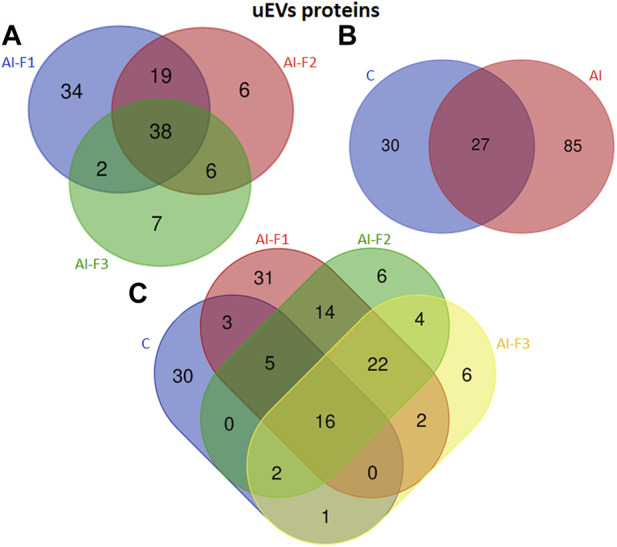
The seminal plasma (SP) is the liquid component of semen that facilitates sperm transport through the female genital tract. SP modulates the activity of the ovary, oviductal environment and uterine function during the periovulatory and early pregnancy period. Extracellular vesicles (EVs) secreted in the oviduct (oEVs) and uterus (uEVs) have been shown to influence the expression of endometrial genes that regulate fertilization and early embryo development. In some species, semen is composed of well-separated fractions that vary in concentration of spermatozoa and SP composition and volume. This study aimed to investigate the impact of different accumulative fractions of the porcine ejaculate (F1, composed of the sperm-rich fraction, SRF; F2, composed of F1 plus the intermediate fraction; F3, composed of F2 plus the post-SRF) on oEVs and uEVs protein cargo. Six days after the onset of estrus, we determined the oEVs and uEVs size and protein concentration in pregnant sows by artificial insemination (AI-sows) and in non-inseminated sows as control (C-sows). We also identified the main proteins in oEVs and uEVs, in AI-F1, AI-F2, AI-F3, and C-sows. Our results indicated that although the size of EVs is similar between AI- and C-sows, the protein concentration of both oEVs and uEVs was significantly lower in AI-sows ( < 0.05). Proteomic analysis identified 38 unique proteins in oEVs from AI-sows, mainly involved in protein stabilization, glycolytic and carbohydrate processes. The uEVs from AI-sows showed the presence of 43 unique proteins, including already-known fertility-related proteins (EZR, HSPAA901, PDS). We also demonstrated that the protein composition of oEVs and uEVs differed depending on the seminal fraction(s) inseminated (F1, F2, or F3). In conclusion, we found specific protein cargo in oEVs and uEVs according to the type of semen fraction the sow was inseminated with and whose functions these specific EVs proteins are closely associated with reproductive processes.
精浆(SP)是精液的液体成分,有助于精子通过雌性生殖道运输。在排卵期和怀孕早期,精浆可调节卵巢活动、输卵管环境和子宫功能。输卵管(oEVs)和子宫(uEVs)分泌的细胞外囊泡(EVs)已被证明会影响调节受精和早期胚胎发育的子宫内膜基因的表达。在某些物种中,精液由分离良好的部分组成,这些部分的精子浓度、精浆成分和体积各不相同。本研究旨在探讨猪射精不同累积部分(F1,由富含精子的部分组成,即SRF;F2,由F1加上中间部分组成;F3,由F2加上SRF后部分组成)对oEVs和uEVs蛋白质含量的影响。发情开始六天后,我们通过人工授精(AI母猪)测定了怀孕母猪以及作为对照的未授精母猪(C母猪)的oEVs和uEVs大小及蛋白质浓度。我们还鉴定了AI-F1、AI-F2、AI-F3和C母猪的oEVs和uEVs中的主要蛋白质。我们的结果表明,尽管AI母猪和C母猪的EVs大小相似,但AI母猪的oEVs和uEVs蛋白质浓度均显著较低(<0.05)。蛋白质组学分析在AI母猪的oEVs中鉴定出38种独特蛋白质,主要参与蛋白质稳定、糖酵解和碳水化合物过程。AI母猪的uEVs显示存在43种独特蛋白质,包括已知的与生育相关的蛋白质(EZR、HSPAA901、PDS)。我们还证明,oEVs和uEVs的蛋白质组成因授精的精液部分(F1、F2或F3)而异。总之,我们根据母猪授精的精液部分类型,在oEVs和uEVs中发现了特定的蛋白质含量,并且这些特定的EVs蛋白质的功能与生殖过程密切相关。