Luongo Chiara, Llamas-López Pedro José, Hernández-Caravaca Iván, Matás Carmen, García-Vázquez Francisco Alberto
Departamento de Fisiología, Facultad de Veterinaria, Campus de Excelencia Mare Nostrum Universidad de Murcia, 30100 Murcia, Spain.
Departamento de Tecnología Agroalimentaria, Universidad Miguel Hernández, 03202 Elche, Spain.
Biology (Basel). 2022 Jan 28;11(2):210. doi: 10.3390/biology11020210.
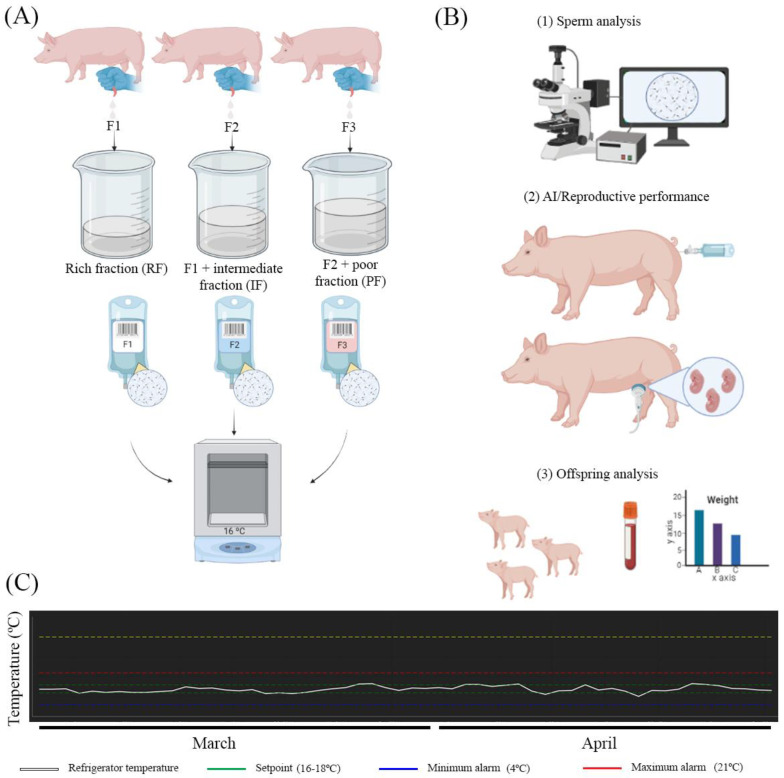
Boar ejaculate is released in several well-characterized fractions, differing in terms of sperm concentration, seminal plasma volume, and composition. However, the inclusion of the last part of the ejaculate for artificial insemination (AI) purposes is still under debate due to its controversial effects. Thus, there is a need to study the potential synergistic impact of the different ejaculate fractions. We aimed to evaluate the effect of accumulative ejaculate fractions on sperm conservation, AI performance, and offspring health. Ejaculates ( = 51) were collected and distributed as follows: F1: sperm-rich fraction; F2: sperm-rich + intermediate fractions; F3: sperm-rich + intermediate + poor fractions. Each group was diluted in a commercial extender, packaged in seminal doses (2000 × 10 sperm/60 mL), and stored at ~16 °C. On day 3 of conservation, sperm were analyzed and used for AI ( = 174). High sperm quality was observed after storage without a significant difference between the groups ( > 0.05). Moreover, no differences were obtained for AI performance (pregnancy and farrowing rates, and litter size; > 0.05) and offspring health (growth and blood analysis; > 0.05). Conclusively, the presence of all ejaculate fractions within the seminal doses does not impair the reproductive performance, reporting important economic savings according to the economic model included here.
公猪精液以几种特征明确的部分射出,在精子浓度、精浆体积和成分方面存在差异。然而,由于其存在争议的影响,将射精的最后部分用于人工授精(AI)的做法仍在争论中。因此,有必要研究不同精液部分的潜在协同影响。我们旨在评估累积精液部分对精子保存、人工授精性能和后代健康的影响。收集了51份精液并按以下方式分配:F1:富含精子的部分;F2:富含精子的部分+中间部分;F3:富含精子的部分+中间部分+质量差的部分。每组在商业稀释剂中稀释,包装成精液剂量(2000×10⁶精子/60 mL),并在约16°C下储存。在保存的第3天,对精子进行分析并用于人工授精(n = 174)。储存后观察到精子质量良好,各组之间无显著差异(P>0.05)。此外,人工授精性能(妊娠率和产仔率以及窝产仔数;P>0.05)和后代健康(生长和血液分析;P>0.05)方面也未获得差异。总之,精液剂量中包含所有精液部分不会损害繁殖性能,根据此处包含的经济模型,可节省重要的经济成本。