Soliman Hamdy A M, Salaah Sally M, Hamed Mohamed, Sayed Alaa El-Din H
Department of Zoology, Faculty of Science, Sohag University, Sohag, Egypt.
Fresh Water Division, National Institute of Oceanography and Fisheries, NIOF, Alexandria, Egypt.
Front Vet Sci. 2023 Oct 6;10:1279382. doi: 10.3389/fvets.2023.1279382. eCollection 2023.
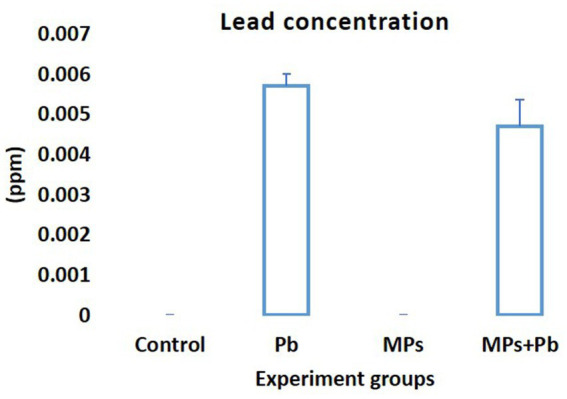
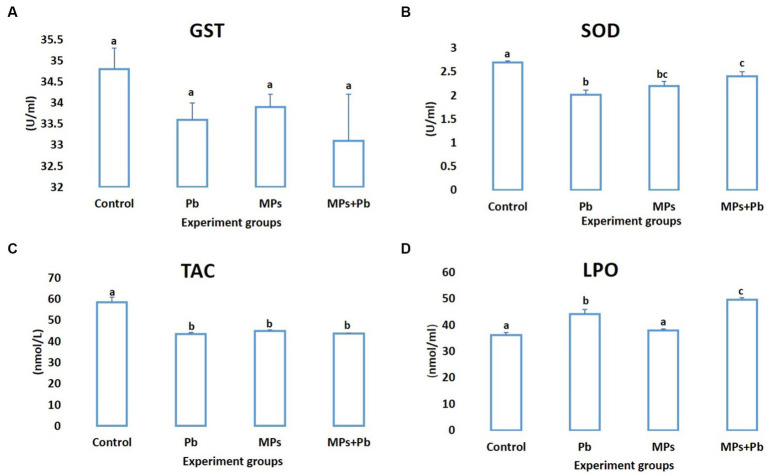
Microplastics (MPs) are an emerging threat to freshwater ecosystems with several ecotoxicological ramifications for fish. Microplastics (MPs) can adsorb heavy metals on their surfaces and increase their availability to aquatic organisms. The combined impact of lead and microplastics on fish has only been studied seldom utilizing a variety of markers. The present study aimed to evaluate the hematological, biochemical, and inflammatory signals (cytokines), as well as antioxidant enzymes in African catfish () exposed to lead (Pb) and MPs individually and combined for 15 days (acute toxicity experiment). The fish were split into four groups, the first of which was the control group. The second group received exposure to 1 mg/L of lead nitrate [Pb(NO)]. The third group was given 100 mg/L of MPs. A solution containing 100 mg/L of MPs and 1 mg/L of lead nitrate [Pb(NO)] was administered to the fourth group (the combination group). According to the findings, when MPs and Pb were combined for 15 days, the red blood cells (RBCs), thrombocytes, and lymphocytes were significantly reduced in comparison to the control fish. When compared to the control fish, the fish exposed to MPs and Pb alone or together showed a significant rise in blood interleukin-1β (IL-1β) and interleukin-6 (IL-6) cytokines. Both MPs and Pb exposure in catfish resulted in significant changes in the plasma electrolytes. The fish treated with MPs and Pb individually or in combination showed significant reduction in superoxide dismutase (SOD) and total antioxidant capacity (TAC) levels compared to the control group. The fish exposed to the combined action of MPs and Pb showed a considerable modification in all biochemical markers. The difference in the mean concentration of Pb (mg/L) between the fish exposed to Pb alone and the fish subjected to Pb and MPs combination was not statistically significant. In conclusion, according to this investigation, exposure to Pb caused an insignificant increase in Pb accumulation when MPs were present. However, co-exposure may result in anemia, cellular harm, extremely high levels of oxidative stress, and an inflammatory reaction.
微塑料(MPs)是淡水生态系统面临的一种新威胁,对鱼类具有多种生态毒理学影响。微塑料(MPs)可在其表面吸附重金属,并增加水生生物对重金属的摄取量。铅和微塑料对鱼类的联合影响仅在少数研究中使用了多种标志物进行探究。本研究旨在评估单独或联合暴露于铅(Pb)和微塑料15天(急性毒性实验)的非洲鲶鱼的血液学、生化和炎症信号(细胞因子)以及抗氧化酶。鱼被分为四组,第一组为对照组。第二组接受1mg/L硝酸铅[Pb(NO₃)₂]的暴露。第三组给予100mg/L的微塑料。第四组(联合组)给予含有100mg/L微塑料和1mg/L硝酸铅[Pb(NO₃)₂]的溶液。根据研究结果,微塑料和铅联合暴露15天后,与对照鱼相比,红细胞(RBCs)、血小板和淋巴细胞显著减少。与对照鱼相比,单独或同时暴露于微塑料和铅的鱼血液白细胞介素-1β(IL-1β)和白细胞介素-6(IL-6)细胞因子显著升高。鲶鱼暴露于微塑料和铅都会导致血浆电解质发生显著变化。与对照组相比,单独或联合使用微塑料和铅处理的鱼超氧化物歧化酶(SOD)和总抗氧化能力(TAC)水平显著降低。暴露于微塑料和铅联合作用的鱼在所有生化标志物上都有相当大的变化。单独暴露于铅的鱼和同时暴露于铅和微塑料的鱼之间铅(mg/L)平均浓度的差异无统计学意义。总之,根据本研究,当存在微塑料时,暴露于铅会导致铅积累量的微小增加。然而,共同暴露可能会导致贫血、细胞损伤、极高水平的氧化应激和炎症反应。