Wang Hao-Chien, Djajalaksana Susanthy, Sharma Latha, Theerakittikul Theerakorn, Lim Hui Fang, Yoo Kwang Ha, Yu-Lin Andrea Ban, Diaz Dina V, Yang Lala, Beekman Maarten J H I
Department of Internal Medicine, National Taiwan University Hospital, Zhongzheng District, Taipei City 100, Taiwan.
Department of Pulmonology, University of Brawijaya-Dr. Saiful Anwar General Hospital, Kota Malang, Jawa Timur 65112, Indonesia.
World Allergy Organ J. 2023 Oct 16;16(10):100823. doi: 10.1016/j.waojou.2023.100823. eCollection 2023 Oct.
The extent of short-acting Beta-2-agonist (β-agonist) (SABA) use across Asian countries is not well documented. As part of the SABA use IN Asthma (SABINA) III study, we assessed SABA prescriptions and clinical outcomes in patients with asthma from Asia.
This cross-sectional study recruited patients (aged ≥12 years) with asthma from 8 Asian countries. Data on disease characteristics and asthma treatments were collected using electronic case report forms. Patients were classified by practice type (primary or specialist care) and investigator-defined asthma severity (per Global Initiative for Asthma [GINA] 2017 recommendations). The association of SABA prescriptions with clinical outcomes was analyzed using multivariable regression models.
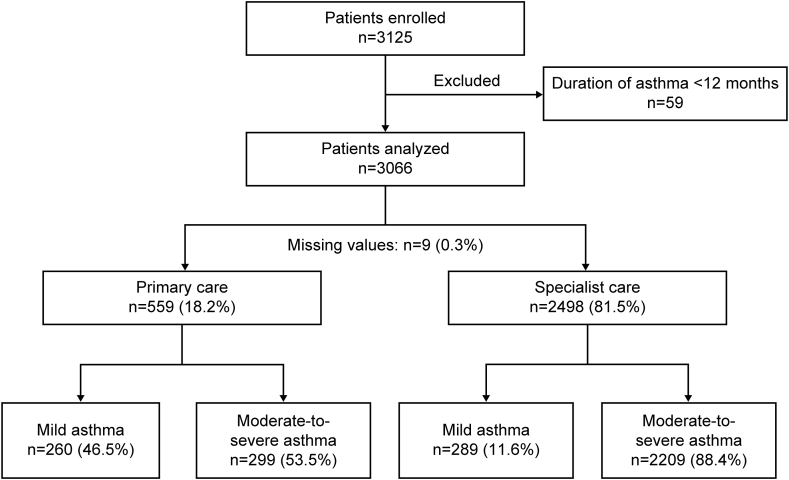
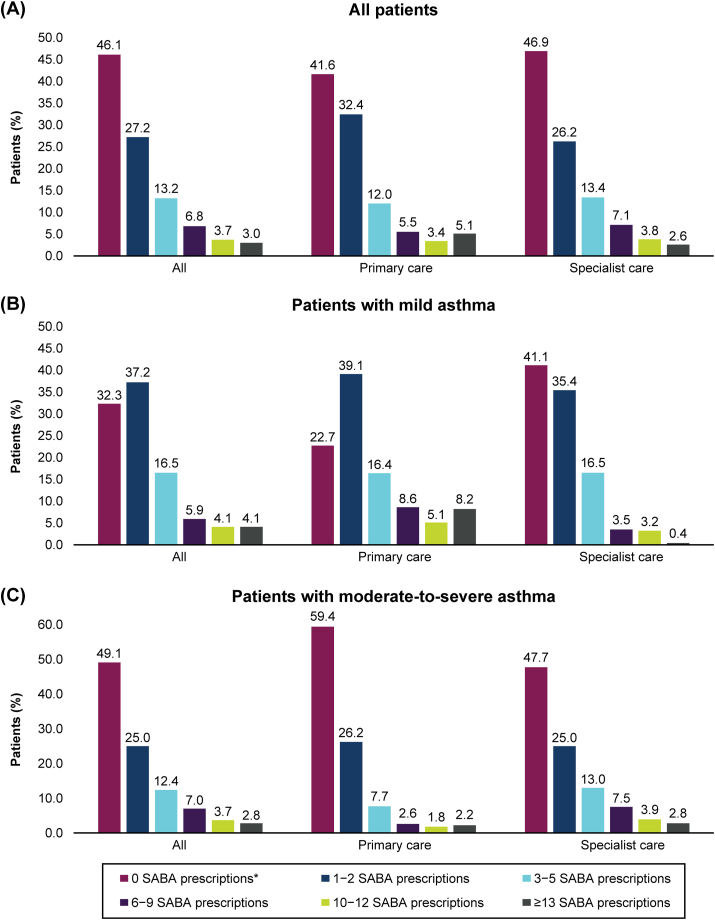
Overall, 3066 patients were analyzed, with a mean (standard deviation) age of 51.8 (16.7) years; of these patients, 2116 (69%) were female, 2517 (82.1%) had moderate-to-severe asthma and 2498 (81.5%) and 559 (18.2%) were treated in specialist and primary care, respectively. In total, 1423 (46.4%) patients had partly controlled/uncontrolled asthma, with 1149 (37.5%) patients experiencing ≥1 severe asthma exacerbation in the previous year. Overall, 800 (26.7%) patients were prescribed ≥3 SABA canisters in the previous year, which is regarded as overprescription and was associated with a significantly decreased odds of at least partly controlled asthma and increased incidence rates of severe exacerbations ( < 0.01 for both associations).
The findings from this cohort of predominantly specialist-treated patients with asthma indicate SABA overprescription in at least 1 in every 4 patients, and this overprescription is associated with poor clinical outcomes. These data highlight the need for adherence to recently updated asthma treatment recommendations in Asia.
亚洲各国短效β2受体激动剂(SABA)的使用情况尚无充分记录。作为SABA在哮喘中的应用(SABINA)III研究的一部分,我们评估了亚洲哮喘患者的SABA处方及临床结局。
这项横断面研究招募了来自8个亚洲国家的12岁及以上哮喘患者。使用电子病例报告表收集疾病特征和哮喘治疗的数据。根据执业类型(初级或专科护理)和研究者定义的哮喘严重程度(根据全球哮喘防治创议[GINA]2017年建议)对患者进行分类。使用多变量回归模型分析SABA处方与临床结局之间的关联。
总体而言,共分析了3066例患者,平均(标准差)年龄为51.8(16.7)岁;其中,2116例(69%)为女性,2517例(82.1%)患有中度至重度哮喘,2498例(81.5%)和559例(18.2%)分别在专科护理和初级护理中接受治疗。共有1423例(46.4%)患者的哮喘控制不佳或未得到控制,其中1149例(37.5%)患者在前一年经历了至少1次严重哮喘发作。总体而言,800例(26.7%)患者在前一年被开具了≥3个SABA吸入器,这被视为处方过量,并且与哮喘至少部分得到控制的几率显著降低以及严重发作的发生率增加相关(两种关联的P均<0.01)。
这一以专科治疗为主的哮喘患者队列的研究结果表明,每4名患者中至少有1名存在SABA处方过量的情况,并且这种处方过量与不良临床结局相关。这些数据凸显了在亚洲遵循最新哮喘治疗建议的必要性。