Cuccarese Marco, Van Hulle Stijn W H, Mancini Ignazio M, Masi Salvatore, Caniani Donatella
Scuola di Ingegneria, Università degli Studi della Basilicata, viale dell'Ateneo Lucano n.10, 85100 Potenza, Italy.
Department of Green Chemistry and Technology, Faculty of Bioscience Engineering, Universiteit Gent, Gr.Karel.de Goedelaan 5, 8500 Kortrijk, Belgium.
J Environ Health Sci Eng. 2023 Aug 23;21(2):497-512. doi: 10.1007/s40201-023-00876-9. eCollection 2023 Dec.
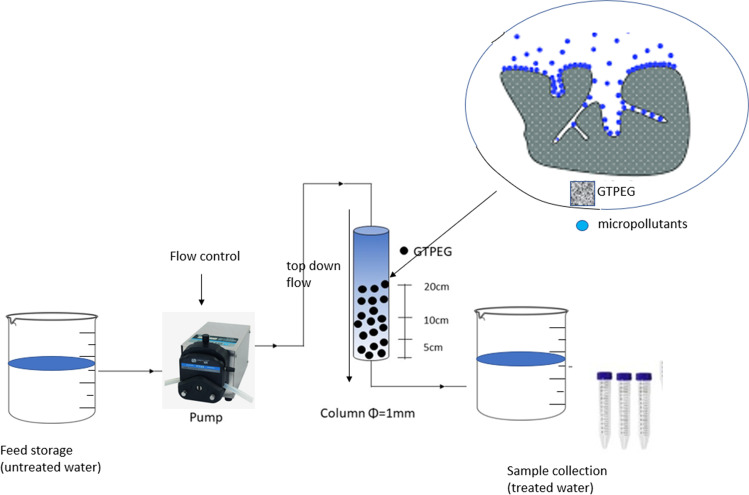
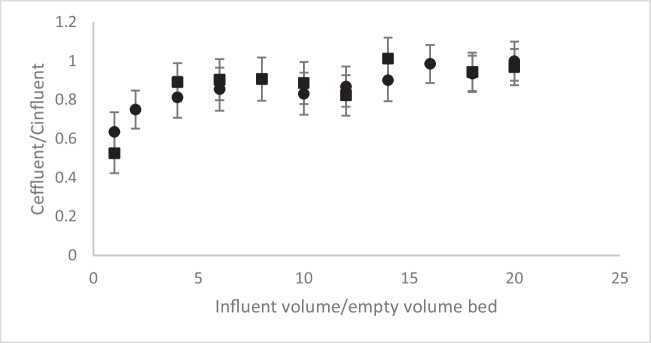
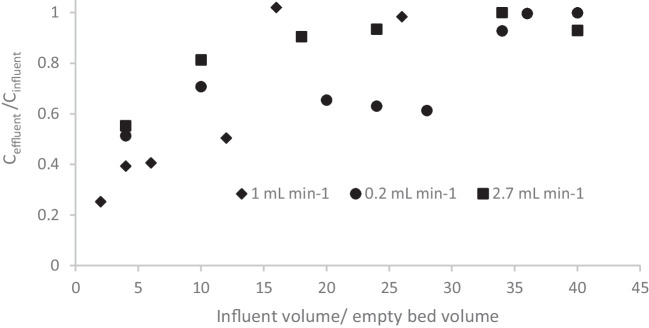
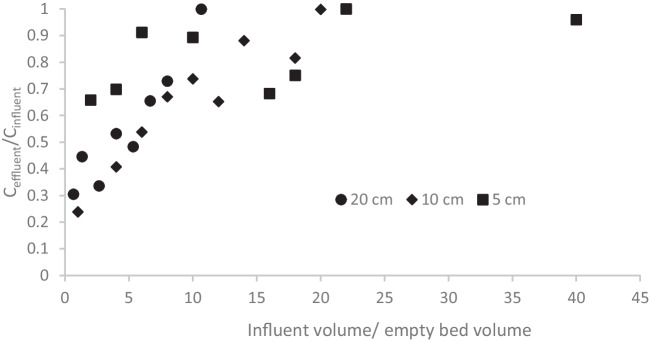
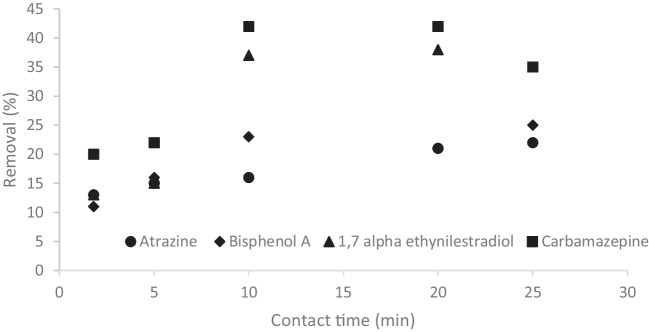
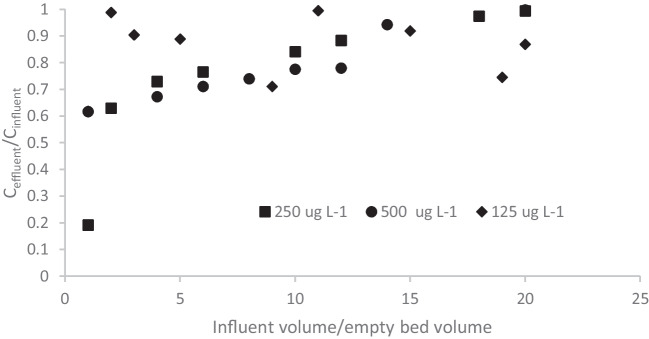
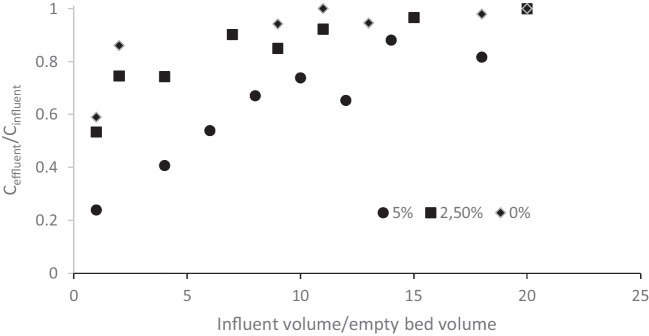
Nowadays, public concern is focused on the degradation of water quality. For this reason, the development of innovative technologies for water treatment in view of (micro)pollutant removal is important. Indeed, organic (micro)pollutants, such as pharmaceuticals, herbicides, pesticides and plasticizers at concentration levels of μg L or even ng L are hardly removed during conventional wastewater treatment. In view of this, thermo-plasma expanded graphite, a light-weight innovative material in the form of a powder, was encapsulated into calcium alginate to obtain a granular form useful as filtration and adsorption material for removal of different pollutants. The produced material was used to remove atrazine, bisphenol-A, 17-α-ethinylestradiol and carbamazepine (at concentration levels of 125, 250 and 500 µg L) by top-down filtration. The effect of flow rate, bed depth and adsorbent composition was evaluated based on breakthrough curves. The experimental data was analysed with the Adams-Bohart model in view of scale-up. Under optimal conditions, removal and adsorption capacity of respectively about 21%, 21%, 38%,42%, 43 µg g, 44 µg g, 37 µg g and 87 µg g were obtained for atrazine, bisphenol, 17-α ethinylestradiol and carbamazepine when using 0.12 g of thermo-plasma expanded graphite to treat 200 mL at 500 µg L (for each compound) of solution obtaining at contact time of 20 min. The granular form of TPEG obtained (GTPEG) by entrapping in calcium alginate results to have a good adsorbent property for the removal of carbamazepine, atrazine, bisphenol A and 17-α ethinylestradiol from water at concentration levels between 250 and 500 μg L. Promising results confirm the adsorbent properties of TPEG and push-up us to investigate on its application and improve of its performance by evaluating different entrapping materials.
The online version contains supplementary material available at 10.1007/s40201-023-00876-9.
如今,公众关注的焦点集中在水质恶化上。因此,开发用于去除(微)污染物的创新型水处理技术至关重要。事实上,诸如药物、除草剂、杀虫剂和增塑剂等浓度为微克/升甚至纳克/升的有机(微)污染物在传统废水处理过程中几乎无法去除。鉴于此,将粉末状的轻质创新材料热等离子体膨胀石墨封装在海藻酸钙中,以获得可作为过滤和吸附材料用于去除不同污染物的颗粒形式。所制备的材料通过自上而下过滤用于去除阿特拉津、双酚A、17-α-乙炔雌二醇和卡马西平(浓度水平为125、250和500微克/升)。基于穿透曲线评估了流速、床层深度和吸附剂组成的影响。为了进行放大研究,用亚当斯-博哈特模型分析了实验数据。在最佳条件下,当使用0.12克热等离子体膨胀石墨处理200毫升浓度为500微克/升(每种化合物)的溶液,接触时间为20分钟时,阿特拉津、双酚、17-α-乙炔雌二醇和卡马西平的去除率和吸附容量分别约为21%、21%、38%、42%、43微克/克、44微克/克、37微克/克和87微克/克。通过包埋在海藻酸钙中获得的热等离子体膨胀石墨颗粒形式(GTPEG)对浓度在250至500微克/升之间的水中的卡马西平、阿特拉津、双酚A和17-α-乙炔雌二醇具有良好的吸附性能。有前景的结果证实了热等离子体膨胀石墨的吸附性能,并促使我们通过评估不同的包埋材料来研究其应用并提高其性能。
在线版本包含可在10.1007/s40201-023-00876-9获取的补充材料。