Institute of Parasitology, Slovak Academy of Sciences, Hlinkova 3, 040 01 Košice, Slovakia.
Institute of Parasitology, Slovak Academy of Sciences, Hlinkova 3, 040 01 Košice, Slovakia - Department of Zoology, Faculty of Natural Sciences, Comenius University, Ilkovičova 6, 842 15 Bratislava, Slovakia.
Parasite. 2023;30:44. doi: 10.1051/parasite/2023045. Epub 2023 Oct 23.
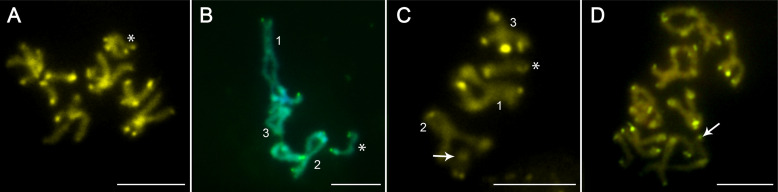
The cytogenetics of Acanthocephala is a neglected area in the study of this group of endoparasites. Chromosome number and/or karyotypes are known for only 12 of the 1,270 described species, and molecular cytogenetic data are limited to rDNA mapping in two species. The standard karyological technique and mapping of 18S rRNA and H3 histone genes on the chromosomes of Acanthocephalus anguillae individuals from three populations, one of which originated from the unfavorable environmental conditions of the Zemplínska Šírava reservoir in eastern Slovakia, were applied for the first time. All specimens had 2n = 7/8 (male/female); n = 1m + 1m-sm + 1a + 1a (X). Fluorescence in situ hybridization (FISH) revealed three loci of 18S rDNA on two autosomes and dispersion of H3 histone genes on all autosomes and the X chromosome. In addition to the standard A chromosome set, 34% of specimens from Zemplínska Šírava possessed a small acrocentric B chromosome, which was always found to be univalent, with no pairing observed between the B chromosome and the A complement. The B chromosome had a small amount of heterochromatin in the centromeric and telomeric regions of the chromosomal arms and showed two clusters of H3 genes. It is well known that an environment permanently polluted with chemicals leads to an increased incidence of chromosomal rearrangements. As a possible scenario for the B chromosome origin, we propose chromosomal breaks due to the mutagenic effect of pollutants in the aquatic environment. The results are discussed in comparison with previous chromosome data from Echinorhynchida species.
棘头虫的细胞遗传学是该内寄生群组研究中一个被忽视的领域。在已描述的 1270 个物种中,仅有 12 个已知其染色体数目和/或核型,且分子细胞遗传学数据仅限于两种物种的 rDNA 作图。首次应用标准细胞遗传学技术和在三个种群的泥鳅棘头虫个体的染色体上对 18S rRNA 和 H3 组蛋白基因进行定位,其中一个种群来自于东斯洛伐克 Zemplínska Šírava 水库不利的环境条件。所有标本均具有 2n=7/8(雄性/雌性);n=1m+1m-sm+1a+1a(X)。荧光原位杂交(FISH)显示两条常染色体上有三个 18S rDNA 基因位点,所有常染色体和 X 染色体上弥散着 H3 组蛋白基因。除了标准的 A 染色体组之外,来自 Zemplínska Šírava 的 34%的标本还具有一个小的近端着丝粒 B 染色体,该 B 染色体总是单价的,未观察到 B 染色体与 A 染色体组之间的配对。B 染色体在染色体臂的着丝粒和端粒区域具有少量异染色质,并且显示出两个 H3 基因簇。众所周知,长期受到化学物质污染的环境会导致染色体结构重排的发生率增加。作为 B 染色体起源的可能情况,我们提出了由于水环境污染中的诱变效应导致的染色体断裂。将结果与以前的棘头虫属物种的染色体数据进行了比较讨论。