Dubanet Olivier, Higley Michael J
Department of Neuroscience, Kavli Institute for Neuroscience, Wu Tsai Institute, Yale University, New Haven, CT, 06510, USA.
bioRxiv. 2023 Oct 4:2023.10.03.560642. doi: 10.1101/2023.10.03.560642.
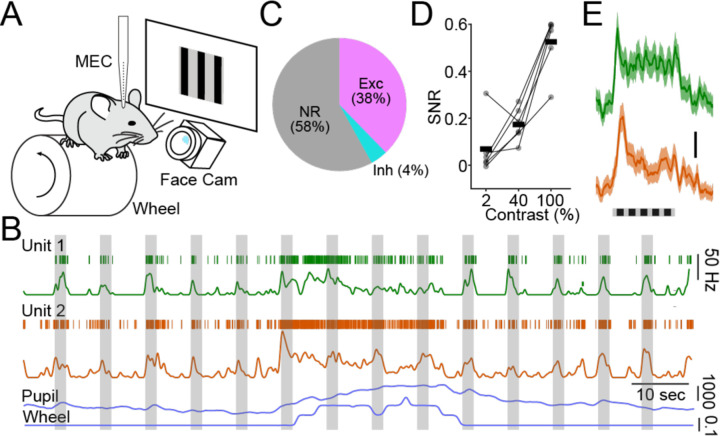
The ability of rodents to use visual cues for successful navigation and goal-directed behavior has been long appreciated, although the neural mechanisms supporting sensory representations in navigational circuits are largely unknown. Navigation is fundamentally dependent on the hippocampus and closely connected entorhinal cortex, whose neurons exhibit characteristic firing patterns corresponding to the animal's location. The medial entorhinal cortex (MEC) receives direct projections from sensory areas in the neocortex, suggesting the ability to encode sensory information. To examine this possibility, we performed high-density recordings of MEC neurons in awake, head-fixed mice presented with simple visual stimuli and assessed the dynamics of sensory-evoked activity. We found a large fraction of neurons exhibited robust responses to visual input that shaped activity relative to ongoing network dynamics. Visually responsive cells could be separated into subgroups based on functional and molecular properties within deep layers of the dorsal MEC, suggesting diverse populations within the MEC contribute to sensory encoding. We then showed that optogenetic suppression of retrosplenial cortex afferents within the MEC strongly reduced visual responses. Overall, our results demonstrate the the MEC can encode simple visual cues in the environment that can contribute to neural representations of location necessary for accurate navigation.
长期以来,人们一直认识到啮齿动物能够利用视觉线索进行成功的导航和目标导向行为,尽管支持导航回路中感觉表征的神经机制在很大程度上尚不清楚。导航从根本上依赖于海马体和与之紧密相连的内嗅皮层,其神经元表现出与动物位置相对应的特征性放电模式。内侧内嗅皮层(MEC)接收来自新皮层感觉区域的直接投射,这表明它具有编码感觉信息的能力。为了检验这种可能性,我们对清醒、头部固定的小鼠的MEC神经元进行了高密度记录,这些小鼠呈现简单视觉刺激,并评估了感觉诱发活动的动态变化。我们发现很大一部分神经元对视觉输入表现出强烈反应,这些反应相对于正在进行的网络动态塑造了活动。根据背侧MEC深层内的功能和分子特性,视觉反应性细胞可以分为亚组,这表明MEC内的不同群体有助于感觉编码。然后我们表明,对MEC内扣带回后皮质传入纤维的光遗传学抑制强烈降低了视觉反应。总体而言,我们的结果表明,MEC可以编码环境中的简单视觉线索,这些线索有助于形成准确导航所需的位置神经表征。