Li Jia, Simmons Alan J, Chiron Sophie, Ramirez-Solano Marisol A, Tasneem Naila, Kaur Harsimran, Xu Yanwen, Revetta Frank, Vega Paige N, Bao Shunxing, Cui Can, Tyree Regina N, Raber Larry W, Conner Anna N, Beaulieu Dawn B, Dalal Robin L, Horst Sara N, Pabla Baldeep S, Huo Yuankai, Landman Bennett A, Roland Joseph T, Scoville Elizabeth A, Schwartz David A, Washington M Kay, Shyr Yu, Wilson Keith T, Coburn Lori A, Lau Ken S, Liu Qi
Center for Quantitative Sciences, Vanderbilt Univerity Medical Center, Nashville, TN, USA.
Department of Biostatistics, Vanderbilt Univerity Medical Center, Nashville, TN, USA.
bioRxiv. 2023 Oct 2:2023.09.30.560293. doi: 10.1101/2023.09.30.560293.
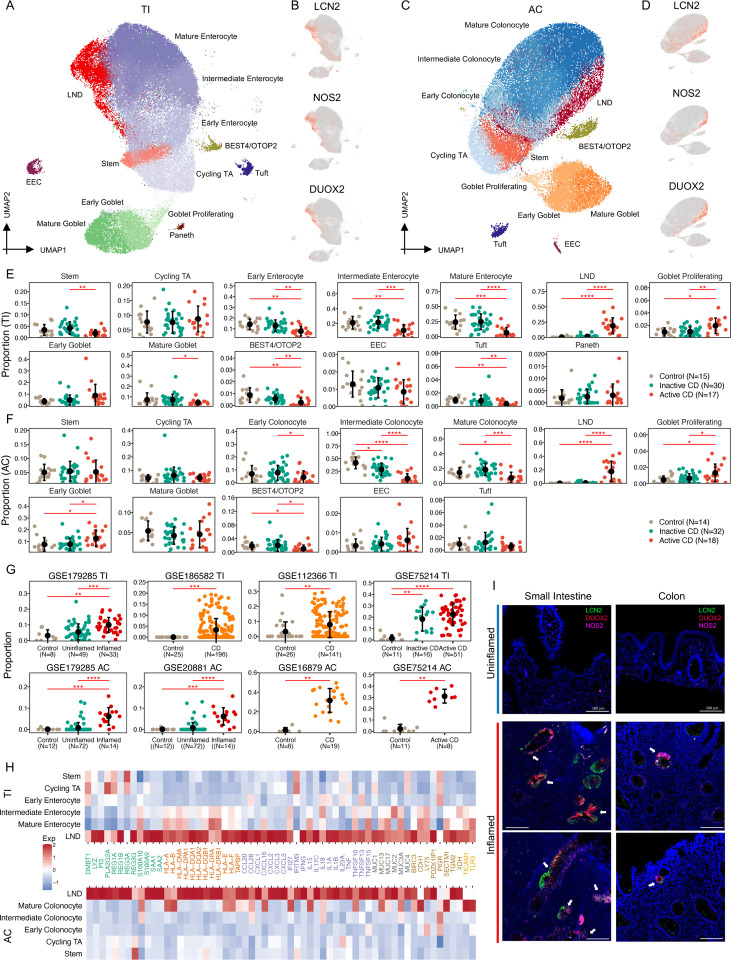
Crohn's disease (CD) is a complex chronic inflammatory disorder that may affect any part of gastrointestinal tract with extra-intestinal manifestations and associated immune dysregulation. To characterize heterogeneity in CD, we profiled single-cell transcriptomics of 170 samples from 65 CD patients and 18 non-inflammatory bowel disease (IBD) controls in both the terminal ileum (TI) and ascending colon (AC). Analysis of 202,359 cells identified a novel epithelial cell type in both TI and AC, featuring high expression of , , and , and thus is named LND. LND cells, confirmed by high-resolution in-situ RNA imaging, were rarely found in non-IBD controls, but expanded significantly in active CD. Compared to other epithelial cells, genes defining LND cells were enriched in antimicrobial response and immunoregulation. Moreover, multiplexed protein imaging demonstrated that LND cell abundance was associated with immune infiltration. Cross-talk between LND and immune cells was explored by ligand-receptor interactions and further evidenced by their spatial colocalization. LND cells showed significant enrichment of expression specificity of IBD/CD susceptibility genes, revealing its role in immunopathogenesis of CD. Investigating lineage relationships of epithelial cells detected two LND cell subpopulations with different origins and developmental potential, early and late LND. The ratio of the late to early LND cells was related to anti-TNF response. These findings emphasize the pathogenic role of the specialized LND cell type in both Crohn's ileitis and Crohn's colitis and identify novel biomarkers associated with disease activity and treatment response.
克罗恩病(CD)是一种复杂的慢性炎症性疾病,可影响胃肠道的任何部位,并伴有肠外表现及相关的免疫失调。为了表征CD的异质性,我们对来自65例CD患者和18例非炎症性肠病(IBD)对照的170个样本在回肠末端(TI)和升结肠(AC)进行了单细胞转录组分析。对202359个细胞的分析在TI和AC中均鉴定出一种新的上皮细胞类型,其特征是 、 和 高表达,因此命名为LND。经高分辨率原位RNA成像证实,LND细胞在非IBD对照中很少见,但在活动期CD中显著扩增。与其他上皮细胞相比,定义LND细胞的基因在抗菌反应和免疫调节方面富集。此外,多重蛋白质成像表明LND细胞丰度与免疫浸润相关。通过配体-受体相互作用探索了LND与免疫细胞之间的相互作用,并通过它们的空间共定位进一步得到证实。LND细胞显示IBD/CD易感性基因的表达特异性显著富集,揭示了其在CD免疫发病机制中的作用。研究上皮细胞的谱系关系发现了两个具有不同起源和发育潜能的LND细胞亚群,即早期LND和晚期LND。晚期与早期LND细胞的比例与抗TNF反应有关。这些发现强调了特殊的LND细胞类型在克罗恩病回肠炎和克罗恩病结肠炎中的致病作用,并鉴定了与疾病活动和治疗反应相关的新生物标志物。