Department of Chemical Ecology, Bielefeld University, Universitätsstr. 25, 33615, Bielefeld, Germany.
Department of Molecular Genetics and Physiology of Plants, Ruhr University Bochum, Universitätsstr. 150, 44801, Bochum, Germany.
Biometals. 2024 Jun;37(3):649-669. doi: 10.1007/s10534-023-00550-5. Epub 2023 Oct 24.
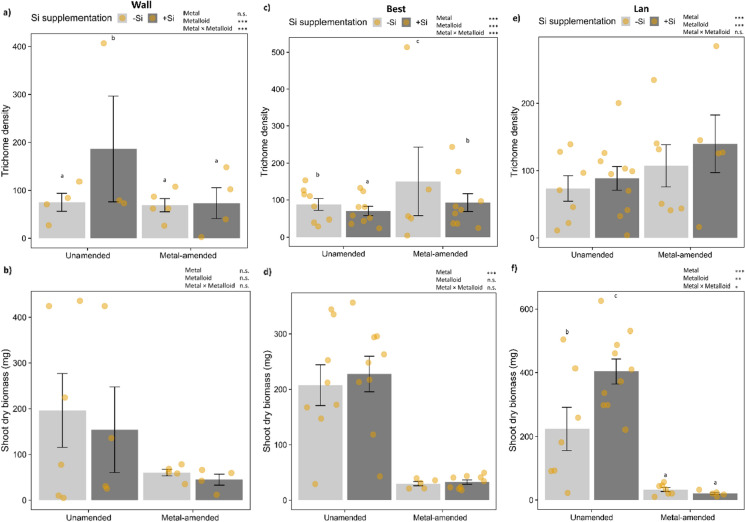
Soil pollution by metals and metalloids as a consequence of anthropogenic industrialisation exerts a seriously damaging impact on ecosystems. However, certain plant species, termed hyperaccumulators, are able to accumulate extraordinarily high concentrations of these metal(loid)s in their aboveground tissues. Such hyperaccumulation of metal(loid)s is known to act as a defence against various antagonists, such as herbivores and pathogens. We investigated the influences of metal(loid)s on potential defence traits, such as foliar elemental, organic and mechanical defences, in the hyperaccumulator plant species Arabidopsis halleri (Brassicaceae) by artificially amending the soil with common metallic pollutants, namely cadmium (Cd) and zinc (Zn). Additionally, unamended and metal-amended soils were supplemented with the metalloid silicon (Si) to study whether Si could alleviate metal excess. Individuals originating from one non-/low- and two moderately to highly metal-contaminated sites with different metal concentrations (hereafter called accessions) were grown for eight weeks in a full-factorial design under standardised conditions. There were significant interactive effects of metal amendment and Si supplementation on foliar concentrations of certain elements (Zn, Si, aluminium (Al), iron (Fe), potassium (K) and sulfur (S), but these were accession-specific. Profiles of glucosinolates, characteristic organic defences of Brassicaceae, were distinct among accessions, and the composition was affected by soil metal amendment. Moreover, plants grown on metal-amended soil contained lower concentrations of total glucosinolates in one of the accessions, which suggests a potential trade-off between inorganic defence acquisition and biosynthesis of organic defence. The density of foliar trichomes, as a proxy for the first layer of mechanical defence, was also influenced by metal amendment and/or Si supplementation in an accession-dependent manner. Our study highlights the importance of examining the effects of co-occurring metal(loid)s in soil on various foliar defence traits in different accessions of a hyperaccumulating species.
由于人为工业化,土壤中的金属和类金属污染物对生态系统造成了严重的破坏。然而,某些植物物种,被称为超积累植物,能够在地上组织中积累极高浓度的这些金属(类金属)。这种金属(类金属)的超积累被认为是对各种拮抗剂(如食草动物和病原体)的一种防御机制。我们通过人工向土壤中添加常见的金属污染物,即镉(Cd)和锌(Zn),研究了金属(类金属)对超积累植物拟南芥(Brassicaceae)潜在防御特性的影响,如叶片元素、有机和机械防御。此外,未添加金属和添加金属的土壤中补充了类金属硅(Si),以研究 Si 是否可以缓解金属过量。从一个非/低金属和两个中等到高度金属污染的地点(以下称为品系)中获得的个体,在标准条件下,在完全因子设计中生长了八周。金属添加和 Si 补充对某些元素(Zn、Si、铝(Al)、铁(Fe)、钾(K)和硫(S)的叶片浓度有显著的交互影响,但这些影响是品系特异性的。特征性的 Brassicaceae 有机防御物硫代葡萄糖苷的图谱在品系之间存在明显差异,并且其组成受到土壤金属添加的影响。此外,在一个品系中,在添加金属的土壤中生长的植物含有较低浓度的总硫代葡萄糖苷,这表明无机防御的获取和有机防御的生物合成之间可能存在潜在的权衡。叶片毛状体密度(作为机械防御第一层的代表)也以依赖于品系的方式受到金属添加和/或 Si 补充的影响。我们的研究强调了研究土壤中共存金属(类金属)对超积累物种不同品系各种叶片防御特性的重要性。