Department of Laboratory Medicine, School of Medicine, Jiangsu University, Zhenjiang, 212013, P. R., Zhenjiang, China.
Department of Clinical and Chemical Pathology, Medical Research and Clinical Studies Institute, National Research Center, Giza, Egypt.
Ir J Med Sci. 2024 Jun;193(3):1403-1409. doi: 10.1007/s11845-023-03545-w. Epub 2023 Oct 24.
The biological function of YKL-40 is not well determined in different inflammatory and autoimmune diseases; however, some data highlighted its possible connection with disease activity.
We investigated the diagnostic utility of serum YKL-40 in patients with SLE and examined its correlation with disease activity. Additionally, we examined any differences in serum YKL-40 levels between juvenile and adult SLE patients.
We included 78 female patients with SLE and 42 controls. The level of YKL-40 in serum was measured by ELISA.
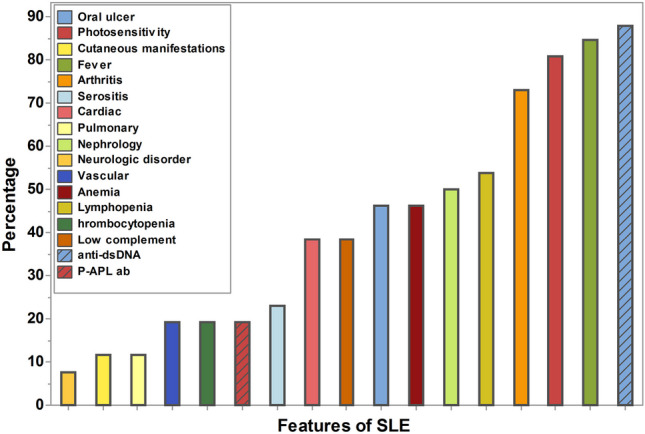
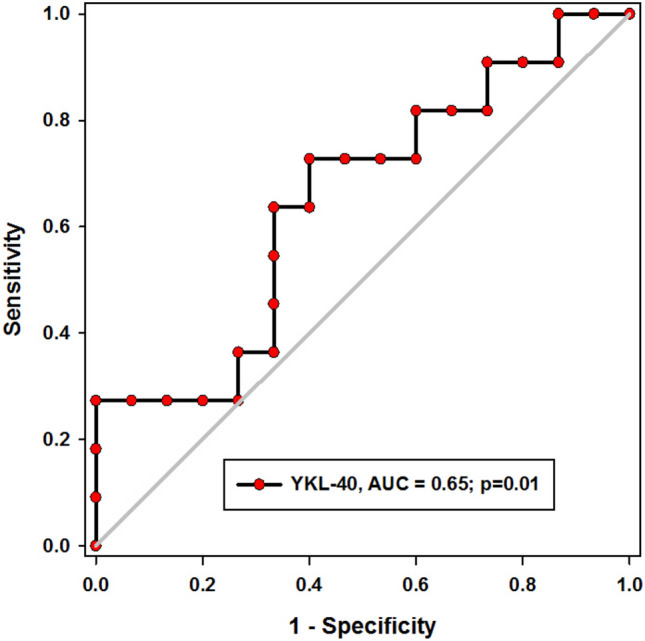
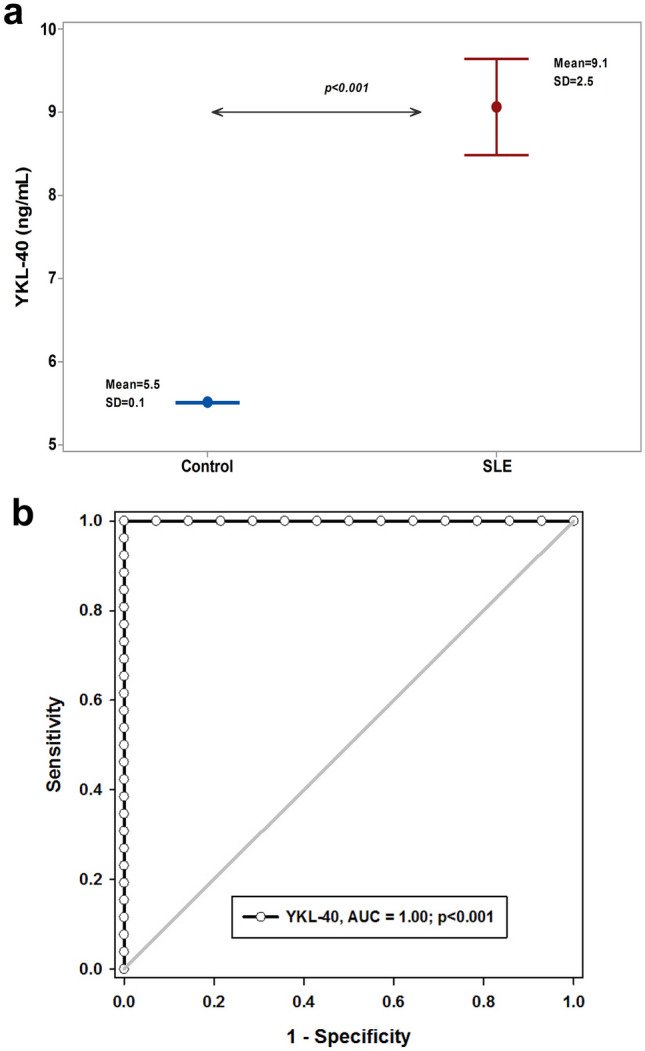
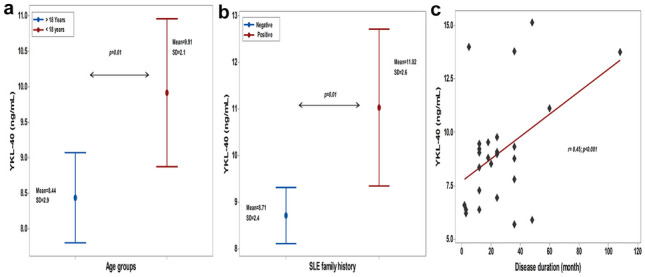
The serum YKL-40 level in SLE patients was significantly higher compared to the control group (9 (3) ng/mL vs. 5.5 (0.1) ng/mL; p < 0.001). YKL-40 showed excellent diagnostic utility with an AUC of 1 (p < 0.001) and a cutoff point of 5.6, providing sensitivity and specificity of 100%. YKL-40 was higher in adolescents and those with a positive family history of SLE (p = 0.01 for both) and positively correlated with disease duration (r = 0.45, p < 0.001). YKL-40 level was significantly higher in patients with photosensitivity, fever, vasculitis, blood disorders, positive anti-dsDNA, and APL ab (p < 0.05 for all). Conversely, patients with skin manifestations had a significantly lower YKL-40 (p = 0.004). In juvenile SLE, the AUC was 0.65 and a p-value of 0.01, and at a cutoff value of (8.7) ng/mL, the sensitivity and specificity were 72% and 60%, respectively.
YKL-40 in serum could be a promising biomarker in patients with SLE, especially in adolescent-onset cases. It is independently influenced by disease duration, anemia, thrombocytopenia, positive anti-dsDNA, and APL ab features.
YKL-40 的生物学功能在不同的炎症和自身免疫性疾病中尚未明确,但有数据提示其可能与疾病活动有关。
我们研究了血清 YKL-40 在系统性红斑狼疮(SLE)患者中的诊断价值,并探讨其与疾病活动的相关性。此外,我们还研究了青少年和成年 SLE 患者血清 YKL-40 水平的差异。
纳入 78 例女性 SLE 患者和 42 例对照者,采用 ELISA 法检测血清 YKL-40 水平。
SLE 患者血清 YKL-40 水平显著高于对照组(9(3)ng/mL 比 5.5(0.1)ng/mL;p<0.001)。YKL-40 具有出色的诊断价值,AUC 为 1(p<0.001),截断值为 5.6,其敏感性和特异性均为 100%。青少年患者和有 SLE 家族史者的 YKL-40 水平较高(均 p=0.01),且与疾病病程呈正相关(r=0.45,p<0.001)。YKL-40 水平与光过敏、发热、血管炎、血液系统异常、抗 dsDNA 抗体阳性和 APL 抗体阳性均相关(均 p<0.05),与皮疹表现呈负相关(p=0.004)。在青少年 SLE 中,AUC 为 0.65,p 值为 0.01,截断值为(8.7)ng/mL 时,敏感性和特异性分别为 72%和 60%。
血清 YKL-40 可能是 SLE 患者有前景的生物标志物,尤其对青少年发病患者。其水平独立于疾病病程、贫血、血小板减少、抗 dsDNA 抗体阳性和 APL 抗体阳性等特征。